Years after GirlsDoPorn, survivors are finding ways to heal and fight back
Michael Pratt and his associates are in prison — but women targeted in his GirlsDoPorn sex trafficking operation say the exploitation never truly ended. Now, they're pushing for reforms to prevent others from ever enduring the same fate.
SAN DIEGO (CN) — Nitzia was still in high school when she first came across the fake modeling ads.
It was 2017, and she was just 17 years old. Posted to the website Craiglist, the listing featured an image of a woman in a bikini, she recalled in an interview. It was billed as an opportunity for aspiring models to get into the industry. For Nitzia, who had a bit of experience already, it felt like a big break.
She responded to the ad and soon found herself corresponding with a man who called himself Jonathan. She says she never learned his real name, but federal prosecutors would later say that Jonathan was an alias for sex trafficker Ruben Andre Garcia.
Jonathan and Nitzia spent months talking, exchanging emails, phone calls and text messages as he claimed to be coordinating a shoot in San Diego. She told friends about the opportunity. She said they were excited for her and encouraged her to go.
Shortly after her 18th birthday, Nitzia took a short flight from her hometown of Sacramento to San Diego. She met a woman, Valerie Moser, who picked her up from the airport and dropped her off at a hotel.
After arriving in San Diego, it quickly became clear to Nitzia that the arrangement was not what she had agreed to. These people did not work for a legitimate modeling agency. They wanted her to appear in a pornographic film.
Scared, overwhelmed and surrounded by strangers far from home, she didn't feel like she had a choice. They offered her alcohol and told her to relax.
Nitzia was one of hundreds of young women who fell victim to this scheme — enticed with promises of modeling opportunities, only to be coerced into filming pornography for the brand GirlsDoPorn. Courthouse News is redacting her last name at her request since she is the victim of a sex crime.
Led by now-convicted sex trafficker Michael Pratt, the operation continued for more than a decade, victimizing at least 573 young women and girls before authorities finally shut it down. To date, it's the largest sex trafficking case ever prosecuted in San Diego County.
The GirlsDoPorn case didn't fit the popular image of a sex trafficking, with prostitution and outright violence. Instead, it centered on fraud, said Alexandra Foster, a Department of Justice attorney who helped prosecute the case.
"There obviously was coercion and sometimes force, but really these women had been lied to at the front end," Foster told Courthouse News.
That led to confusion and self-doubt for many victims, as they struggled to wrap their heads around what they had experienced.
"I spent a lot of time just trying to understand what happened to me," said Mariah Rief, another victim in the case who has channeled her experiences into public advocacy. "I didn't get kidnapped. I got to go home. I got paid. How do you mentally make that make sense?"
Charged with sex trafficking in 2019, Pratt fled the country and lived as a fugitive for three years.
The New Zealander was arrested in Spain in 2022, then extradited to the United States. Last year, a federal judge sentenced him to nearly 30 years in prison. Six other co-conspirators were also sentenced.
Although the GirlsDoPorn proceedings ended this year, survivors say the fallout hasn't, as videos of their abuse have continued to circulate online. Often, the videos are hosted on sites in places like Russia and China, where U.S. laws have less reach.
But while the U.S. has increasingly cracked down on nonconsensual intimate images and videos, advocates say the burden still falls on survivors to track down and report content that in many cases depicts the worst moments of their lives. In the aftermath of the GirlsDoPorn case, survivors like Nitzia and Rief are now spearheading efforts to fix that loophole. They say it should be up to authorities and online content providers — not victims — to make sure that videos of their abuse don't spread.
When women like Nitzia arrived for what they thought were modeling shoots, the efforts to intimidate them into pornography were only just beginning.
In the GirlsDoPorn criminal cases, authorities outlined a range of tactics that Pratt and his conspirators used to amp up the pressure. Victims were accused of breaching contracts, threatened with lawsuits and told they would have to find their own flights home. They were plied with alcohol and drugs and rushed into signing confusing documents.
Like many victims, Nitzia was told that videos of her would not be shared online and would only be sent to a private overseas collector. But that was just another lie. Not only were GirlsDoPorn videos posted online, the company went out of its way to advertise them to friends, family members and employers, in a twisted bid to generate web traffic.
Nitzia doesn't know how or when exactly the videos first began to circulate. Regardless, it soon felt like many people in her life knew about them. "It felt like no one wanted to be around me and be associated with me," she said.
She comes from a large and traditional Mexican family, and soon they too had learned about the videos.
"I was no longer invited to parties," she said. "I was no longer invited to family events."
As GirlsDoPorn collapsed into infamy and federal prosecutions, it didn't stop the spread of its material.
In fact, for some internet users, the sex trafficking charges and widespread media coverage seemed to only add to the appeal. "It becomes its own kind of fetish," Nitzia said.
The harassment also didn't stop. To this day, Nitzia said she regularly deals with cyberstalkers, who send her intimidating messages or post her personal information online. Her experience is far from unique. "Online communities are really obsessed with getting as much information about us," Rief said.
The constant stress has become too much for some victims. According to both Nitzia and Rief, more than a dozen survivors in the GirlsDoPorn case have died from suicide, drug overdose and domestic violence. Others, including Nitzia, have made suicide attempts.
"I'm very confident that many of us have," she said. "Some of us have succeeded."
Faced with hundreds of victims and continuing online abuse, U.S. District Judge Janis Sammartino, a George W. Bush appointee who oversaw the GirlsDoPorn case, made a groundbreaking decision.
In 2021, she gave survivors in the case copyright rights to their own abuse materials. That novel legal move let them file takedown notices under the Digital Millennium Copyright Act.
There have been other attempts at reforms, including the Take It Down Act, passed by Congress that year. The law takes aim at revenge porn and AI deepfakes, requiring platforms to remove offending material within 48 hours of a takedown request.
But Rief, who now runs a content-removal company focused on victims of nonconsensual online content, says the Take It Down Act "still puts the burden on the victims to track down the links." Survivors like her and Nitzia want to change that. During California's last legislative session, they pushed for reforms aimed at making it harder for nonconsensual pornography to stay online. And while the proposal ultimately failed, they say they plan to try again next year.
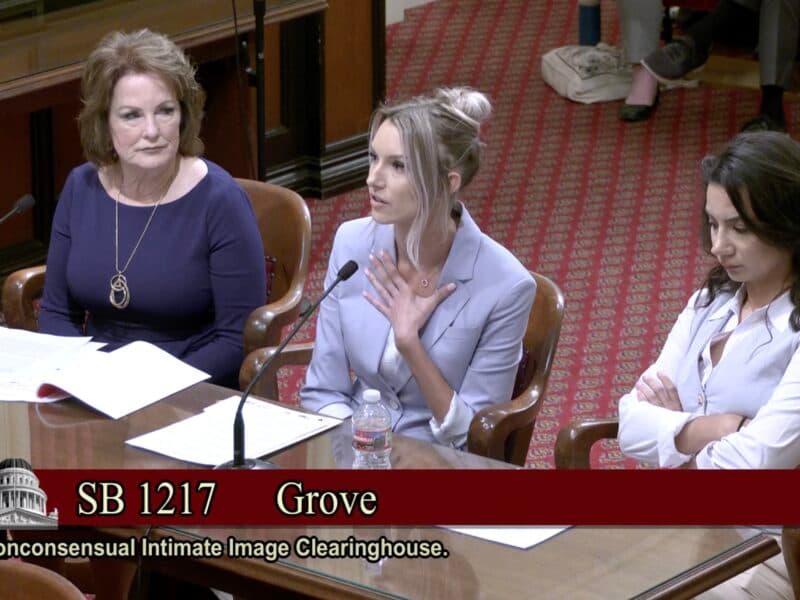
Testifying before a California Senate committee in April, Rief and Nitzia explained what it has meant for them to have their GirlsDoPorn videos continue to circulate online.
"I have been forced to search for my own abuse online, collect the links, document the evidence and relive it," Rief told lawmakers. "This is not a rare story, but a rarely told one."
"I live every day with a very real fear that, without the establishment of this clearinghouse, my children, who are six and four, may one day come home from school with tears in their eyes, asking why somebody at school found a video of their mother online being abused," she continued. "Right now, the system does not just fail to protect us after the crime is proven: It leaves us responsible for cleaning it up."
The pair was there to speak in favor of Senate Bill 1217, introduced by outgoing Republican state Senator Shannon Grove.
The law had a simple goal: to move the responsibility of removing abusive material from survivors to the government and a network of trusted NGOs.
The law would have created a clearinghouse for abuse material, assigning each piece of content a unique hash or digital signature. If a piece of content with that hash was uploaded, it could be automatically removed by providers like Google. Hosts would face penalties if they did not remove content promptly. It's roughly the same model used by the National Center for Missing & Exploited Children to combat online child abuse material.
Rief and Nitzia said the bill would help bring California law up to speed with rapid technological advancement, in which many people — not just GirlsDoPorn survivors — face the nonconsensual spread of intimate images and videos. It would change the current status quo, an awful and traumatizing game of whack-a-mole in which abusive material gets removed from one site, only to pop up somewhere else.
"Every hour that content stays online, it spreads. It's downloaded, copied and reuploaded faster than any victim can keep up with," Nitzia told lawmakers. "The internet moves in seconds, not days, and that's the gap that this bill needs to close."
Sadly for victims, Senate Bill 1217 stalled out in the Senate Appropriations Committee in May, effectively killing it for this legislative session.
In a statement to Courthouse News, Grove expressed disappointment. "Survivors already face a lifelong journey of healing and recovery," she said. "The images that remain online allow the cycle of exploitation to continue over and over again."
Rief credited the bill's failure to financial concerns — specifically, the cost it would take for the California Department of Justice to implement the clearinghouse. Although disappointed, she stayed optimistic in an interview, noting that advocates would get a chance to fine-tune a bill for the 2027 legislative session. "It gives us time to create it in a way it should have been."
Although no mainstream groups support the dissemination of nonconsensual content, some do worry about the technical mechanisms of internet takedown laws like these.
Perhaps most prominent among them is the Electronic Frontier Foundation, a digital rights organization that has opposed both the Take It Down Act and SB 1217.
While laws like SB 1217 are well-intentioned, groups like EFF say there's no clear mechanism to decide what constitutes nonconsensual material or even to ensure that takedown requests are being made in good faith. Therefore, "it turns this into a filtering and surveillance tool on the margins of lawful speech," said Aaron Mackey, the EFF's deputy legal director. "We have some concerns about the safety and the lack of safeguards around that system, and what it means for people to go after speech they just want removed."
Critics like Mackey point to statements by figures like President Donald Trump, who brought up the Take It Down Act during his 2025 State of the Union address.
"I look forward to signing that bill," the president said. "I'm going to use that bill for myself too if you don't mind, because nobody gets treated worse than I do online. Nobody."
For advocates of internet freedom, it highlighted a core concern that laws meant to crack down on abusive material could run afoul of the First Amendment.
"It's sort of just a censorship racket," Mackey said. "When the president of the United States says he wants to remove things critical about him, we're sort of missing the mark."
Rief takes First Amendment concerns seriously. Still, she argues that the legal experts sometimes focus too much on hypothetical scenarios while victims face real harm.
"Why does the theoretical risk to lawful speech … carry more urgency than the documented, ongoing harm to real victims and their families?" she asked. "When the loudest worry in the room is the marginal speech case, and not the woman whose trafficking footage is being downloaded as we speak, we have lost the thread of who this is actually about."
Rief disputes the notion that laws like SB 1217 targets lawful speech at all. Instead, she argues the opposite: that without laws like SB 1217, content that is unquestionably illegal is allowed to remain up.
While policymakers debate abstract concepts, victims like those of GirlsDoPorn continue to face documented and real-world harm, she said.
"The permanence is the harm," Rief said. "Every re-upload is a new violation, and without a clearinghouse that addresses the file itself, the survivor is left to chase it forever while the platform that hosts it faces nothing."
For survivors, it's been a long road as they work to heal and rebuild their lives.
The public nature of the GirlsDoPorn crimes added to the pain. A double-take from a stranger or a comment like "Don't I know you from somewhere?" took on new and terrible meanings. And as Pratt and his criminal co-conspirators shared videos with victims' friends and family, some found their reactions profoundly inadequate.
"The people who shared it the most, and changed the trajectory of my life, are family," Nitzia said. "I still don't understand to this day why. These are the same people who I held so dearly in my life and hurt me the most."
Many struggled with self-blame. After all, they reasoned, they had agreed to perform in pornography, even if only under duress and after lots of deception.
Rief never reported what happened to her. She never called the police.
"I just always assumed guilt," she said. "Maybe I deserved what happened to me."
For some victims like Rief, the realization didn't fully hit until federal authorities started contacting. Rief recalled a day years after her abuse, when prosecutors invited her to a meeting with other GirlsDoPorn survivors.
"All the air was sucked out of me," she said. "There were so many victims there."
Michael Pratt is now serving 27 years in prison. Ruben Garcia, who introduced himself to hopeful models as Jonathan, is serving 20. Multiple others involved in the scheme, including fixer Valerie Moser and Pratt's business partner Matthew Wolfe, have also been sentenced.
In the years since GirlsDoPorn first appeared on the internet, Rief said she's come to understand she's a sex trafficking survivor.
"Trafficking is not one thing," she said. "It exists in hundreds of forms, and the majority of them look nothing like the version the public has been sold: the kidnapping, the van, the plot edited into a Liam Neeson movie. Real cases are more complex, quieter and harder to recognize."
Besides her advocacy work, Rief is now an artist. Among her mediums of choice: surfboards.
As for Nitzia, she's thrown her energy into a fitness center with multiple locations in the Sacramento area. Known as Kintsugi Strong, it caters toward neurodivergent people and others who may feel uncomfortable in a traditional gym setting.
Her center takes its name from kintsugi, a Japanese art of pottery-mending. Instead of trying to hide damage, kintsugi believes in filling cracks with gold, emphasizing them with the goal of making something new and beautiful. It's not about what's been broken but what's been rebuilt.
The metaphor of kintsugi resonates with her. She still faces harassment, her videos still circulate, and yet she's still trying to build something more beautiful than the damage that came before.
"No matter what walk of life you've had, you can come here and just know that every single coach and person is going to love you no matter what," Nitzia said of the gym. "We're going to fill in those cracks with gold. In the end, that's what makes you unbreakable."
It's a message of hope she shares with others — and one she tries to remember for herself.
If you are having thoughts of suicide, call or text 988, or call the National Suicide Prevention Lifeline at 1-800-273-8255 (TALK). Visit SpeakingOfSuicide.com/resources for a list of additional resources.