Why the Smears Against Graham Platner Didn't Work
Opponents went all in on smearing Graham Platner as a Nazi based on a bad tattoo choice. It didn't work. Maine voters decided they'd rather have universal health care and an end to reckless wars than a polished politician with an unblemished past.
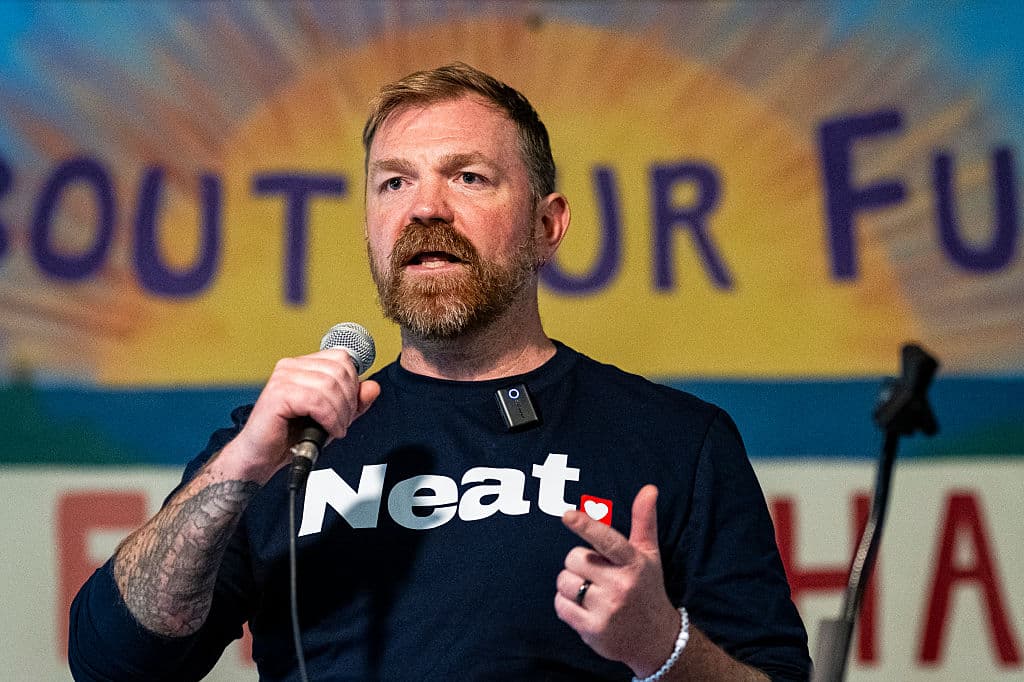
Last December, Maine Senate candidate Graham Platner was interviewed on the socialist podcast Left Reckoning. The hosts asked him about his approach to voters who are swayed by Trumpian demagoguery and played a clip from one of his town halls. In the clip, a woman in the audience asks him how he plans to deal with the alleged horde of "illegals" getting "free benefits" in Maine. The crowd of Platner supporters reacts with impatience and starts heckling her. Platner interjects to defuse the situation. "If you listen to what she was saying," he says, "at its core, she's angry about the same things you are," only that anger was being channeled in the wrong direction.
Discussing the clip with hosts David Griscom and Matt Lech, Platner said that "when economic systems fail people" and the lives of working-class Mainers get worse as a result, then "right-wing populism arises" to provide misleading answers and "always blames marginalized communities, immigrant groups, those who are weakest." The solution is to give a better answer, rooted in "left-wing populism, or progressive populism, a populism that is there to address the underlying economic failures."
As he warmed to the theme, he dredged up something he vaguely remembered hearing several years earlier. "I forget whose quote this is but . . . be forgiving with people, be brutal with systems."
It was a striking moment, and one I thought back to last week when Maine Governor Janet Mills dropped out of the primary, making Platner the presumptive nominee. One of the parts of my life I'll always be proudest of is my time doing a regular weekly segment on The Michael Brooks Show. Michael was the most talented left-wing broadcaster of his generation, and one of the most clear-sighted political commentators on the scene. He's sorely missed. And the quote Platner was trying to remember was from Michael. "Be ruthless with systems, be kind with people."
If Platner manages to unseat Republican incumbent Susan Collins in the fall, he'll become the first Michael Brooks fan to win a seat in the United States Senate. That's notable enough. But his win is also a win for the politics of targeting systems instead of people.
Platner was subject to one of the most intense smear campaigns in the history of modern electoral politics. Despite a platform that would make him one of the Senate's most left-wing members (along with Bernie Sanders and, if he wins his own race, Abdul El-Sayed), he was widely accused of being a secret Nazi.
This accusation wasn't based on his issue positions. He has a clear history of supporting gay and trans rights, for example, and he advocates abolishing Immigration and Customs Enforcement (ICE) and creating a pathway to citizenship for undocumented immigrants on the grounds that this way "multinational corporations" no longer have a terrorized labor force they can "pay slave wages and abuse at will." The internet in 2026 is full of actual Nazis, as well as edgy conservatives who enjoy "ironically" dipping a toe in pro-Nazi rhetoric, and no one in either category would agree with these stances.
Instead, the accusation is entirely based on a skull and crossbones tattoo that Platner got when he was a young Marine on shore leave in Croatia. He and a friend picked the design off the wall of the tattoo parlor. Unfortunately, he chose a Totenkopf, the skull and crossbones configuration used by the Nazi SS. If you do a Google search for "how to tell Totenkopf from other skull and crossbones designs," you'll learn that it has a "more articulated lower jaw" and more "defined" teeth than skulls used in other designs. I'm willing to take it on faith that there are people who can tell at a glance which jawline is which, but I am not one of them — and neither, unfortunately, was Platner.
The tattoo raised no red flags when Platner later underwent standard screenings for hate symbols for a stint working security for the US embassy in Afghanistan. He himself clearly didn't think he had a Nazi symbol for all those years, since the only reason we know about it is because of a picture of him singing karaoke shirtless in front of his Jewish in-laws. Nevertheless, anyone who supported Platner for the last year has been told by angry conservatives and left-bashing liberals that they're rooting for a Nazi.
The whole thing reached a fever pitch of absurdity when a trove of his anonymous Reddit posts, spanning from 2009 to 2021, was revealed to the public in an attempt to embarrass him. There was much there that was actually embarrassing, as you might expect from a dozen years of anonymous posting by an opinionated and often angry private citizen with no reason to think anything he said would come back to haunt him. He was unfiltered and sometimes immature. But as Jacobin's Branko Marcetic, who read the entire archive, documented at the time, there isn't a single solitary crumb of antisemitic or pro-Nazi sentiment in all those years of anonymous posting. Quite the opposite. Marcetic wrote:
When a Trump-loving GOP candidate said that African Americans commit more crime because they were raised in fatherless homes and that police only shoot a black person who "needs to be shot," Platner called him a "racist motherf*cker." When a fellow Hancock County resident defended the local sheriff for blocking an addiction recovery nonprofit from working with inmates because of its support for BLM, Platner told him, "F*ck off, racist." [ . . . ] When a user posted a 1994 photo of South African neo-Nazis about to be killed by a police officer, Platner didn't mince words.
"And not a thing of value was lost. These c*nts were firing indiscriminately into civilian homes, just trying to kill blacks," he wrote in reply to the 2021 post. "No quarter for fascists. Good on the constable."
In the end, the smears against Platner failed to stop his political ascent. The claim that Platner was a Nazi was too obviously at odds with observable reality to stick. And Maine voters, who had coalesced behind him in numbers that drove the sitting governor to despair and drop out of the race, were apparently unmoved by the actually embarrassing parts of those dozen years of unfiltered private thoughts.
Voters cared less about what he said on Reddit a decade ago than about his passion for taxing the billionaires and guaranteeing health care as a human right. They cared less that he once got a regrettable tattoo on shore leave than that, like many vets who saw friends killed in Iraq and Afghanistan, he drew the obvious conclusion about starting similar wars going forward and has fiercely and vocally opposed Donald Trump's assault on Iran.
In other words, voters decided that Michael Brooks was right. Individual people, with all of our flaws, need to find ways to forgive each other and channel our rage against the system that's failed us all.