When the Orthodox Church Was Red
Drawn to its promise of a "trad" conservative lifestyle, young American men are increasingly converting to Russian Orthodoxy. But two generations ago, the Orthodox Church in the US was an FBI-surveilled hotbed of Bolshevik-inspired leftism.
In 2025, the young American Orthodox convert and podcast host Conrad Franz visited Donbas in occupied Ukraine on a media tour sponsored by the Russian Orthodox Church. On social media, Franz posted photos with Russian soldiers holding a flag with an icon of Christ and boasted of receiving a badge from the Tsar Nicholas II Rocket Brigade. For Franz, experiencing a war-torn region was invigorating. Recounting the trip, he recalled that "life feels way more real down there."
Like the Moscow-based Russian Orthodox church, which has strongly supported Russia's invasion, Franz views the war in moral terms, even referring to Ukrainian soldiers as "satanists." After returning to Moscow, he praised the reconstruction of Christ the Savior Cathedral in Moscow — a symbol of Vladimir Putin's reintegration of the Russian church and state — as an example of "what a Christian government is capable of."
Franz's celebration of Christian authoritarianism and far-right politics is common in a small but growing movement of male Orthodox converts in the United States. Primarily based in the South and Southwest, these new converts seek an older, more hard-line version of Christianity shorn of technological frills or contemporary aesthetics. Unlike both mainline Protestantism and modern Evangelicalism, Russian Orthodoxy's unquestioned hierarchical authority, strict patriarchy, and aesthetic beauty offer an alternate vision of Christianity for those dissatisfied with the American religious mainstream. Seeking a connection with the past absent in warehouse-like megachurches, converts are drawn to the onion domes, icons, and long-bearded priests of Russian churches. Orthodoxy's rightward turn, including condemnation of LGBTQ rights and the social conservatism of Putin's Russia, is equally attractive to Protestant converts who dissent from the progressive wings of their former denominations.
Historically, Orthodoxy in America — roughly 1 percent of the population — has consisted of Eastern European and Middle Eastern migrants. The two largest Orthodox groups in the United States are the Greek Orthodox Archdiocese of America and the Orthodox Church in America (OCA), the American daughter of the Russian Orthodox Church. The OCA adopted its current name in 1970 when Moscow granted it independence. Because Orthodoxy was often associated with an ethnic group and derived authority from patriarchs abroad, there are many Orthodox jurisdictions in the United States, including Armenian, Antiochian, Carpatho-Rusyn, Ukrainian, and Serbian churches. But converts are overwhelmingly concentrated in the Antiochian Church and the OCA due to their many English-speaking churches and convert priests.
The right-wing Orthodoxy sought by today's American converts however is only one part of the Russian church's long history in the United States. Built by working-class migrants in mining and industrial towns, the roots of Russian Orthodoxy are more communitarian and rebellious than new converts might expect. Religious studies scholar Aram Sarkisian's new book, Orthodoxy on the Line: Russian Orthodox Migrants and Labor Migration in the Progressive Era, excavates the radical history of Russian Orthodoxy in the Midwest and Northeast from foreign language newspapers, church archives, and FBI files. Sarkisian challenges hagiographical accounts of the church that "draw a distinct line between Orthodox adherence and leftist politics." Indeed, many "clergy and laity participated in labor actions, voiced critiques of industrial capitalism, and joined socialist, communist, and anarchist groups." In the aftermath of the Russian Revolution in 1917, some Orthodox believers even went as far as to create independent Bolshevik-inspired churches.
As a church with a strong national orientation, Russian Orthodoxy in the United States has been implicated in European conflicts since its earliest days. In Alaska, the church arrived as part of imperial expansion, and in the continental US, the tsar funded the church's growth to increase Russian soft power among Slavic migrants. As Sarkisian argues, "The resources of imperial bureaucracies blurred the boundaries between the Russian Church and the czarist state." Sailors and a choir from a Russian battleship participated in the dedication of the new Orthodox Cathedral in Manhattan in 1901, and Orthodox priests promoted tsarism by urging all Slavic migrants to "look lovingly to Moscow." But in 1917, the Bolshevik revolution ended the Romanov dynasty, severing American Orthodoxy's ties with the motherland and forcing churches to rethink the meaning of their political and spiritual ties to Russia.
Some of today's Orthodox converts, especially those to the Russian Orthodox Church Outside of Russia (ROCOR) — a traditionalist sect founded in the 1920s by supporters of the Russian monarchy — similarly look to Russia and cite Putin's alliance with the Russian Orthodox Church as inspiring. They see Putin's public religiosity as a bulwark of Christianity in an increasingly secular world and hope to emulate the Russian model of church-state relations in the United States.
Because this wave of converts was not raised in Orthodox countries or around diasporic communities, social media provided their first exposure to the church. Popular images of a bare-chested Putin in nature wearing a tripartite cross and drone footage highlighting the grandeur and rich ornamentation of new government-funded churches showed converts how political power could powerfully aid religion, even if this vision of tightly interwoven church-state relations is banned by the American Constitution.
Frequently circulated videos on Orthodox social media feature Putin's massive Main Cathedral of the Russian Armed Forces. Constructed outside of Moscow in 2018, the imposing church celebrates a militant, authoritarian faith. War is portrayed as foundational to Orthodoxy. In giant mosaics, soldiers with machine guns accompany saints bearing weapons. Underneath captions list dozens of wars fought by Russian soldiers, ending with the invasion of Ukraine in 2014 and leaving space for the names of wars yet fought to be inscribed.
Putin's 2022 invasion of Ukraine has also pulled American Orthodoxy into its orbit. On August 15, 2025, Archbishop Alexei of Sitka met with Putin during his visit to Alaska and expressed appreciation for Russia's role as protector of the church. The meeting escalated growing concerns about the influence of Russia in American Orthodox churches. Leaders of the Ukrainian Orthodox Church in the United States swiftly condemned the archbishop's participation in a photo shoot with Putin as "a betrayal of the Gospel of Christ."
But as strange as it sounds, the phenomenon of Americans converting to Orthodoxy is nothing new. Much like today, converts drove the first major expansion of Orthodoxy over a century ago. While most associate Russian Orthodoxy in the US with colonization in Alaska and missions to indigenous communities, the church's greatest growth occurred in the industrial Midwest and Northeast. This wave of converts was mostly Greek Catholic, primarily Ukrainians and Carpatho-Rusyns from the provinces of Galicia and Transcarpathia in the Austro-Hungarian Empire. They shared a liturgical history with the Orthodox but a political history with the Catholic powers of Poland, Austria, and Hungary. Under Catholic empires, large Orthodox populations in the region were allowed to continue Orthodox practices, such as married clergy and iconostases (icon screens), in exchange for pledging allegiance to Rome.
When Greek Catholics arrived in the United States, they tried to practice their faith as they had in Europe. But Roman Catholic bishops protested Greek Catholic practices such as married clergy and denied the authority of European Greek Catholic bishops to minister to flocks in the US. The American bishops did not understand what made Greek Catholics different from other Slavs and hoped that they could join existing Polish or Slovak congregations. Attempts by Roman Catholic bishops to control and assimilate Greek Catholics fueled dissatisfaction. Working-class Greek Catholics did not want to give their hard-earned wages to a church that resented their unique culture and liturgical expression.
The conversion of Greek Catholic priest Alexis Toth accelerated the growth of Russian Orthodoxy. Toth is revered as "Confessor and Defender of the Orthodox Faith in America" and as one of the fathers of American Orthodoxy. Toth turned to Orthodoxy after being rebuffed by the Roman Catholic Bishop John Ireland of Minneapolis. Toth had presented himself to the bishop, requesting permission to work among Greek Catholics in Minneapolis, but Ireland threw him out upon learning that he had been married. Toth was a widower, and for Ireland, no true Catholic priest could have had a wife, even though that was the norm for Greek Catholics in Europe. Seeking new spiritual authority, Toth contacted the Russian Orthodox bishop of San Francisco and was eventually received into the church, along with his entire congregation in Minneapolis.
Toth's conversion ignited discontent in Greek Catholic communities and transformed Minneapolis into "American Kyiv" — the birthplace of Orthodoxy in America. Inspired by Toth's leadership, congregations voted en masse to leave the Catholic Church and join the Russian Orthodox Church, opening vast new mission territory among Slavic migrants. Community identity was central to these migrants, and unlike today's conversions, entire parishes often converted, rather than an individual or personal decision of faith. Converts enshrined their unique history in the official name of their new church: Russian Orthodox Greek Catholic.
Although Sarkisian focuses on the spiritual appeal and excitement of Russian missionaries in the United States, the sudden interest in Russian Orthodoxy among migrants from the eastern border of the Austro-Hungarian Empire had political ramifications: conversions in the US drew the attention of the tsarist authorities. The converts' Carpathian homeland held great strategic value because it contained mountain passes that controlled Russian access to the Hungarian basin. Spreading Orthodoxy offered political benefits by increasing Russian soft power in the United States and spurring return migrants to spread Orthodoxy into the Austro-Hungarian borderlands that Russia hoped to one day conquer.
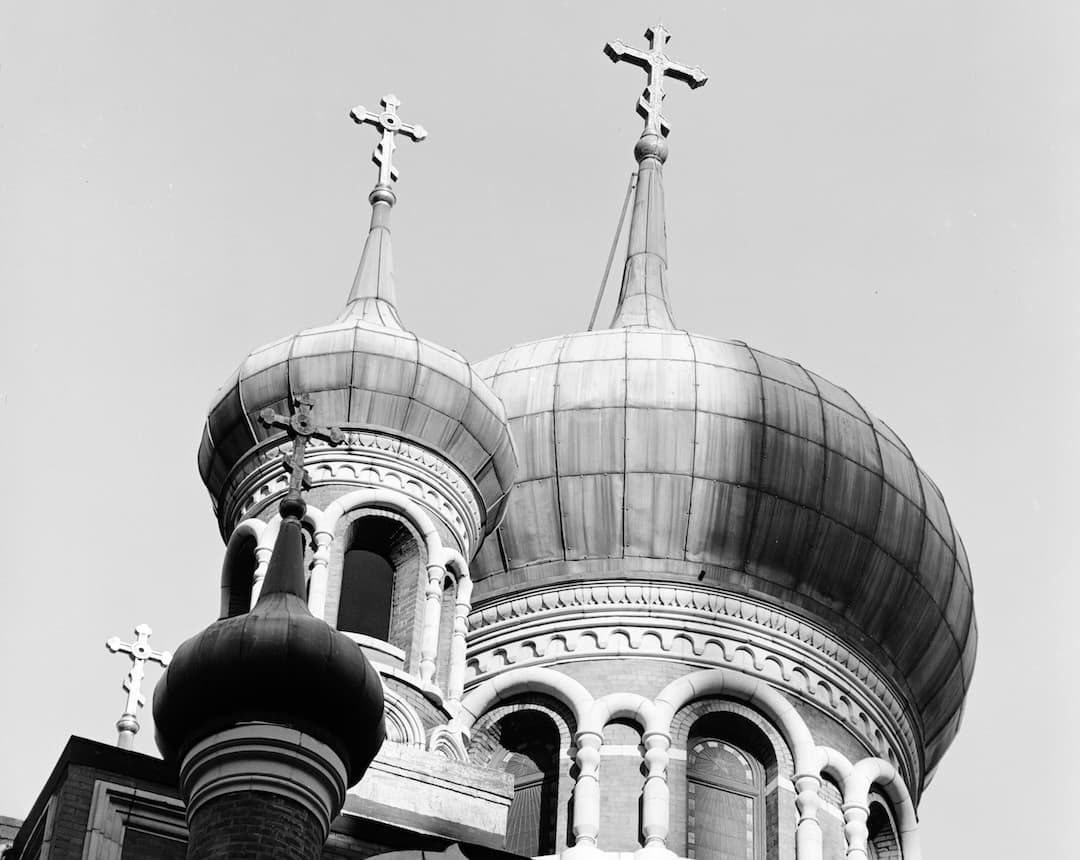
Russian funding aided struggling migrant congregations and helped the church to quickly expand. The tsar donated lavishly, funding the majority of the church's budget. Striking cathedrals rose in Chicago, Cleveland, Passaic, and Brooklyn, introducing distinctive Russian architecture to America's industrial cities. These high-profile projects drew significant attention. Notably, the American modernist architect Louis Sullivan designed Chicago's Russian Orthodox Holy Trinity Cathedral, blending his distinctive, eclectic forms with traditional Russian church plans, creating one of the most unexpected crossovers in American architecture.
Jobs in America's booming industries beckoned Orthodox immigrants from around the world, including Albanians, Syrians, and Serbians. Large numbers from Ukraine and Belarus joined the many Greek Catholic converts, forming a diverse community of believers that Sarkisian calls American Orthodox Rus'. These multiethnic churches of American Rus' served as outposts of Moscow, extending imperial authority over multinational diasporic communities in the United States. Visits by Russia's military choirs, prayers for the tsar during liturgy, and the promotion of the Russian language (rather than Belarusian, Rusyn, or Ukrainian) projected a Russian political agenda into the American heartland.
But in 1917, the Russian Revolution destroyed the social and financial ties between Orthodox believers in the US and the tsar, sending the church into hundreds of thousands of dollars in debt. One Orthodox official in New York expressed concern about the situation in Russia and stressed the church's role. "In the absence of a permanent form of Government the Church will be more necessary than ever to keep the masses under control and prevent them from leaping into all kinds of brutal excesses to which revolutions give rise." But without the tsar, financial support and gifts of icons and liturgical equipment from the Russian state to the American church came to an abrupt halt.
During the same period, harsh conditions, ethnic discrimination, and workplace accidents had made many Orthodox sympathetic to the communist message of egalitarianism, cooperation, and collective ownership of industry. A church newspaper warned readers of difficult conditions in American industry and advised that "only the most completely physically able and healthy person" should emigrate. One incident in Detroit especially offended the Orthodox community. On Christmas 1914, Ford fired hundreds of Russian workers who took the day off to celebrate on January 7. When critics objected to the cruel policy, a Ford spokesman stated, "If these men are to make their home in America, they should observe American holidays," blaming the workers' termination for the failure to assimilate rather than the company's breach of their religious rights.
Corporate officials hoped that Russian Orthodoxy would exert a calming influence on workers, but that was not always the case. After the Bread and Roses strike in Massachusetts, Metropolitan Platon Rozhdestvensky, a high-ranking bishop, declared, "In no other country throughout the world can the condition of the unemployed be as terrible as in these most wealthy United States," and proclaimed, "We are in need of a law that firmly asserts a worker's rights." On-the-ground efforts achieved mixed results. In Gary, Indiana, US Steel donated thousands of dollars to help fund the construction of St Mary's Church, which, one Russian observer noted, decreased the readership of a popular anti-tsarist paper.
After an alcohol-fueled Easter Sunday brawl in Berlin, New Hampshire, paper company executives wrote to the Russian diocese pledging support for a full-time priest to bring the community under control. When the priest arrived and the company paid for the new church, the situation proved more challenging than expected. An observer noted that "the saloon element is making a last desperate effort to control things at the church" and advised the priest, "The only way out of the matter is to absolutely prohibit these men being in any way connected to the Church Committee." After only four months, the priest was forced out of the church.
Orthodox communities in the United States followed events in Russia. When the revolution broke out, many parishioners were eager to support reform in Russia and in their own churches. The Russian Orthodox Church had fundamentally been part of an imperialist project, and in the wake of the collapse of the tsarist regime, workers wondered what a people's church would look like and how it could support their struggle against corporate greed through union organizing.
Tensions over Bolshevism and Orthodoxy came to a head in Detroit and Baltimore. At All Saints Russian Orthodox Church on the edge of Detroit's Poletown, one Orthodox priest feared that his entire congregation had become "Bolsheviki." The congregation hung banners of Eugene Debs and Vladimir Lenin in a parish-affiliated club and loudly sang radical songs in the church basement. To control the situation, the priest denied communion to suspected "Reds" who "worked and agitated against the church," and he may have even informed the police to advocate for the arrest and deportation of unruly parishioners.
But the radicalized parishioners refused to give up, took control of the church council, and insisted on reform. They reasoned that since the church had prayed for the tsar as the leader of Rus', it should now pray for the Soviet Union's success. Parishioners even demanded that an icon of St Nicholas the Wonderworker be replaced with one of Lenin. These conflicts between the priest and the congregation over the compatibility of Bolshevism and Orthodoxy escalated into a yearslong legal battle for control of the parish that eventually reached the Michigan Supreme Court.
Similarly inspired by the revolution, Russian Orthodox believers in Baltimore formally established a breakaway parish. The congregation resented their pastor's introduction of capitalist practices, such as charging high fees for religious services. Breaking away from Orthodox jurisdictional control, the parishioners decided to establish a new church, Holy Trinity, that would be collectively owned by the people where they could live out their radical political convictions. The message resonated among workers, and the church quickly raised an extraordinary sum to acquire property and hire a priest.
Orthodox workers were not the only ones to respond to the Russian Revolution. American authorities unleashed a wave of hysteria, spreading fear that Bolshevism threatened the American way of life. Diaspora communities like the radicals at All Saints in Detroit immediately fell under suspicion. Eastern European migrant workers and their children made up a plurality of workers in much of the country's heavy industry and had led some of the country's longest strikes. The outbreak of a massive steel strike in September 1919, along with the involvement of thousands of Eastern Europeans and communist organizers, led many Americans to conflate all Slavs with Bolsheviks.
In late 1919 and early 1920, the federal government targeted left-wing activists across the country, including those in the radical Orthodox parishes of All Saints in Detroit and Holy Trinity in Baltimore, for deportation without due process in what became known as the Palmer Raids. As Sarkisian recounts, "In thirty-three cities spanning twenty-three states, federal agents arrested thousands of alleged 'radicals,' most of whom were Eastern European immigrants." The press welcomed the move and praised the dramatic, sweeping arrests, without concern for the flagrant violation of civil liberties.
Alarmed by the powerful combination of Bolshevism and Orthodoxy that erupted in Baltimore, the Bureau of Investigation (today's FBI) surveilled the growing Holy Trinity Church and sought to deport its pastor. Government investigators assumed the only explanation for the church's rapid success was Soviet funding and sent spies to infiltrate the parish. The bureau found that the church's priests led parishioners in singing Wobbly songs and concluded the church had been established exclusively for political reasons, but uncovered no evidence of Soviet funding.
Deportation raids created an atmosphere of fear in the Baltimore church. An unusual visitor at a parish picnic alerted the congregation to the presence of a spy. The priest informed the congregation that they were under surveillance and urged them to act carefully: "We must know with whom we speak and not use the same words as we do to our workers." Furthermore, the priest condemned the bureau's incursion into church affairs, comparing the informants who sold out the church to Judas's betrayal of Christ.
Surveillance of the parish continued, and the bureau hired additional informants. Even under increased scrutiny, the priest continued to critique American society in sermons, lamenting that "the American people are educated to worship gold and not God." Driven to reform society, religion, and industry, parishioners organized for social change in Baltimore, and the church cooperated closely with the local Communist Party branch. A Communist fundraising event even featured the church's seal on its tickets.
Although the combination of Orthodoxy and Bolshevism drew criticism from anarchists and concern from the federal government, it was clearly popular among Baltimoreans. Holy Trinity continued to grow and remains an active parish today. After toning down some of its revolutionary rhetoric, the church reconciled with Orthodox authorities, but the legacy of leftism and Orthodoxy endured for decades. When a new priest arrived in the 1950s, he found a Soviet flag and portraits of Lenin and Joseph Stalin displayed in the church hall. In vain, the priest tried to explain to the congregation that Marxism and religion were incompatible, unaware of the irony that their combination had led the faithful to build some of the most important Orthodox churches in the country.
In recent decades, Orthodoxy has taken a markedly different path. Enter a church today, and you might find worshippers venerating an icon of Nicholas II and the imperial family. This new vision of Orthodoxy idealizes the power of kings over peasants, priests over parishioners, and men over women. The Romanovs, killed by Bolsheviks in 1918, were controversially glorified as saints in 2000 by Patriarch Aleksy II. For converts, authoritarianism and gender hierarchy are part of the appeal. In posts on X, Franz lamented the Romanovs' demise as the "end of the God ordained Imperial order" and promoted various conspiracy theories about Bolsheviks and Judaism.
While the current state of the Orthodox church is a far cry from the reform efforts of activists a century ago, Orthodoxy on the Line shows how religious organizing led to significant reforms and reveals how Orthodoxy's communal tradition supported migrants and workers seeking a better life in the United States. Through painstaking archival work, Sarkisian has reclaimed an extraordinary chapter in religious and labor history that defies many stereotypes about Russian Orthodoxy and highlights the critical contributions of Slavic migrant churches to working-class struggle.
Although the story of independent Bolshevik churches is a forgotten chapter in American Orthodoxy, it's proof that the most radical reform can start in very unexpected places.