Trump admirer de la Espriella leads going into Colombia's presidential runoff
A political outsider with a hardline security agenda is closing in on becoming Colombia's next leader. The elections will be on June 21.
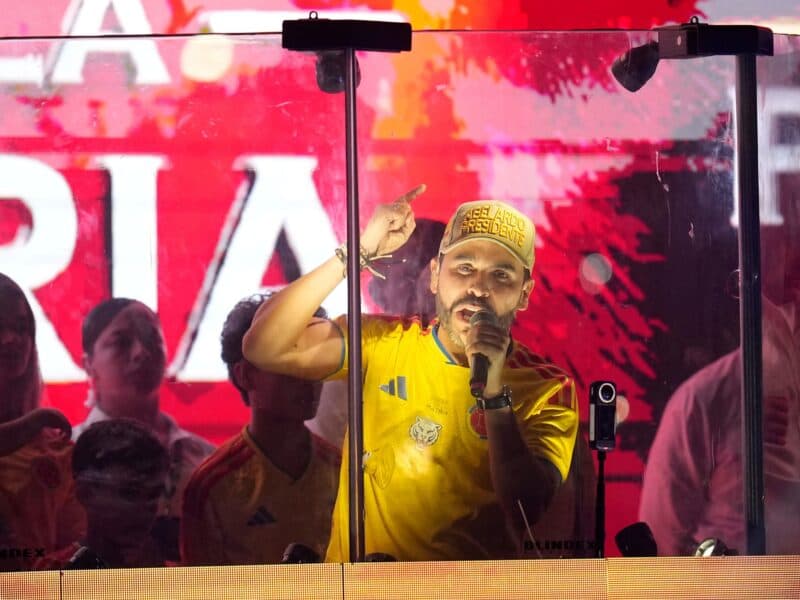
BUENOS AIRES (CN) — Abelardo de la Espriella, an unyielding far-right businessman and lawyer who goes by the nickname "The Tiger," led Colombia's general election on Sunday with 43% of the votes, putting Colombia on course for a sharp rightward political shift.
He will face leftist Senator Iván Cepeda, who got 40%, on June 21.
Cepeda and President Gustavo Petro questioned the results, claiming irregularities without presenting substantial evidence. Their accusations gained little traction among electoral authorities and major political actors.
De la Espriella, who ran his campaign promising a dramatic overhaul of the country's security policies, gave an energetic speech late Sunday night from Barranquilla, a port city in the Colombian Atlantic.
"You're out," he said, addressing Cepeda and Petro, whose party, Pacto Histórico, became the first progressive government in Colombia four years ago.
A political outsider mimicking Argentina's Javier Milei or El Salvador's Nayib Bukele, de la Espriella has has centered his presidential campaign on a hardline security and government reform agenda.
"This result shows the will of freedom and progress from the Colombian people," Milei wrote in a post on X congratulating de la Espriella. "And the will to say enough to the failed socialist model that has harmed our region so badly."
De la Espriella has pledged to reduce the size of the public sector by 40%, reclaim territories controlled by criminal and guerrilla groups within his first 90 days in office, and strengthen the military through greater use of drones and artificial intelligence. His proposals also include building 10 privately operated maximum-security prisons modeled on El Salvador's anti-crime approach and resuming aerial fumigation of illicit coca crops as part of a broader strategy to combat organized crime and restore state authority.
"I came to rock the boat, politically," he said in a recent interview. "That's the real transformation Colombia needs."
Laura Bonilla, a manager in Pares Foundation, a human rights and peace watchdog organization, was unsurprised by the result. "People in Colombia have demanded an outsider for a long time," she said. "A populist government promising tough policy."
Security, Bonilla said, was the central issue in Sunday's vote. The Petro administration's failure to significantly reduce the influence of armed groups turned voters back to demands of armed state intervention, a political vow often made by right-wing candidates.
Paloma Valencia, a more traditional conservative candidate who stood third in the election, gained 6% of the vote and has said she will support de la Espriella to combat Cepeda's progressivism.
For more than six decades, Colombia has been shaped by a conflict involving leftist guerrillas, right-wing paramilitary groups, drug trafficking organizations and state security forces.
A landmark peace agreement signed in 2016 with the Revolutionary Armed Forces of Colombia, or FARC, led to the demobilization of thousands of fighters and helped reduce violence in many parts of the country. But the accord did not bring a definitive end to the conflict. Dissident factions, the National Liberation Army or ELN, and criminal groups continue to compete for control of territory and illicit economies in several regions.
While the peace deal is widely credited with ending one chapter of the country's war, many Colombians remain frustrated by persistent insecurity and the government's limited ability to establish lasting state control in some rural areas.
And although de la Espriella promises to decimate the armed groups within 90 days, Bonilla remains skeptical.
"It's unrealistic — he'll bring back the politics of confrontation with civil groups, which will lead to human rights violations again," she said. With such a rooted dynamic of crime in Colombia, forced recruiting has become a standard reality across the country, making citizens prone to being criminalized rather than seen as victims. "We've seen this before," she added.
Bonilla pointed to the presidency of Álvaro Uribe, whose signature "Democratic Security" policy drastically reduced kidnappings and weakened guerrilla groups in the early 2000s. With time, his militarized approach faced severe criticism over human rights violations. The Special Jurisdiction for Peace, or JEP, has said at least 6,402 civilians were killed and falsely presented as combatants by members of the military during the armed conflict, in what became known as the "false positives" scandal.
Uribe, who was backing Valencia, has asked his voters to vote for de la Espriella in the runoff.
De la Espriella has repeatedly cited President Donald Trump as a political influence, praising his opposition to "wokism" and calling for closer ties with Washington. De la Espriella's affinity for Trump has fueled speculation among some analysts and political observers about whether the U.S. president could weigh in on the runoff.
The relationship between Bogotá and Washington has grown increasingly tense at times during Petro's presidency, particularly over security cooperation, Venezuela and the war in Gaza.
Although Petro and Trump met again in February after tensions surrounding Venezuela escalated, diplomatic relations remain delicate — a factor that could deeply affect Colombia in the years ahead.
De la Espriella has said he expects closer cooperation with Washington on security matters. Analysts say greater U.S. support could strengthen Colombia's capacity to combat armed groups, but some human rights advocates warn a more militarized strategy could also increase risks for civilians in conflict-affected regions.
"I will defend Colombia as if I were its best warrior," said de la Espriella during his Sunday address.
Cepeda, his opponent, also used a metaphor for fighting.
"Our lives have been plagued with battles, which we have fought in the worst possible conditions," Cepeda said. "But we've overcome them."
Lucía Cholakian Herrera is a Courthouse News correspondent based in Buenos Aires, Argentina.