Tiny, greedy swarming ants
We are all living in a horrifying short story written by Italo Calvino in 1954: "The Argentine Ant." O, yes we are.
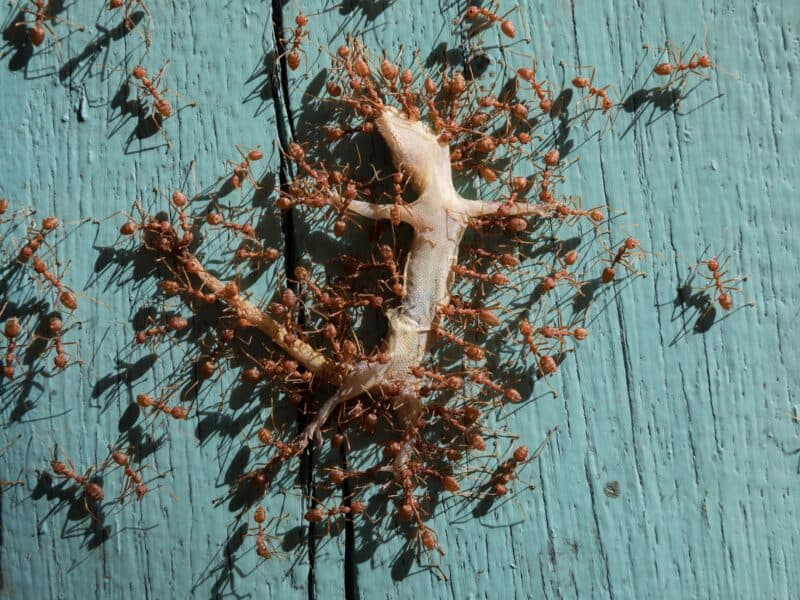
In this story, the unnamed narrator moves to a seaside town with his wife and their baby, though Uncle Augusto had warned them about the ants.
"You should see the ants over there … they're not like the ones here, those ants," Uncle Augusto said.
But really, how bad could a few ants be?
Yet it turned out that in this unnamed town in an unnamed country, everything was covered with ants. Not just the houses and fences and gardens, and all the tools and hoses and all the food, and the bags the food came in, but all the people and their children and the children's mattresses and toys. The ants were actually inside the children's noses and ears, and crawling into babies' eyes. An infinite number of still-breeding ants, vicious little bastards that cared for nothing or no one save to fill their tiny, blood-smeared ant mouths.
So the unnamed narrator (let's call him Bob) seeks help from his neighbors.
"What do you do about all these ants?" Bob asks, or words to that effect.
(For some reason, Calvino wrote in Italian. Probably because he was from Italy — his choice, not mine. Any quotation in this column, in fact the whole damn column, is a rough translation of my own. You can call me Bob.)
"What do you mean?" some neighbors respond.
"What are you talking about?" ask the others.
It seems that the way most people deal with it is to deny that there are any ants at all, even as the ants are swarming all over them, biting them on their … biting them everywhere, biting their children, eating the food they just bought at the market even as they carry the food home, swarming the food on the children's plates.
One neighbor invents machines to squash the ants: draw them into a place and then squash them into ant paste. "I'm smarter than any ant," this neighbor says. "Sooner or later I'll solve the problem, in my house, anyway." But he does not.
It's too damn expensive and too time-consuming to invent and build and scatter the ant traps, and even when he does, the slimy ant paste merely draws other ants, who carry the nourishing, obnoxious smelly food home to the ant nest, to feed other ants — baby ants.
Then one day, unbidden, the government's Ant Man comes, with the government-approved solution to ants. The Ant Man enters Bob's house without asking for permission, as he does with all the neighbors, then commences to smear a sweet-smelling, molasses-like substance in the corners, along the baseboards, in the cupboards, on the baby's mattress, in fact, everywhere in Bob's house.
"Stop!" Bob cries. "What are you doing?" But the Ant Man shows him a badge and continues smearing molasses, allegedly containing powerful formicides.
Bob runs to his friendliest neighbor, who is in their adjoining front yards, smashing ants with the flat side of a shovel.
"What's going on?" Bob pleads, pointing at the enormous, armor-plated Antmobile parked on their lawns. "Is that man really from the government?"
"Ayup," the man replies.
"Does he have permission to paint my house with molasses?"
"Ayup. The gummint says the ants take the molasses back to their nests and the p'isin kills 'em all."
"And does it?"
"No, sir."
"But people believe it?"
"Ayup."
"But, the ants are biting my baby. They're eating his food; they're biting my wife."
"Ayup."
"Is there any way I can get him out of my house?"
For answer, the man bent down and picked up another shovel and handed it to Bob.
"Use the flat side," he said.
(Erratum: There were not actually an infinite number of ants in this horrible village; a caucus later counted only 77,302,580, plus one named John Fetterman.)