Thorny Roundup fight arrives at Supreme Court with baggage
As the high court takes on cancer warnings for the controversial weedkiller, interested parties are issuing dire warnings no matter how the justices rule.
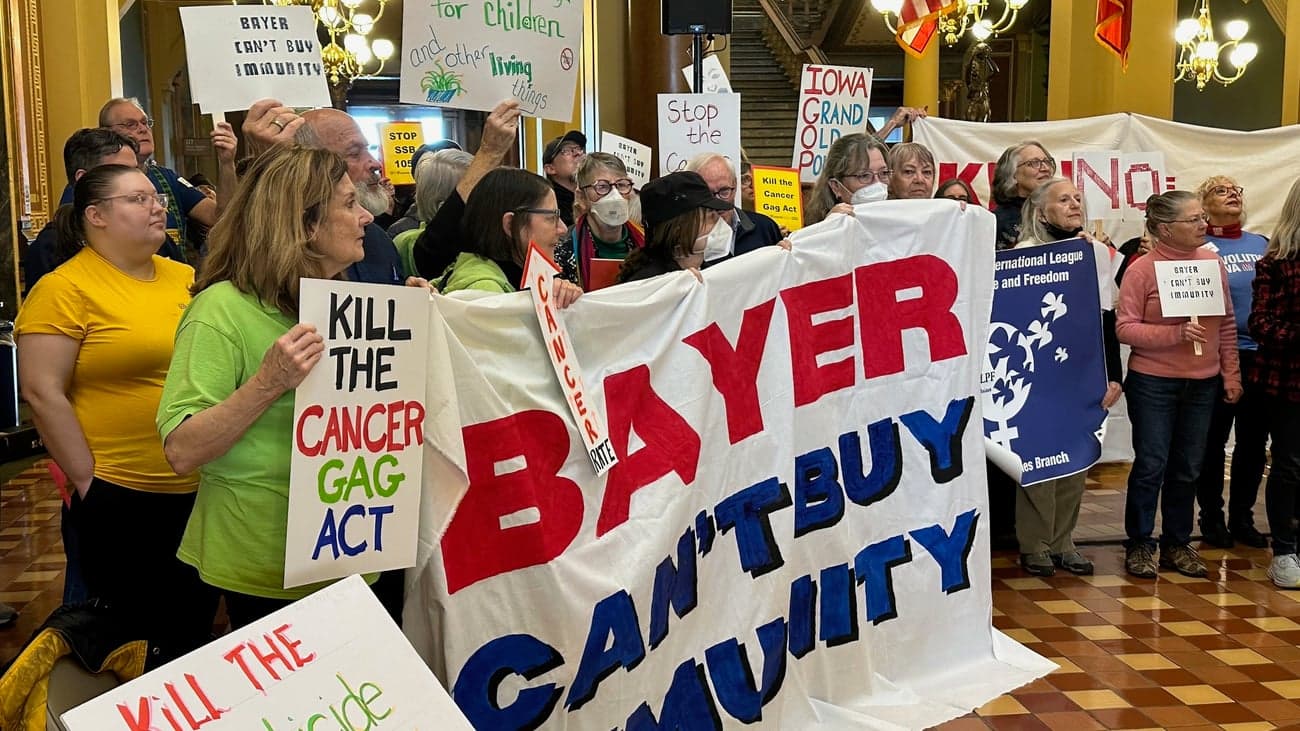
WASHINGTON (CN) — The Supreme Court will hear arguments next week over a weedy preemption question, and the only thing all parties can agree on is that the justices' ruling will have vast consequences for the health and safety of Americans.
Monsanto Company v. Durnell is one of over 100,000 lawsuits from cancer patients blaming Roundup weedkiller for making them sick. For John Durnell, other non-Hodgkin lymphoma sufferers, farmworker advocates and scientific researchers, the high court's review threatens to upend the regulatory scheme for holding pesticide manufacturers accountable.
But for Monsanto, Roundup's manufacturer owned by Bayer, agricultural trade groups and the federal government, the case is about shutting down a bifurcated labeling system undermining an essential component of the U.S. food supply.
The justices' decision will then be measured against a $7.25 billion settlement, impending regulatory review and a presidential directive linking the herbicide to national security.
The key to Roundup's effectiveness is glyphosate, a compound that kills weeds and pests at a plants' roots without harming crops. Beginning in 1974, the Environmental Protection Agency has evaluated and reevaluated glyphosates' safety and potential health risks for humans.
Such review is required under the Federal Insecticide, Fungicide, and Rodenticide Act, or FIFRA, which sets rules for selling pesticides. Manufacturers submit safety data and proposed labeling to the EPA, which checks that the pesticide doesn't create an unreasonable risk of adverse effects on human health.
The EPA administrator also reviews the product's label for compliance with FIFRA. Misbranding, such as not containing a warning or caution statement necessary to protect health and the environment, is strictly prohibited. This process repeats every 15 years to consider any labeling changes under new information.
According to Monsanto, the agency has repeatedly found no evidence that glyphosate causes cancer in humans and does not pose unreasonable risks or adverse effects to humans.
"EPA has exhaustively studied glyphosate and repeatedly concluded that it does not warrant a cancer warning," Monsanto said in a statement. "Accordingly, EPA has said such a label with a cancer warning would be misbranded under FIFRA."
Manufacturers can only make minor label chances without agency approval. Monsanto said once approved, the "label is the law!"
After decades on the retail and commercial market, the International Agency for Research on Cancer — part of the World Health Organization — issued a report in 2015 finding that glyphosate was probably carcinogenic to humans. California subsequently categorized the compound as a carcinogen.
But the EPA stood by its prior research, issuing an interim decision stating that glyphosate is not likely to be carcinogenic to humans. That assessment was challenged in court, however, and the Ninth Circuit found it to be unsupported by substantial evidence and inconsistent with the views of the EPA's own epidemiologists.
Regardless of the EPA and Monsanto's claims to the contrary, the IARC report unleashed a tidal wave of lawsuits claiming that Roundup led them to develop non-Hodgkin lymphoma.
Durnell was diagnosed with an aggressive form of non-Hodgkin lymphoma in 2018, at which point he'd been using Roundup for over two decades. In 2019, he filed a failure-to-warn claim against Monsanto in Missouri. A jury found that Roundup lacked an adequate warning and caused Durnell's cancer, awarding him $1.25 million.
Monsanto asked the Supreme Court to review Durnell's case, arguing that his state-law claims were barred by FIFRA. Because the statute prohibits manufacturers from making label changes without approval, Monsanto claims that the EPA's pesticide-specific labeling determinations are a mandate that manufacturers must adhere to under federal law.
"Monsanto has been punished under state law despite its compliance with federally required warning labels," the company said in a statement.
Durnell counters that FIFRA makes it unlawful to sell pesticides without meeting certain conditions, far from creating an affirmative right to do so. He said registration from the EPA didn't absolve Monsanto of its obligation not to sell misbranded products.
Instead of a bifurcated labeling regime, Durnell says state and federal rules run parallel.
"State law forbids the sale of a pesticide without a truthful and 'adequate warning,'" Durnell wrote in his brief. "Federal law prohibits selling a pesticide with a misleading or 'inadequate warning.' Barring an outright copy-and-paste, it would be hard to have less daylight escape between the legal standards established by state and federal law."
Durnell said whether Roundup caused cancer was a fact based question that the EPA administrator and a jury could disagree on.
"The supremacy clause does not of its own force anoint Lee Zeldin the supreme arbiter of scientific truth with a veto over a Missouri jury," Durnell wrote.
If the Supreme Court accepts the jury's determination of the facts, then the justices would be left to answer whether a cancer-causing pesticide that fails to warn of this risk is inadequate or misleading.
Late last year, a landmark study touting Roundup's safety was retracted by the scientific journal that published it a quarter century ago. The journal said concerns were raised about the validity of its findings after potential conflicts of interest among its authors and misrepresentation of their contributions came to light thanks to lawsuits against Monsanto.
Known as the Williams study, the 2000 paper was heavily cited in regulations as evidence of Roundup's safety. But emails released in court documents revealed that the article's conclusions were based on unpublished studies from Monsanto.
Those emails only came to light because of state-tort litigation like Durnell's. EPA doesn't have the tools to analyze or study pesticides themselves. Instead it relies on peer-reviewed research and journals to scrutinize available science and question its accuracy.
Researchers say the Williams study demonstrates how scientific evidence can be distorted. They say state tort claims have served as a counterbalance to the flaws in the EPA's registration process.
"Discovery in a lawsuit is a key tool for individuals — and the EPA — to learn about facts the industry would rather remain hidden," professors who analyzed the Williams study wrote. "It can also motivate the industry to disclose facts before litigation materializes, to reduce the threat of liability. Either way, this information can be used to correct and update EPA's review of registrations under FIFRA, pushing EPA closer to the role Congress expected EPA to fulfill."
Monsanto said glyphosate has been extensively studied over the last five decades, stating that thousands of studies have validated its safety. The company said it had no involvement in the vast majority of those published studies.
"Monsanto's involvement with the Williams et al paper did not rise to the level of authorship and was appropriately disclosed in the acknowledgments," the company said in a statement. "The listed authors had full control over and approved the study's manuscript. Two prior inquiries into the study previously found that the paper was appropriate, including the European Food Safety Authority (EFSA), and William's former employer."
News of the retracted Williams study comes as the EPA faces a 2026 guideline to reexamine glyphosate's safety. Monsanto says it has no reason to believe that the agency will diverge from its consistent findings that glyphosate can be used safely and does not warrant a cancer warning.
In February, Monsanto proposed a nationwide class settlement to resolve current and future Roundup claims for non-Hodgkin lymphoma injuries. The company agreed to make annual payments for 21 years totaling up to $7.25 billion.
Monsanto said the proposed class combined with Durnell's case before the Supreme Court "are independently necessary and mutually reinforcing steps in the company's multipronged strategy designed to significantly contain the Roundup litigation."
A favorable ruling from the justices would only apply to cases not covered by the settlement — those filed after Feb. 12, opt outs and certain limited exceptions.
Pesticide trade associations said Monsanto's litigation costs are a cautionary tale for the risks of allowing state tort claims. Even if a company wins in most cases, the organizations said, just a few multibillion-dollar damages awards can endanger a company's existence. They worried that such litigation could drive economically viable products off the market.
In 2021, Bayer removed its glyphosate-based products from the retail market, but commercial farmers continue to use them. Pesticide associations said removing glyphosate-based products from commercial farming would be devastating for U.S. agricultural production.
"A farmer faced with unnecessary warnings will be unable to make meaningful decisions between products and could lose confidence in the robust scientific basis of EPA's registration process," the groups wrote. "In short,there is a real-world cost, both economic and in terms of human health, to 'crying wolf.'"
According to advocates for the agricultural industry, Bayer is the only domestic manufacturer of glyphosate. If the company ceased selling its product on the commercial market, U.S. farmers would be dependent on imported glyphosate from China and India.
"Complete reliance on imported glyphosate-based products would lead to higher, more volatile prices and product shortages, which in turn would reduce crop yield, increase costs for farmers and consumers, and cause adverse impacts to the environment," industry advocates wrote.
In February, President Donald Trump issued an executive order invoking the Defense Production Act to protect the manufacturing of glyphosate-based herbicides.
The Trump administration filed a brief in favor of Monsanto at the Supreme Court, but the White House did not respond to questions about whether the pending litigation or the executive order would impact the EPA's forthcoming assessment.
The Supreme Court will hear oral arguments Monday.