Thomas and Alito see Supreme Court role in refereeing fights between red and blue states
English-language proficiency has been a topic of concern among the conservative justices as the Trump administration seeks to clamp down on immigrants with commercial driver's licenses.
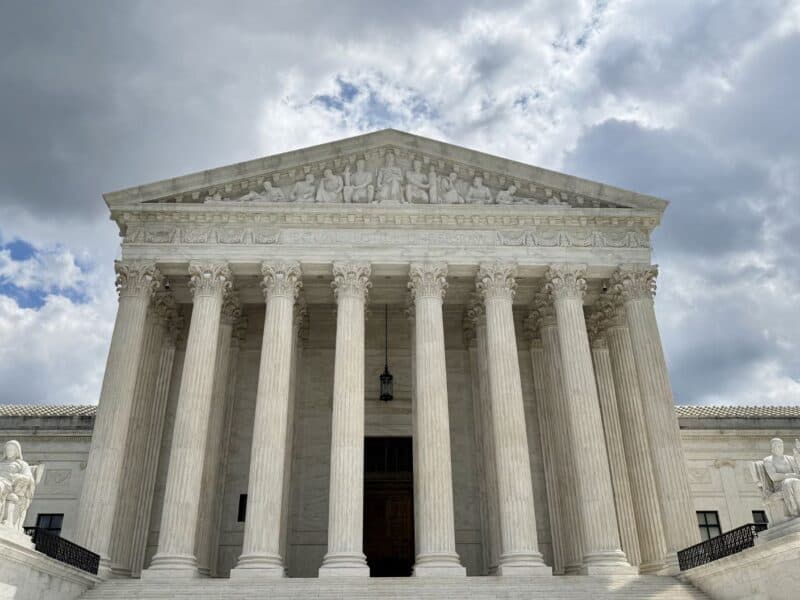
WASHINGTON (CN) — Despite dissents from two conservative justices, the Supreme Court on Tuesday refused to become the sole referee in a Republican state crackdown on immigrant trucker drivers.
Florida sought to utilize the Supreme Court's original jurisdiction to sue California and Washington state, claiming the Democratic-run states illegally licensed a commercial trucker who caused a fatal crash because he couldn't read highway signs.
Immigrant truck drivers have come under scrutiny by the White House, which finalized a rule earlier this year barring "unqualified foreign drivers" from obtaining commercial licenses. The move follows executive orders from President Donald Trump and actions by U.S. Transportation Secretary Sean Duffy to audit foreign workers' licenses and strengthen enforcement of English-language standards.
Original jurisdiction appeals are limited to cases affecting parties without a clear jurisdiction in the lower courts, such as disputes among states. The Supreme Court's action on such cases is exceedingly rare because the posture allows the justices to be the first and only court to hear the appeal — a departure from its normal role as the last to review a case.
But justices Clarence Thomas and Samuel Alito, George H.W. Bush and George W. Bush appointees respectively, said the court should hear more of these disputes.
"Congress has made our original jurisdiction 'exclusive' in 'all controversies between two or more states,' meaning that no other court can hear this case," Thomas wrote in a dissent joined by Alito. "I doubt this court has discretion to refuse to hear cases within its exclusive original jurisdiction."
Thomas and Alito expressed similar views in 2024 after the Supreme Court rejected Missouri's complaint against New York seeking to lift a gag order and delay Trump's sentencing for felony convictions in his hush money criminal case.
The justices consider both the nature of a state's complaint and the availability of an alternative forum to decide whether it qualifies for the court's original jurisdiction.
Thomas said Florida's case fit the bill because it was akin to an international dispute between nations.
"A dispute over one nation sending dangerous people into another would be the source of considerable international tension,'" Thomas wrote. "If Florida were an independent nation, it 'might resolve [this] dispute by diplomacy, by submitting it to international arbitration, or by self-help measures.'"
Thomas said all agreed that Florida cannot sue California and Washington in another forum, and the federal government could only seek judicial review to ensure such a policy in limited circumstances.
The English-language proficiency of truckers has been a topic of concern among the conservative justices. In March, Justice Brett Kavanaugh, a Trump appointee, cited reports finding that over 10,000 truckers failed English tests over the past year during an oral argument session.
Florida claimed California and Washington violated federal safety regulations about commercial driver's licenses by authorizing immigrants without legal status to drive on Florida's roads despite lacking proper training or the ability to read road signs.
The Sunshine State says Democratic states' policies directly led to a 2025 crash involving an Indian immigrant who made an illegal U-turn, hitting a minivan and killing all three passengers.
California and Washington strongly opposed Florida's complaint, stating it was meritless and built on unfounded assumptions. Both states said they comply with federal safety regulations.
Siding with the Democratic states, the Supreme Court rejected Florida's complaint. Thomas and Alito said their colleagues did so based on "policy judgments that are in conflict with the policy choices that Congress made in the statutory text specifying the court's original jurisdiction."
California and Washington framed Florida's complaint as an abuse of the court's original jurisdiction for a "political stunt."
"If states can use this court to litigate policy disputes like this, there will be no end to the claims," Washington state officials wrote. "Can states bring nuisance claims against each other in this court alleging that lax vaccination policies or firearm restrictions in one state are causing harm in another? The court should not open that door."
Thomas seemed to disagree, saying that states didn't have to resolve disputes by diplomacy or international arbitration.
"By entering the union, states agree to instead have such disputes resolved by this court," Thomas wrote.