'There's no turning back': French tech sovereignty takes center stage in Paris
Roughly 220,000 people gathered at VivaTech and Eurosatory — two major events in the tech and defense sectors — in Paris this week. Against the backdrop of a changing world order, one word was everywhere: sovereignty.
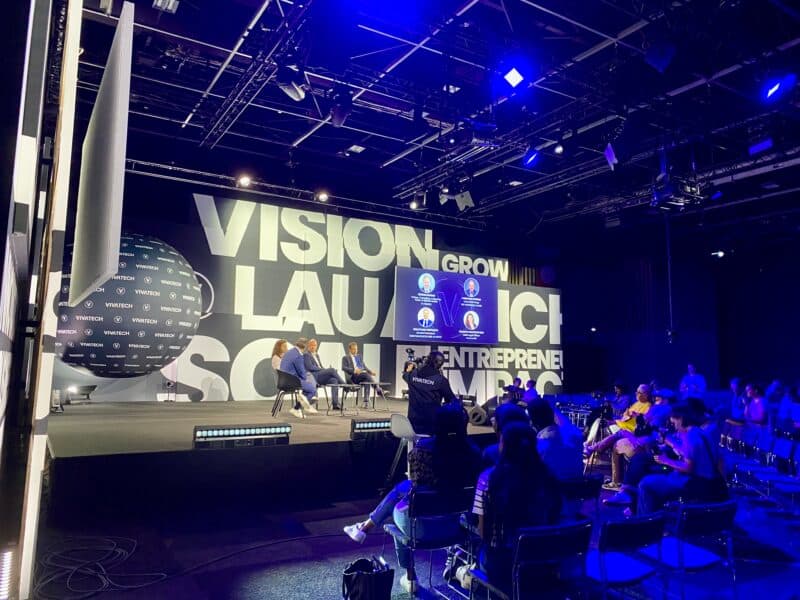
PARIS (CN) — Europe's increasingly urgent message of self-reliance carried over into the defense and technology sectors in Paris this week, as leaders scramble to prepare for a geopolitical landscape where traditional loyalties are no longer a guarantee.
The notion of sovereignty has been central to the continent's political discourse for months. New questions are simmering over longstanding alliances, including with the United States under President Donald Trump.
Over 40,000 people gathered Monday through Friday for the Eurosatory trade show on defense and security. In a sprawling, warehouse-like exhibition center roughly 25 minutes from Paris, military hospital trucks abutted tanks and a combat shoe display.
In one booth, operated by Fire Point — a Ukrainian defense company that manufactures drones and military equipment — a stuffed flamingo was propped atop a pink missile. The text displayed on a screen in the background read "Love at first strike."
A few booths down, panelists engaged in a discussion on funding, innovation and sovereignty in the defense export sector.
"The notion of sovereignty must not become a taboo blocking-point," Marc-Henri Figuier, an export adviser to the chairman of the trade group GICAT, said. "I think today in the defense-tech market … our businesses, when they really have a pertinent idea, when it has a place in our defense tools … we must help them immediately in a large way."
He added that today, agility is key.
"The Ukrainians told me the other day, 'One day we won't need you, we'll create faster, better …'" Figuier said.
Sovereignty is a state's ability to operate autonomously, without relying on other countries' infrastructure, products or capabilities. In Europe, the problems of relying on outside suppliers have become especially evident in recent years.
Trump's insistence that Europe contribute more to its own defense and threats to yank U.S. troops, along with Russia's aggressive stance, have led the bloc's 27 nations to boost defense spending, investment in local manufacturers, and in some instances, conscription drives. When Russia launched its full-scale invasion on Ukraine in 2022, the continent scrambled to offset its losses of Russian gas, highlighting a serious energy vulnerability. Earlier this month, the Trump administration announced an export ban on Anthropic's advanced AI models, which will sever Europe from cutting-edge technology. France announced this week its internal spy service DGSI would ditch U.S.-based Palantir for ChapsVision, a homegrown alternative.
And sovereignty was central to VivaTech, which is expected to draw roughly 180,000 visitors from Monday through Saturday to the Paris Expo Porte de Versailles, along the southwestern edge of the city. Bright lights flashed as crowds snaked around each other, lining up to hear an address from Indian Prime Minister Narendra Modi or chatting with representatives of one of the 15,000 startups on site.
"Sovereignty & Ethics" was one of the themes of this year's event, featured in over 20 panel discussions, many of which took place in a dedicated "Sovereignty Arena." Other discussions focused on how European tech companies could scale up, grow and gain autonomy.
On Thursday, one panel kicked off with blinking strobe-lights and techno music as panelists walked onstage.
"I've been coming to VivaTech since the very beginning [in 2016], and I would say that five years ago, we would have never had a roundtable around sovereignty, and now it's a topic that everyone is talking about," Jérémie Haddad, a partner at EY France, said during the opening of the panel. "So my first question is, what changed?"
Solange Viegas Dos Reis, the chief legal officer of OVHcloud, took the mic. In her view, geopolitical changes over the last 18 months have boosted discussions about autonomy.
"Why? Because now the geopolitical context is less predictable than it used to be," she said. "What we see is that tech, trade, regulation, export control … all of these are used as tools, political tools, not just against the bad guys, but against European citizens, organizations and countries, and this change led organizations to understand that tech dependency is no longer a tech matter, but indeed a strategic matter."
On the sidelines of VivaTech, Sebastiano Toffaletti, the secretary general of the European DIGITAL SME Alliance, explained there's a clear link between geopolitical strategy and the tech sector that may not seem immediately obvious. He said during the Munich Security Conference in 2025, there was a "collective realization" among colleagues when U.S. President JD Vance gave a stingingly critical speech directed at Europe.
"I wasn't there personally, but I was told there were people crying in the room … . Some people still refer to it as the moment where they opened their eyes to an ally not behaving like an ally any longer," he said.
In his view, the U.S. administration's threats to take over Greenland — and going back and forth with their intentions — were also a wake-up call.
"Which is interesting, because it's absolutely not technological-sovereignty related, right? But all of these geopolitical tensions are linked one to another," he said. "And when you realize that technology itself is a tool of power, it's impossible to untangle one issue from the other."
When the U.S. and Israel launched the Iran war on Feb. 28, triggering an ongoing regional crisis, they did so without consulting many longstanding allies beforehand. Marius Strubenhoff, a policy analyst at the European Policy Center in Paris, said these events have reshaped how the U.S. is perceived.
"The part that was shocking to Europeans is actually that we're mentioning [the U.S.] in the same sentence as the Russians and the Chinese," he said. "That's the new thing — and people, both emotionally and policy-wise, they're still coming to terms with that."
That isn't to say sovereignty wasn't part of the European discourse before Trump's second term. Strubenhoff said during the Biden administration, Europe had been talking about gaining more independence across many sectors, including technology and defense.
"Trump is not the reason that it's changing everything, but it's rather part of a larger trend that has been going on for several years now," he said. "You could say that Trump is creating a lot more urgency."
Christian Vrancic, the head of strategy at SAP Sovereign Cloud, said the current geopolitical climate led to a realization.
"There's no turning back," he said during the panel. "There's no back to normal — this is the new normal and we have to find answers."