The Invisible Heart of Modern Life Is the Garbage Worker
The backbreaking toil of the sanitation worker is the work that makes all of human civilization possible.
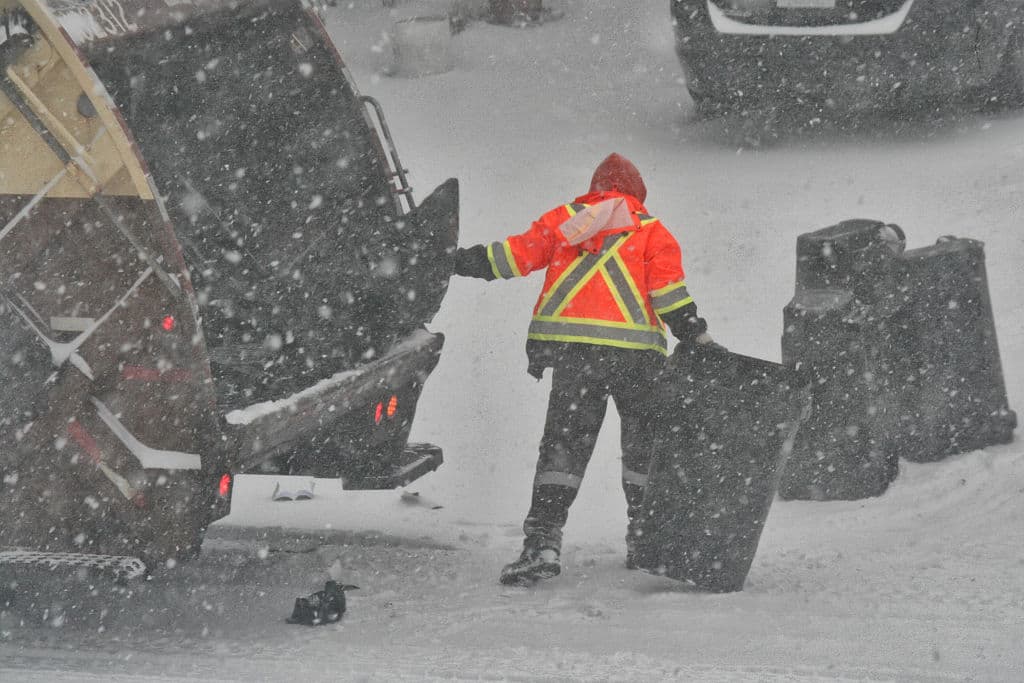
Simon Paré-Poupart begins Trash!, a memoir of his years as a garbage collector, by explaining why he started swearing again. He had promised religious friends he would stop taking the Lord's name in vain. Then one day, he jumped off the truck and found eighteen overloaded contractor bags wedged between two badly parked cars. They were stuffed with construction debris and nails. If he hurt himself carrying them, that would be his fault. If he scratched either car squeezing back through the gap, that would also be his fault. The homeowner, meanwhile, watched from behind the curtains.
"It's then," Paré-Poupart writes, "at that very moment, that the urge overcomes you and you let out a cry of rage: 'Jesus f — ing Christ!!! . . . I mean, swearing is all you've got left."
The homeowner quickly becomes "the good middle-class" aquarium owner, while the garbageman is reduced to "the piddly creature that keeps the tank glass clean." Within a few more pages, Paré-Poupart has invoked Sisyphus, Georges Bataille, Victor Hugo, and René Descartes; described garbage juice as "the holy water of your baptism"; and explained that "it's the swearing that makes you a real garbageman."
Paré-Poupart has spent more than twenty years collecting garbage in and around Montreal. By his estimate, he has hauled nearly seventy thousand tons of waste. Garbage collectors, he writes, "scrub clean the stains of our consumer society." Their work "keeps the whole edifice from crumbling down." They make it possible to live the way most people do while remaining almost entirely invisible. The illusion he wants to dismantle is simple: "Nothing disappears by magic."
"Being a garbageman is itself an act of self-violence," Paré-Poupart writes. The pace wrecks shoulders, knees, wrists, and backs. The highest compliment another collector can receive is simple: "He's a machine." But if becoming machine-like is the standard, Paré-Poupart asks, what exactly is being demanded of the worker? "Isn't the fact that we're forced to work at this inhuman pace a sure sign that we're drowning in waste?"
It is a question the book keeps returning to. Nobody on the truck decided products should become cheaper, flimsier, and harder to repair, or that municipalities should move ever greater quantities of waste with ever fewer workers. The garbage collector inherits those decisions.
Which brings Paré-Poupart to the recycling bins.
He returns to them with comic obsession. They're too heavy in summer and worse in winter. They fill with rainwater. They freeze into snowbanks. They scatter paper across entire streets.
"The bins and boxes have all clearly been designed, selected, and purchased by people who've never been on the back of a garbage truck," he writes. "And of course, no one ever thought to ask our opinion!"
Winter is when everything breaks down. "Put a garbageman on recycling, especially in winter," he writes, "and prepare to hear the drawn-out lamentations of a cursed soul." He imagines recycling becoming an Olympic event: competitors dragging overloaded wheelie bins over snowbanks, weaving between parked cars, wrestling frozen containers loose before sprinting back to the truck to do it all again.
Throwing garbage has style. Routes have rhythm. Ti-Chris, the legendary coworker everyone insists once threw a washing machine into the truck with one hand, is the sort of singular figure every workplace seems to produce. Garbage collectors recognize one another by the way they move.
Victor Hugo called the sewer "the conscience of the city." Paré-Poupart argues that garbage "bursts our mirages" and "tells the whole story — if you know how to listen."
Garbage collectors have their own hierarchy. Garbage is at the top, recycling comes next, and compost is last. To anyone outside the industry, the ranking seems upside down. Recycling is cleaner. Compost is greener. Garbage is simply garbage.
But garbage collection leaves the greatest room to organize the route yourself. Trucks fill quickly. The rhythm rarely breaks. Experienced workers improvise. Compost collection, by contrast, "quickly degenerates into a bureaucratic shitshow." "The more workers feel free to steer the course of their work," Paré-Poupart writes, "the less they feel supervised."
The recycling bins were designed by people who never hauled them. Routes are reorganized by people who never ran them. Supervisors explain the work to people who have spent decades doing it. Every few pages, someone who has never climbed onto the back of the truck is reorganizing the lives of people who do.
At one private waste company, Paré-Poupart and his coworkers try to organize a union. They want higher wages and management to take their "point of view and know-how into account." Instead they got cameras installed in truck cabs, consultants, and bosses who treated experience as an obstacle rather than an asset.
"If you boys aren't happy, piss off," one manager tells them. "Think I'll have a hard time finding other employees with no education willing to work for twenty dollars an hour?"
The assumption that garbage collection is simply what people without other options do surfaces throughout the book. Paré-Poupart worked his shifts while earning a bachelor's degree and then a master's, alternating "shifts behind a truck and days spent in the classroom and the library." He kept throwing trash anyway. When one resident tells him to "try getting an education," Paré-Poupart replies that he already has a master's degree. The man doesn't believe him.
"Recycling is a magic trick," Paré-Poupart writes, "or more properly a sleight of hand." The garbageman makes bottles, cardboard, and plastic disappear — "tadaaa!" — and everyone else gets to feel the problem has been solved.
His target isn't recycling itself so much as the story told about it. Reduce receives "short shrift," because there is remarkably little money in producing less waste. Reuse isn't much better. Recycling leaves the same system intact while promising environmental responsibility. "More crap, less waste: that's the plan, folks." By this point, the blue bin is no longer a symbol of environmental virtue. It is another awkward piece of equipment designed by somebody who never had to drag it between parked cars.
Then the route leaves Montreal. It does so through a chapter in which Paré-Poupart follows Quebec's recycling stream to Vietnam, drawing on anthropologist Mikaëla Le Meur's research in the recycling village of Minh Khai. Milk bags and yogurt containers become plastic bales unloaded in Minh Khai, Vietnam, where women spend ten-hour days opening, washing, sorting, and separating waste shipped from wealthier countries. Paré-Poupart quotes Le Meur's account of one worker asking whether jobs like hers exist in France. Told they probably do not, she replies simply: "Then take me with you to France."
Elsewhere he writes that what separates rich countries from poor ones is not that one produces waste while the other does not. Both do. The difference is that one enjoys "the privilege of getting rid of their waste," while the other inherits it.
Compared with production, the labor process, or logistics, of waste has occupied a relatively modest place in political-economic literature. But there is an important body of work on the subject. Robin Nagle's Picking Up, an ethnography of New York sanitation workers, remains one of the finest accounts of the labor that keeps a city alive, demonstrating that garbage collection deserves to be understood as skilled, indispensable work. Harold Crooks's Giants of Garbage traced how the absence of democratic public control over waste collection left organized crime extraordinarily well positioned to dominate the business. Scholars like Zsuzsa Gille, Martin O'Brien, and Josh Lepawsky have all treated refuse as a problem of political economy rather than sanitation. Trash! is a welcome addition to that tradition.
Near the end of the book, Paré-Poupart briefly invokes Zygmunt Bauman's observation that modern societies produce "human waste" alongside material waste. It is a fitting conclusion to a memoir that has spent two hundred pages showing how easily the workers who handle waste disappear from public view as well. Consumer society depends on rendering certain people as disposable as the things they are paid to move.
Near the beginning of the memoir, Paré-Poupart says he wanted to prove "that no job is 'lower' than another." By the end of the book, it's difficult to doubt him. In showing what garbage collection actually demands — its skill, judgment, and accumulated know-how — he also reveals how much of modern society becomes visible from the back of a garbage truck.
What stays with the reader, though, are the small details from the routes themselves: contractor bags wedged between parked cars, blue recycling bins frozen into snowbanks, truck cabs fitted with cameras, milk bags arriving in Vietnam. Together they reveal a society that looks rather different from the back of a garbage truck than it does from the curb.