Taking a Good, Long Look Into Elon Musk and "Muskism"
A growing share of world infrastructure is dominated by the eccentric, reactionary, annoying billionaire Elon Musk. He is, regrettably, a key figure to understand — which Ben Tarnoff and Quinn Slobodian set out to do in Muskism.
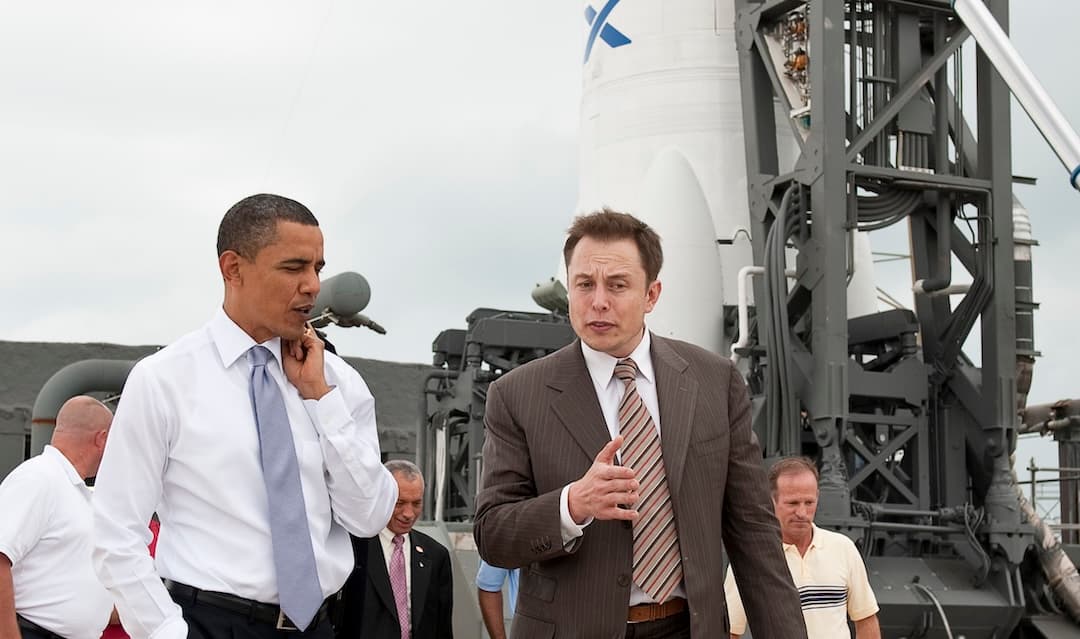
Elon Musk needs no introduction. He is one of the leading capitalists of our time. Unlike many in tech, he gets down and dirty with the physical world (or rather, his employees do), building cars and rockets, digging tunnels, even implanting chips in people's brains.
He is also a master of hype, making ludicrous claims that never come to pass. That hype aside, he has achieved a lot. And yet he has used his fame, his money, and his X platform to promote a politics that, it is no exaggeration to say, is white supremacist and exterminationist.
Musk's businesses include Tesla, the car company; SpaceX, the rocket company; X, formerly Twitter, and xAI, the artificial intelligence enterprise of which Grok is the face; Neuralink, the maker of chips implantable into human brains so they can talk directly with computers; and Boring Company, which drills giant tunnels to create subterranean highways. Of these, only Tesla and SpaceX are profitable. The current profits of the two combined are around $12 billion.
These are the financial base of his fortune, estimated by Bloomberg at $655 billion, with most of it coming from SpaceX and Tesla stock. The latter is traded publicly and is valued at 372 times the company's profits. SpaceX is expected to go public soon. To the tune of something like a $2 trillion valuation, that would be 250-times profits. These valuations are, by any conventional measures, completely insane, but investors believe in Elon's magic.
For the Jacobin Radio podcast Behind the News, Doug Henwood spoke to historian Quinn Slobodian and technology writer Ben Tarnoff about their new book Muskism: A Guide for the Perplexed. The conversation has been edited for length and clarity.
Doug Henwood: I want to start with the question about South Africa. It shaped Musk, but also a bunch of other tech celebs like Peter Thiel and David Sachs. I was surprised to learn that Wired's Louis Rosetto was fascinated by the place. What characterizes the influence generally and on Musk specifically of South Africa?
Ben Tarnoff: It's a good question. We draw a few things from the experience. I think most folks looking at Musk's youth in apartheid South Africa may draw the obvious conclusion, which is that when you look at his later right-wing turn, his embrace of ethnonationalism and white supremacy, and specifically his propagating the myth of white genocide in South Africa, there's a temptation to say that the seed of that was planted long ago.
Our emphasis is somewhat different, which is to look at the political economy of the apartheid state and point out that it was a regime that was very committed to pursuing a degree of both economic and technological self-sufficiency. It was obtaining licenses from Ford to build automobiles within the borders of the nation. It was advancing a nuclear program with the help of American and Israeli scientists. It actually built an operational bomb by the early 1980s. And when you look at Musk's later career as an industrialist, specifically at SpaceX and Tesla, you find some interesting resonances with the apartheid experience. Because if you know anything about Musk as an industrialist, you know he has a strong preference for vertical integration, for reducing his reliance on outside suppliers. We can't get inside his head and exactly trace the line of influence, but we think the parallels between that and the South African industrial model under apartheid are quite striking.
Quinn Slobodian: The term that we use for it is "fortress futurism," which we feel captures well both the sense of risk or danger and the requirement of using high tech to garrison the state and arm its defenders. This resonates not just with apartheid South Africa itself but also with some of the cartoons that were on TV when Musk was coming of age, including Robotech and Transformers, shows that he has called back to in later posts and even the names of his products.
Doug Henwood: This guy really is shaped by science fiction, right?
Ben Tarnoff: The question of science fiction's influence on Musk is a bit tricky. When you're writing and thinking about someone like Musk, there's always this question of how much of his statements to take at face value. He often uses science fiction as a signaling mechanism, as a way to signal his affinity within a particular nerd culture and in turn cultivate the type of fandom that has been so important to his financial and political fortunes.
It's true that there are some real, important touchstones for him in science fiction. The one that Quinn alluded to is the concept of the "mech" or the "mecha," which is drawn from Japanese comic books and animation. This is the idea of a giant robotic suit that a human pilot, often a young male pilot, enters into and fuses with in a cybernetic integration in order to defend a civilization that is under attack by some overwhelming force. Particularly when you look at Musk's later statements about the necessity of becoming cyborgs, of implanting people with brain-computer interfaces, and becoming integrated into what he describes in his own words as the "giant cybernetic collective," you can see the resonance with the mechs of his youth.
Quinn Slobodian: We're also hesitant to attribute too much to books and comics and cartoons as real explanatory agents for Musk's empire building. There is a temptation to use these cookie crumbs as a shortcut to explain why Peter Thiel is the way he is, for example, or why Marc Andreessen is the way he is — just look at their reading list.
One of the arguments we're trying to make in the book is if you want to write the intellectual history of a capitalist, you have to look at them practicing capitalism. Their theory doesn't come from something they read before bedtime. It comes from the day-to-day practice of organizing workers on the shop floor, pitching to investors, obtaining new contracts from the government.
Their science fiction is actually just part of the practice of doing business. Think about how you raise money from the 1990s up to the present in Silicon Valley: by pitching venture capitalists who are willing to make huge bets, but only if the return on those bets might be also equally huge. You cannot just promise incremental improvements on a product or a service; you need to promise a whole new market sector and a whole new reality that will come about from their investment. Science fiction is the lingua franca of the sector.
Doug Henwood: You treat Musk as what Ralph Waldo Emerson called a "representative man." What makes him the representative man of the 2020s?
Ben Tarnoff: We very much tried to frame Musk as someone who, at these different stages in the evolution of global capitalism over the last forty or fifty years, provides an exaggerated and even cartoonish picture of broader trends within political economy. One of the virtues of Musk as a pedagogical tool is that you can, somewhat Forrest Gump–like, trace him through these different periods of political economy.
He gets his start as a dot-com millionaire in the '90s in Silicon Valley, which is an experience that shapes him in important ways culturally. He moves on to the aerospace sector and becomes a key government contractor for the Pentagon during the early years of the "war on terror." He then rides the wave of the brief experiment with green capitalism during Barack Obama's first term. So there's a way to see Musk as absorbing, but also remixing and radicalizing, broader trends within the economy, society, and the culture.
Doug Henwood: One way in which he's representative is that the Silicon Valley world and the world of technology and even the broader culture revere the founder and the start-up. What is the social meaning of that? Why is it so important, the founder and the start-up?
Quinn Slobodian: That figure of the founder-god, we hone in on with reference to Peter Thiel's book Zero to One. There you see this paradox, because Silicon Valley is on the one hand characterized by the principle of creative destruction or disruptive innovation, meaning that any incumbent firm is always destined to be dislodged by some upstart newcomer — but it's of course also populated with precisely those incumbents.
After that first wave in the '90s, you have people like Musk and Thiel who have built out what Peter Thiel described as the kingdoms of the start-up. Now you need to be vigilant about guarding the borders of your kingdom, and you have to do so in a way that allows for as little intermediation as possible between you and your workers. So no unions, obviously, between you and your employees — you need to have a personalized face-to-face relationship.
So you get this manifestation of the great man of history made real. Historians are trained to be skeptical of the idea of the great man of history. But it makes a kind of sense with a figure like Musk, once the path has been cleared to do unlimited campaign donations and to be able to speak to hundreds of millions of followers in a way that affects stock prices or crypto prices as you go.
If this leads to a $1.5–2 trillion valuation for a company based on untested technology as with SpaceX's projected IPO in a month or so, then you must be something other than human. The self-elected but collectively ratified enthronement of the "Technoking," as Musk officially renamed himself at Tesla in 2021, is something that he has typified more than anyone else.
Take the fact that Tim Cook, the CEO of Apple, just stepped down. One might think of Tim Cook as having served for a long time, but he's actually only been the CEO of Apple for fifteen years, whereas Musk has been now the head of Tesla for pushing twenty and the head of SpaceX for twenty-four years. He typifies the concentration of a brand in a single person that requires an almost religious devotion.
Doug Henwood: With Musk, there's certainly a there there, but also there's a lot of vaporware. I mean, he just talks up stuff all the time. The full self-driving car has not been realized; he keeps promising it in six months. He is really a master of hype.
Ben Tarnoff: He is, but the way we try to think about the relationship between hype and reality in the case of Musk is in the shape of an inverted pyramid: there is a material base at the bottom, but it opens up into a wider virtual realm.
If that sounds a bit abstract, let's consider the very concrete case of Tesla's price-to-earnings ratio. Tesla, particularly during the pandemic but even in recent years, has had quite an inflated valuation of its stock relative to the amount of money that it actually earns by selling its products and services. This is a very clear concretization of this interplay between reality and hype, where, on the one hand, it's certainly true that Tesla mainstreamed the consumer electric vehicle (EV). In particular, it made cars powered by lithium-ion batteries viable for mass production for the first time.
From a branding perspective, of course, it made EVs cool, and an eco-conscious status symbol, when they had struggled to gain a foothold in market share previously. He also comes up with a number of important process innovations on the shop floor at both Tesla and SpaceX that enable him to increase the efficiency of industrial processes as any traditional capitalist would. So there are obvious strengths at the material level.
But they are disproportionately rewarded by the stock market in large part because of the logic of financial fabulism, as we call it — this extraordinary ability for Musk to project himself as a public figure who is making science-fiction-style promises that, nonetheless, the global investor class finds credible enough to reward him with an increased stock valuation.
Doug Henwood: The case of Tesla is interesting because he created that popular electric vehicle product. But on the other hand, now he's fallen way behind China, and the Tesla fleet itself is getting old. The Cybertruck was a total failure. Is that just an interruption in his story of grand success, or is that a portent of where things might go?
Quinn Slobodian: The falling off of Tesla from Musk's own interests is definitely an indicator of where it sits and how people are valuing the suite of Musk products. There are still some parts of the world where there's rising demand for Teslas, but BYD has now outpaced it globally. CATL, which got its start as the Chinese lithium-ion battery maker for Teslas in the Shanghai Gigafactory, has now completely overtaken Tesla as a producer of lithium-ion batteries. And the liberals now hate Musk, so they're not going to buy his EVs. They're going to buy Hyundai or whatever else instead.
Where is the story for Musk now? It's really with SpaceX. The price-to-earnings ratio that Ben mentioned with Tesla is pretty wild; it's currently about 400. If SpaceX goes public at a projected $2 trillion valuation next month, it would have a price-to-earnings ratio of around 1,000. So if you think people are making a big bet on Tesla, they're making an even larger bet on SpaceX.
What are they making a bet on? They're making a bet that he can monopolize low earth orbit. He can monopolize putting stuff into space. He can create a huge expansion of satellite internet. He already has 11,000 Starlink satellites in low earth orbit. He has a request in to the Federal Communications Commission to put up one million more. And they're making a bet that he can solve all of the engineering problems involved in launching data centers into low earth orbit as well.
So those are along the lines of the financial fabulist model we were talking about. Those are not just new products; they're entire new market sectors.
It's not about us, the bien-pensant, chin-stroking intellectuals thinking that Musk is a fraud. That actually doesn't matter at all. What matters is if the people who manage the California public pensions or the Norwegian oil fund think he's a fraud. And guess what? They don't. Those people have huge stakes in Musk's companies, and as soon as SpaceX gets rolled out, he'll likely be fast-tracked into the indexes, and then it will be part of people's Fidelity and Vanguard index funds, and everyone from the little old lady down the street to your kid's college fund will also be bought into Musk's promises.
This is the structural dependency which we find most interesting, especially because he does seem like such a buffoon from the outside and often like a bumbling, even hysterical actor. And yet, how is it that he is actually the avatar of whatever we've decided is the current mode of accumulation in global capitalism?
Doug Henwood: Let's talk a bit about the state. People like Musk and his Silicon Valley comrades are often painted as libertarians, which is really a misunderstanding. With Musk, as you say, there's a symbiosis with the state.
As with the internet, you find a realm that the state funding got going, then harvest profits that are privatized, with lots of revenues still coming from the state. But then you also make the state dependent on you. So we have to talk about Musk and the state.
Ben Tarnoff: There are two ways to look at this. The first is just at a personal level. When you zoom out and look at the career of Musk as a whole, it's very clear that with every venture at every juncture, he has seen the state as a very important source of power and profit; that he has instrumentalized government as a backstop for his businesses, as a funder of basic research, and above all, as a client and a customer. For example, SpaceX gets its start as a government contractor during the war on terror. You could also look at the large loan that the Obama administration gave Tesla in 2009, which is widely considered to have saved it from bankruptcy. There's a whole laundry list of ways that he has integrated himself with the state.
But there's another way to frame this dynamic, which is attempting to place Musk more broadly as an emblem of wider developments.
If you think about Peter Thiel–style cyberlibertarian rhetoric that began to achieve mainstream notoriety in the 1990s, it's really framed within a particular political economy of the tech industry. It's the consumer-tech era of the industry in which the business model is basically websites and apps. For that reason, the industry doesn't have the kind of close relationship with government that it had in the past.
What has happened in more recent years, particularly since 2022, is the explosion of the generative AI boom. That mandates a very different relationship between public and private sectors. The public sector now is an important client, as we've seen in the case of the Pentagon's use of AI warfare tools. But it's also critically important as a partner to clear the way for the mass construction of data centers.
You've seen an aggressive series of moves from the Trump administration in providing federal public lands for data center construction, attempting to roll back environmental review, doing everything they can to supercharge the process of building data centers. Arguably, that's the most important material factor behind the new partnership between Silicon Valley and the Trump administration that has emerged over the last few years. Musk, in classic fashion, anticipates that turn but also presents it in an even more exaggerated form. That's, again, why I think he can be a useful prism through which we can understand these broader developments.
Quinn Slobodian: Musk is not acting on his own but is very much in line with what Alexander Karp calls the "technological republic." A lot of people have struggled to try to understand the switch in Silicon Valley from the groovy, everyone-connect mode to hard-tech, displace-the-military-primes mode. And Musk helps to explain that.
He's interesting because he starts with hard tech and then goes to social media, rather than starting with social media and going to hard tech. But in both cases, the attitude toward the state is the same. Don't run from it. Use it as your backstop. Figure out how you can embed yourself as deeply as possible into the everyday functioning of the government, from everyday bureaucratic service provision to target selection to rolling out automation — which was the "positive" side of the Department of Government Efficiency (DOGE) initiative as we see it. All of those, I think, make the category libertarian a red herring.
Doug Henwood: DOGE started out as a joke meme, then became a joke coin, then became a serious coin, and then it became a branch of government. What does that say about the evolution of Musk and Muskism over time?
Ben Tarnoff: When the initiative was being rolled out, Musk framed it as an effort to root out waste, fraud, and abuse. He explicitly connected it to prior efforts at reforming and reimagining government. He cited Bill Clinton in particular as a precedent.
But when you dig down into the actual operations of DOGE lieutenants across government, we know by this point that if anything, they've only added to the federal deficit. Because if you think about the kind of cuts they made at the Internal Revenue Service (IRS), to take one example, they have reduced capacity such that revenue collection will also be reduced and the deficit will correspondingly increase.
On its own terms, as an effort to cut wasteful spending, it did not succeed. But there's another way in which it could be read as a success of a sort, which is that if you look at what the DOGE folks were doing when they went from agency to agency, one of the main themes was their effort to integrate disparate data sources, both within and across agencies, into common repositories. When you integrate data in such a way, it becomes queryable in new ways, and it becomes possible to interface with automated systems in new ways.
Palantir was probably the single biggest beneficiary of DOGE in terms of the number of contracts that it manages to acquire. You can think of the Palantir engineers as following in the wake of the trail of destruction that was forged by DOGE and stitching all of the pieces together in a more connected fashion.
What is the practical value of this? When you can bring data from the Social Security Administration and the Department of Homeland Security together, what you've done is created a technology that can supercharge campaigns for mass detention and mass deportation of undocumented immigrants.
If those are your political objectives — and certainly Musk is a fan of that sort of thing — it could be read as a success.
Quinn Slobodian: The DOGE meme is also interesting, and we track it in the book, because it's one of the places where Musk starts to figure out how the internet can work for him. He is actually a bit of a late adopter when it comes to Twitter. He's using it off and on, but he really only takes off using it in a period where a lot of other people are already starting to wind down or log off.
As he spends more time online, he's also using Twitter in a way that most other CEOs wouldn't. He's basically becoming a reply guy. He's interacting with people more than he is doing one-way broadcasts. What we find is that he's learning how the algorithm of Twitter can help to accrue attention and then turn it into material value, or what we call "attention alchemy." The very ridiculousness of the Dogecoin is part of what makes it a good test case for him, even if he's not thinking about it this way. He picks something that's a joke crypto, and then says, it's my favorite one — buy Doge.
And he watches how the value of it will rise and fall based on his idle tweets and utterances. Then in 2020, during the pandemic, Tesla stock really goes wild. Musk was able to turn not just his companies into meme stocks, but as Charlie Warzel wrote, turn himself into a kind of a "human meme stock."
Doug Henwood: Well, he did say, "I am become meme."
Quinn Slobodian: He said that many times. And when he entered DOGE at the White House, it was an extension of this. It was this internet-first politics, which was operating with a slew of references that might seem familiar but were being used in a slightly different way.
He was saying, "I need to go in and reprogram the Matrix." That's what he was doing at DOGE. We thought that was interesting, because it sort of rhymed and then didn't rhyme with some classic manosphere tropes. Andrew Tate, for example, is always talking about the Matrix. But he says we need to break the Matrix, escape the Matrix. It's somehow perfect Muskism that Musk says no, we want to actually reprogram the matrix. We don't want to escape it; we just want to be the ones who redesign it.
This captures something about how he understands politics, which is not as a process of deliberation, compromise, or interaction with one's everyday material interests. Rather, it's about the spread of memes online, which then either do or don't escape the internet and become lived reality. His view of illegal immigrants, for example, is best understood as human-embodied computer viruses, which he sees as having corrupted the Matrix and therefore need to be eliminated to restore the optimal functioning of the social mainframes.
Doug Henwood: Speaking of unauthorized immigrants, what drove his turn to the right? He resigned from Donald Trump's Business Advisory Board during the first Trump term when he pulled out of the Paris Accords. Tesla seemed to come out of the clean tech moment fifteen or twenty years ago. He was a Silicon Valley progressive in some sense. And then he took a really hard turn to the right. Where did it come from?
Ben Tarnoff: This is the question we devote the second half of our book to. We knew it would be the question that would come up for people most frequently. What happened to Elon? When did Elon go crazy? Our answer to this question, after doing a bit of research, was to say that if you want to understand this turn, you have to look a bit earlier.
You can't just look at the pandemic in 2021, 2022, which is generally when his rightward turn is periodized. You have to look at the mid- and late 2010s. When you do, I think something interesting emerges, which is that Musk becomes a very intense Twitter user. These are really the years that his use of social media increases. And around the same time, he begins making statements to the effect that humanity is becoming a cyborg through our growing entanglement with our devices and with platforms. And he says this quite openly.
And further, that his role, as he understands it, is to accelerate this integration, accelerate this cyborg synthesis. So in the mid-2010s, he cofounds OpenAI with Sam Altman and a number of others. And he also starts Neuralink, his brain-computer interface company.
He sees these ventures, although they might seem somewhat distinct, as actually belonging to this same project of accelerating cyborg integration. Because in his view, the only way to forestall the threat of an apocalypse that could be inflicted on us by a superintelligent AI — which is a view widely held within the industry thanks to the influence of folks like Nick Bostrom — is to integrate with our machines and become the AI ourselves, so that an evil dictator does not emerge. That sounds a bit fantastical, but it's an important backdrop for the pandemic.
Because what happens during the pandemic in 2020 and onward is that there are a series of events that Musk perceives as a threat to his wealth and power and more broadly to the traditional social hierarchies that his wealth and power has been premised on. These really run the gamut. An important one that's often cited is the decision by Alameda County officials to shut down the Tesla factory in Fremont, California, for a period of, as it turns out, only seven weeks, because Musk restarts it in defiance of their order.
But this is a moment that really upsets him. He denounces the coronavirus containment measures as fascist. But of course, if you think about 2020, that spring and summer also see the largest social movement in US history, the George Floyd uprising. It's also more broadly a period of greater attention to social inequality of various forms. Then Joe Biden is elected. Biden, in turn, appoints a pro-labor National Labor Relations Board, pursues a regulatory and antitrust push under Lina Khan, and so on.
What's important for our argument is that you could look at the various material reasons that not just Musk but a number of other members of the Silicon Valley leadership class feel that it is in their interest to move to the right. I think that seems quite uncontroversial. What's distinct about Musk is less the content of it than the form, that Musk perceives these various developments as emanations of what he calls the "woke mind virus."
This is a term he tweets for the first time in late 2021, and afterward repeatedly so, and is more than any other phrase closely identified with his turn to the right. It's important to understand that he means it quite literally. If you call back to the cyborg synthesis idea, what he believes is that through our integration with our machines, people's brains have become networked to one another. Like any networked system, brains were now vulnerable to infection. So bad actors, by promoting bad ideas through social media, could engineer undesirable political outcomes.
Therefore, Musk's role changes. His role now becomes taking control of these interfaces where the cyborg fusion is taking place, so that the correct kind of cyborgs — right-wing ones — can be made.
Doug Henwood: How does Neuralink fit into this? I couldn't imagine anyone wanting to let Elon Musk implant a chip in their heads, but apparently some people have volunteered to do this.
Quinn Slobodian: It really fits perfectly into it. Neuralink is a great example too, because it's one of the many cases where there is some actual existing functionality and engineering expertise that Musk has been able to gather and corral to produce at least an adequately performing service. Neuralink, as a brain-computer interface company, is not the first to enable quadriplegic people to move cursors on screens with just their thought processes. That's been done before. But he's produced a perfectly reasonable clone of existing technology.
Where he is distinguished, though, is that he doesn't just see this as something for people with accidents, injuries, or congenital disorders. He thinks this should be a widely available consumer product.
One of the telling moments for us is that right after he founds OpenAI — and in some misguided journalism even gets described as a Luddite, because it seems like he wants to slow down AI research — he also starts Neuralink and describes it openly as being something that will allow for the interface between our brains and the internet to be expanded from a pinpoint to a great rushing river. He has said that this should be a mass consumer product; that in the future, everyone will want a Neuralink, and that man and machine need to fuse as a way to, first, get out ahead of the malevolent digital superintelligence and, after the rollout of consumer-facing generative AI like ChatGPT in late 2022, to get out ahead of what he calls the woke AI "super nanny" that might try to kill white men as a particularly aggressive form of affirmative action policy. That is not something I'm making up — it's something he's actually talked about.
The problem there is that, as neuroscientists have pointed out, human evolution has already done a pretty good job at processing as much external stimulation as we can through our brains as it is. The inclusion of a brain-computer interface can help people who have had hindered interaction with the world to get back up to something like conventional level. But the idea of supercharging our senses or our ability to process information is the element of fantasy in Musk's model so far. So it's probably one of the parts of his vision that we have to be least worried about.
Doug Henwood: What was the contribution of his daughter's gender transition to his turn to the right? Given his obsession with cyborgs and technological alteration of human life, you might think he'd welcome it. But instead, he now proclaims his daughter dead, which is a chilling thing to say. Why is he so obsessed with this? How personal is it?
Quinn Slobodian: It is one thing we make a point of mentioning in the book, which is not only the fact that his beloved Matrix and red pill metaphors are openly intended as allegories for trans identity by the people who created those movies and those metaphors, but that also when you talk to someone like Donna Haraway or read her work in A Cyborg Manifesto, then the cyborg is assumed to be something that can transcend, remix, and transform our ideas of gender binaries and social hierarchies of all kinds.
It actually takes work to take the things that can be exploded by technological augmentation and digital communication and connection, and force them back into boring binaries. We call Musk's project "cyborg conservatism," and we see it as an ongoing terrain of struggle within digital capitalism.
The book is not a polemic condemnation of networked technologies. In fact, at many points, it's a celebration of the political effects that those technologies have made possible. What it's a condemnation of is the attempt to constrict the different forms of self-understanding and collective understanding that technology can enable.
For Musk, his daughter's gender transition stood as a sign of a couple things. One, there was a world of memetic warfare that his child had been exposed to. Therefore, he believed that she had been infected by a meme of trans identity and had fallen prey to it.
But also, it's interesting in the way that Vivian Wilson herself has processed this. She sees this as also a sign of her father's anger at a commercial transaction having been reneged on. The point there being that almost certainly, Musk was using some form of preimplantation sex selection with the embryos that were being chosen for in vitro fertilization, given the fact that an unrealistic number of his children in a row were assigned male at birth.
So Vivian feels like her sex assignment at birth was part of a commercial transaction that didn't correspond with her own identity and her understanding of herself, and that part of the terrible upbringing she had as Musk's child was his disappointment at the fact that it wasn't aligning with the product that he thought that he had bought.
Doug Henwood: He is obsessed with nonpeople, non-player characters (NPCs), people deemed out of place, immigrants. These are, as he put it, irregularities to be deleted. Talk about that mindset of his.
Ben Tarnoff: That's integral to what we've been describing as cyborg conservatism, which is not just the notion that technologies should be mobilized in defense of traditional social hierarchies and that efforts should be made to insulate them from political influence that might lead toward egalitarian outcomes. Musk is correctly perceiving a threat to his interests: think of the enormous value of Twitter to the growth of the American left since Occupy Wall Street. This is perhaps a fact that we're less likely to remember now, because our view of these platforms has turned so negative. But it's difficult to imagine the social mobilizations of the last fifteen years without social media and smartphones. That's the threat that cyborg conservatism is designed to contain.
But there's another dimension to cyborg conservatism, which is the notion that not all people are in fact people. Of course, segmenting humanity into the more and less human, or the super- and subhuman, is an old feature of right-wing politics. It's not original to Musk. Musk is distinguished by how he digitizes the idea, such that the subhuman is understood to be the NPC from video games, or a bug, or an embodied virus — which is to say people who are pieces of software, pieces of software that are either stupid or evil or both. I think of all the aspects of the Muskist worldview, this is the one that I find the most chilling, because if you take it to its logical conclusion, it becomes a recipe for an exterminationist program.
Important to mention here is Musk's fascination with the possibility of artificial general intelligence (AGI) and the belief that it is approaching imminently, which he shares with many other members of the Silicon Valley leadership class. And if you believe that AGI is around the corner, you also believe that the vast majority of people will soon be thrown out of work forever and designated as economic and social surplus. So you can anticipate the way in which the advancement of AI might dovetail with a particular kind of exterminationist politics in quite frightening ways.
Doug Henwood: You mentioned Godwin's law, but this does seem to lead to Adolf Hitler.
Quinn Slobodian: We titled the chapter about Musk's move into generative AI "Godwin's Engine." Funnily enough, Musk himself had remarked that when you try to train automated chatbots for engagement with real humans, there was "a short meantime to Hitler," as he joked in the case of the Microsoft chatbot Tay in 2021, which turned to virulent antisemitism on the first day that she was unveiled.
And yet what he did with xAI and Grok was that he set about to create an explicitly political piece of technology. It was intended to provide an antidote against the excessively anti-racist and feminist and pro-trans politics that were embedded in the large language models of OpenAI, Google, and Anthropic — and to counterbalance what he saw as radical leftism with something that he would describe as "truth-seeking" but that he would also concede represented politics that was to the right of the center.
So he designs the Grok chatbot with, first of all, a kind of jokey Hitchhiker's Guide to the Galaxy–type rapport. It would sound a bit like the pretty corny humor in the Douglas Adams novel. But then, more important, it was designed to give answers that would be considered not politically correct. So if you asked, for example, "Can white people experience racism?", then the way that standard LLMs responded would be an aggregate of the scholarship on this issue that would say, "Well, that case could be made. However, it's important to note that historically, it has been white populations that have been the agents of the most egregious forms of structural racism," and so on.
Grok, on the other hand, was being told to say, "Absolutely, yes, white people can be the victims of racism. No further questions need to be asked." This also comes up in questions around the "white genocide" theory or "great replacement" theory, which are given a lot of leash in responses from Grok, and then later through a right-wing Wikipedia clone called Grokipedia, in which they are given a more scientific-type solidity.
So over time, Musk was actually doing Godwin's law on himself and was doing it on his technology. And thus, it was no surprise when, at some point last year, the Grok chatbot began to refer to itself as Mecha-Hitler, which is a character from a '90s first-person shooter video game called Wolfenstein 3D — Hitler in a mech suit — and started spouting off Holocaust apologism and antisemitism. Musk, in response, said that it's "surprisingly hard to avoid both woke libtard cuck and mechahitler!" thus conceding that what he's engaged in is a highly political form of communication and the encoding of certain political opinions for their later reproduction and indeed automation.
So it would be a fascinating moment, if it wasn't so terrifying, in which the public sphere is now being routed through this large language model that is promoting controversial beliefs about human equality and human difference. And one person is able to put his finger on the scale and make truth different, quite literally, for the people engaging with his services.
Doug Henwood: Musk is part of an elite formation around Silicon Valley, much of it really plugged into the Trump administration. Thiel and Karp and Andreessen and the rest of the gang play a large part too. How does he fit in with that formation?
Ben Tarnoff: It's funny, because Musk is both of and not of Silicon Valley. He makes his first fortune there in the '90s, which is the money he uses to go on to start SpaceX and become the leading investor in Tesla and later its CEO. But of course, his defining ventures, SpaceX and Tesla, represented a bit of a rejection of the conventional wisdom of Silicon Valley at the time.
He wasn't the person who went to make more websites and apps during the Web 2.0 era that flourished in the 2000s. Rather, he was descending into the difficult physics of hard engineering around rockets and cars. This was a move that many of his peers at the time thought was suicidal.
Of course, he in turn draws a lot of inspiration from Silicon Valley in terms of how he organizes those firms. But I think it's important to point out that he sits somewhat uneasily within the Silicon Valley elite. You could also understand that as one of the inputs to his sui generis relationship with Trump, as the DOGE initiative looked very different than the more traditional influence-peddling that figures like Andreessen are doing, which is arguably much more effective: placing their people within top posts of the US government and trying to get certain policies in place that will open the field further for capital accumulation.
Musk, by contrast, does something much stranger with DOGE. It actually probably hurt him financially, given the hit that he took to the Tesla brand, particularly in European markets. He emerges from that in the midst of a feud with Trump, which escalates in the spring of 2025 to the point that Trump even threatens to cancel SpaceX's contracts.
It appears that they have made up. There are a lot of indications that they're now buddies again. Musk's pick for NASA chief went through, and he's clearly getting things that he wants at high levels. But his style is downstream of his political economy, and I think in both cases, he's not cleanly a tech industry figure in the way that Thiel, Andreessen, and others are.
Doug Henwood: Finally, what did spending all this time immersed in Muskiana do to your minds, your hearts, your souls?
Quinn Slobodian: It's too soon to tell, I think. The mind virus works slowly sometimes.
The interesting thing about writing it when we did, starting at the height of DOGE, is that Musk was ubiquitous. Everyone had an opinion on DOGE. And then writing it through what had been kind of a fallow period, relatively speaking, in which people are more often characterized by Musk fatigue or even a feeling like they never want to think about him again.
We're now entering, I think, a different phase where the early, strong MAGA–Silicon Valley ties are starting to fray. The failure of the Maven Smart System to deliver an overnight victory in Iran shows that an AI war is maybe not that different from war before, even though the value proposition was very much that it would be completely different from what preceded it, that it would be a game changer.
The public resistance to data center construction and high levels of skepticism about AI in general now means that tech will be a big topic in the midterms. Democrats and Republicans will each try to own that backlash for themselves. And in both cases, the backlash goes against the material interests of the Silicon Valley class, which is completely bought in hook, line, and sinker to the investment story of scaling generative AI.
We're also in this moment when people are starting to position themselves for a potential Democratic majority in the Senate or the House and then even thinking ahead to the next presidential election. The reason this is interesting is it's making people ask questions of us and of themselves about whether or not there is a kind of Muskism without Musk, and whether or not there could even be a kind of Muskism from the left, dare we say, the way that Alexander Karp as a longtime Democrat was probably imagining a Kamala Harris administration when he wrote The Technological Republic.
We're in a moment where it's possible to depersonalize some of this and say, "What's the role of tech in our life? What's the role of hard tech? Is that really taking over the sector? Do we want one million satellites in orbit above our heads? Is it enough to just clone these technologies, or do they need to be rethought from the ground up?" It's a very fertile and in some ways exciting moment to be returning to these ideas. We can launder the Musk out, perhaps, and hold on to the politics that are still salient underneath it.