Taboo broken: Social Democrats join far right to bring down Romania's prime minister
Another crack in Europe's firewall against the far right opened in Romania. The center-left Social Democrats worked with the far right to oust Prime Minister Ilie Bolojan and stop his austerity plans.
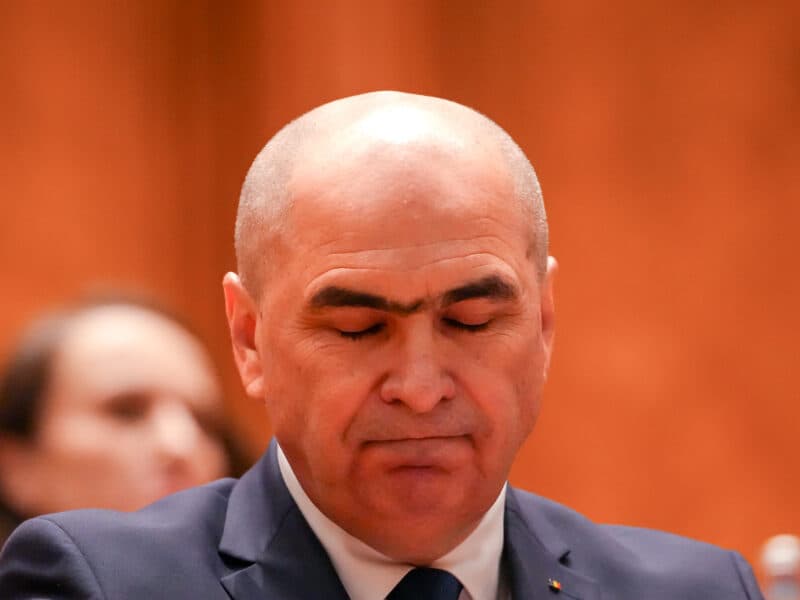
(CN) — Romania's center-left Social Democrats joined forces Tuesday with the country's far right to end the government of center-right Prime Minister Ilie Bolojan, whose cost-cutting and privatization measures angered large swaths of the population.
With 281 votes, Romania's National Assembly backed a no-confidence vote brought by Social Democrats and the Alliance for the Union of Romanians, or AUR, a far-right party ahead in the polls with about 37% of the vote. The Social Democrats were in a four-way coalition with Bolojan's National Liberal Party before dropping out in late April.
A period of political negotiations over a new government awaited Romania, a country of 19 million people in the midst of an economic crisis due to a grave budget deficit and soaring inflation, the highest in the European Union.
Bolojan had become very unpopular and the target of demonstrations, many of them led by teachers upset at cuts to education and frozen salaries and pensions.
By voting with AUR, the Social Democrats broke a taboo in Europe where centrist parties vow not to collaborate with the far right, which is seen as a danger to the EU project and democratic government.
Following the vote, Sorin Grindeanu, the Social Democratic leader, said he wanted to form a new pro-EU coalition and that he was open to working once again with the National Liberal Party. Grindeanu has ruled out governing with AUR.
Romanian President Nicuşor Dan will appoint a new prime minister and he made it clear he would not back any government that includes AUR.
Still, Tuesday's vote weakened the so-called cordon sanitaire — or firewall — against far-right forces. The cordon sanitaire has come under strain across Europe because the far right has gained in strength. Much-weakened big-tent centrist parties on both the right and left are finding it increasingly difficult to govern and have often joined in uncomfortable alliances.
In a speech before the vote, Bolojan attacked the Social Democrats and called the censure motion against him "cynical and artificial."
"Can anyone say how Romania will function from tomorrow?" Bolojan asked. "Do you have a plan?"
Bolojan took office in June 2025 and blamed previous Social Democratic governments for allowing deficits "to run out of control for years" and putting Romania in a position where it faced paying a "quite high bill."
"Ten months ago I found myself in a difficult situation of doing what was right, not what was popular, but what was necessary," Bolojan told the National Assembly Tuesday. He accused previous governments of viewing the state's coffers as a "piggy bank" for wasteful projects.
Bolojan reduced Romania's deficit by pushing tax hikes and making cuts to education, culture and social spending. But his plans to partially privatize state-owned companies prompted the Social Democrats to rebel.
In their censure motion, the Social Democrats and AUR said they wanted to stop Bolojan from "destroying the economy, impoverishing the population and fraudulently selling state assets."
"Romania is not a commodity and state-owned companies are not assets to be liquidated to cover political failures," AUR and the Social Democrats said.
Bolojan was looking at selling stakes in numerous state-owned companies, including airports in Bucharest, the Port of Constanta on the Black Sea, the National Salt Company, the Romanian Lottery, the national postal operator and a hydroelectric company.
But the Social Democrats and AUR said privatizing those companies made no sense, especially when some of them were profitable, and they accused Bolojan of seeking to move "money from state property into the private pockets of obscure interest circles."
Bolojan argued Romania could no longer afford the financial drain and operational inefficiencies caused by its under-performing state enterprises. He also pointed out that the state would hold onto a majority stake in the companies.
He also has pushed Romania to list or restructure at least three state-owned companies from the energy and transport sectors by August as a condition to secure up to 10 billion euros ($11.7 billion) in EU recovery funds.
Until a new government is formed, Bolojan's cabinet will remain in office with limited powers.
Courthouse News reporter Cain Burdeau is based in the European Union.