Supreme Court snubs anti-abortion flyer case, leaving school political speech off docket
The Supreme Court refused to review whether an Indiana high school violated a student's speech rights by prohibiting political messaging in an ad for an anti-abortion club, with Justice Alito dissenting and calling for clarification of precedent.
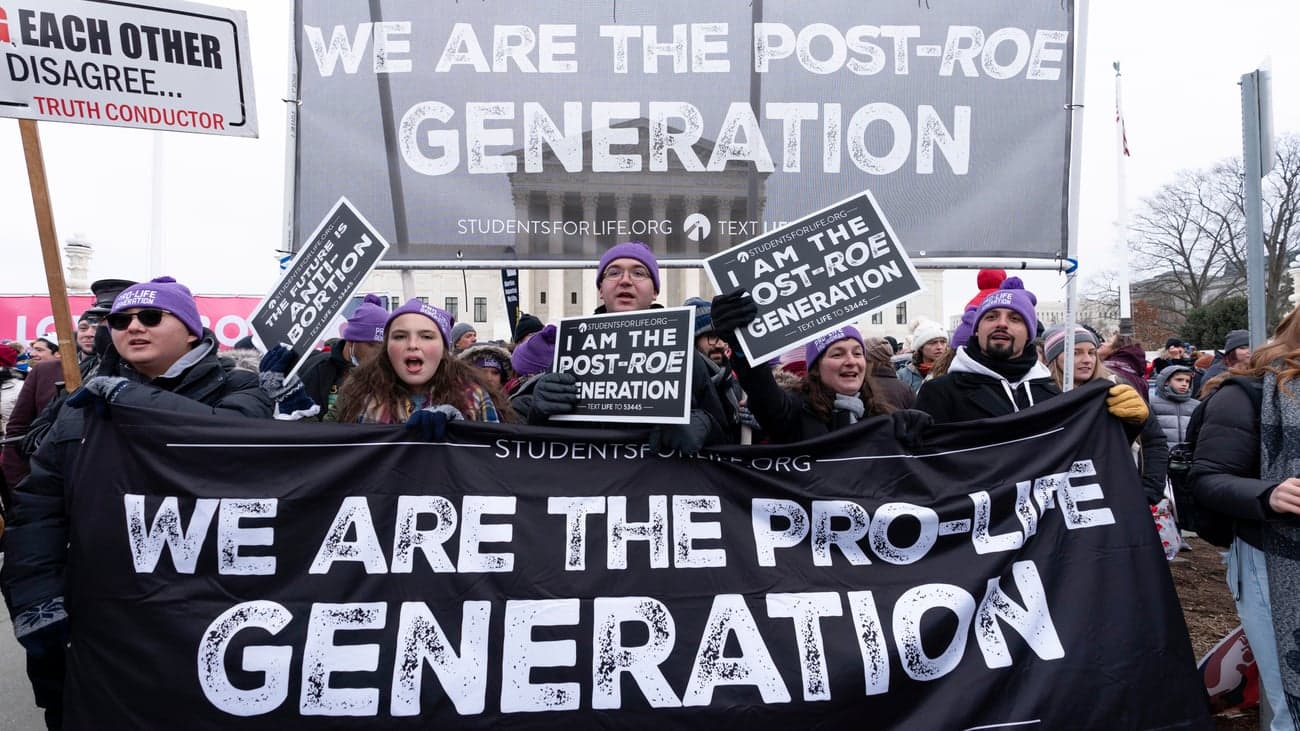
WASHINGTON (CN) — The Supreme Court refused on Monday to review whether an Indiana high school violated a student's speech rights by prohibiting political messaging in an ad for an anti-abortion club.
A freshman identified as E.D. sought to hang flyers for a local chapter of the national organization Students for Life of America at Noblesville High School in the fall of 2021. But a dispute over a political photo included in the advertisement led the clubs to be shut down.
The lower courts sided with Noblesville, using a four-decade-old precedent on student speech known as Hazelwood School Dist. v. Kuhlmeier. The 1988 ruling concerned the regulation of school-sponsoned publications, allowing administrators some control over content that might be perceived as the opinion of the school.
In a solo dissent, Justice Samuel Alito, a George W. Bush appointee, said the court should have taken the opportunity to balance Hazelwood's limits against Tinker v. Des Moines Independent Community School District — a 1969 case involving students wearing anti-war arm bands to protest the Vietnam War.
"The distinction between private speech and government speech is critical because the free speech clause of the First Amendment constrains censorship of the first category only," Alito wrote in dissent. "Accordingly, 'courts must be very careful when a government claims that speech by one or more private speakers is actually government speech,' because 'it can be difficult to tell whether the government is using the doctrine 'as a subterfuge for favoring certain private speakers over others based on viewpoint.''"
The lower courts held that Noblesville's arguments prevailed under Hazelwood.
In a mockup provided to administrators at the Indiana public school, E.D.'s flyers included photos of students in front of the U.S. Supreme Court holding signs that read, "I reject abortion," "defund Planned Parenthood" and "I am the pro-life generation."
Noblesville objected to the political messaging, saying its walls are a place to advertise student clubs, not a public forum for speech. The assistant principal told E.D. her flyers could only contain the name of the club, meeting location, time and date. A faculty sponsor also reiterated these requirements.
Instead of removing the photos from her flyers, E.D. and her mother arranged a meeting with the school's dean, who informed them of the same requirements.
High school administrators claimed E.D. and her mother were trying to make an end-run around the rules. And they argued the mother's participation in two of the club's meetings in less than a month called into question whether the organization was student-driven.
Noblesville revoked the club's approval for the remainder of the semester, stating E.D. could apply again in the new year. E.D. and her mother then sued, claiming the school and its administrators violated their First Amendment rights.
In the four decades since Hazelwood, Alito noted the court has routinely ruled against classifying private expression as government speech. And he said the court should review the precedent to clarify if Hazelwood conflicts with more recent rulings.
"When Hazelwood was decided, this court's decisions had never even mentioned the term 'government speech,'" Alito wrote. "I would grant the petition to clarify the relationship between Hazelwood and our subsequent government-speech decisions. In an appropriate case, we should do so."