Supreme Court shuts down last-ditch effort to rein in landmark voting ruling
The timing of the Supreme Court's decision to strike down Louisiana's voting maps set off a week of additional litigation over how the ruling would impact the midterm elections.
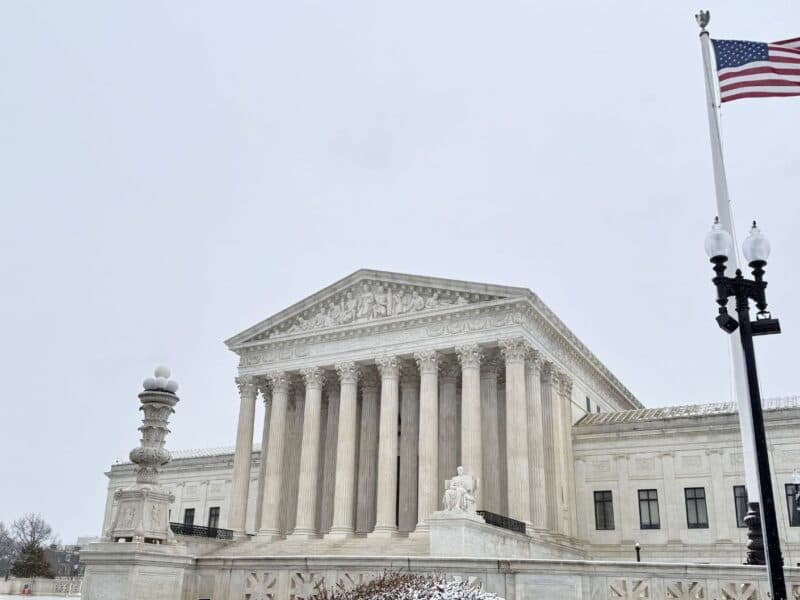
WASHINGTON (CN) — The Supreme Court refused on Wednesday to reconsider its decision helping Louisiana Republicans redraw favorable congressional maps ahead of quickly approaching primary elections.
Black voters who forced the state to add a second majority-Black district claimed the decision was based on an error, asking the justices to recall it. The Supreme Court refused, denying their motion in a single sentence.
The justices did not explain their ruling, and there were no noted dissents.
Under court practice, the clerk issues a certified judgment about 32 days after a ruling. Just hours after its decision last week, the plaintiffs in Louisiana v. Callais — a group of "non-African American voters" — asked the high court to fast-track the procedural process formalizing their win.
In an unsigned order, the high court said it would allow its decision to take immediate effect because Black voters and civil rights groups hadn't asked the court to reconsider its judgment.
But civil rights groups supporting the voters said that was incorrect. The second sentence of their opposition to expediting release of the ruling states "this court should afford appellants the opportunity to consider seeking rehearing in the ordinary course."
Tension across the bench over granting their request spilled out into the public Monday night. Justice Ketanji Brown Jackson, a Joe Biden appointee, issued a blistering solo dissent admonishing her colleagues for ignoring protocol to assist a Republican redraw amid an ongoing election. She noted the court has only ever agreed to rush the release of its judgment in two other cases over the last 25 years.
Justice Samuel Alito, a George W. Bush appointee, said Jackson's accusation was "groundless and utterly irresponsible" in a concurring opinion joined by Justices Clarence Thomas and Neil Gorsuch. He said Jackson leveled charges that cannot go unanswered, characterizing her reasons for delaying as "trivial at best" and "baseless and insulting."
Louisiana Governor Jeff Landry issued an executive order last week, delaying the state's May 16 primary elections until July to give lawmakers time to draw a new map. The decision came just days before early voting was scheduled to begin but reportedly after 42,000 absentee ballots had already been submitted.
A different group of Louisiana voters and a Democratic primary candidate filed a lawsuit challenging Landry's order, noting absentee ballots had already been sent out and that early voting was scheduled to begin Saturday.
Black voters and civil rights groups sued Louisiana over its 2022 voting maps, which included just one majority-Black district despite Black voters making up 30% of the voting-age population in the state. The Supreme Court approved the map for the 2022 midterms, citing Purcell v. Gonzalez, which limits federal court interference in the run-up to elections.
After a lengthy legal fight and a federal ruling, lawmakers approved a new map in 2024 with a second majority-Black district. A group of "non-African American voters" then sued, saying the map is unconstitutional. The court again paused changes for the 2024 election under Purcell but left the new map in place.
The Supreme Court heard two argument sessions last year on whether adding the second majority-Black district under Section 2 of the Voting Rights Act was unconstitutional. In a 6-3 ruling last week, the court held that it was.