Supreme Court affirms 'jurisdictional anchor' in hotel guard arbitration dispute
The complex jurisdictional debate led Justice Samuel Alito to joke about asking Claude AI to decide the case during oral arguments in March.
WASHINGTON (CN) — Ruling against a former hotel security guard, the Supreme Court on Thursday rejected limits on federal courts' authority over arbitration awards.
Adrian Jules told the justices that a New York court didn't have authority to rule on a motion confirming an arbitration award against him. The court unanimously disagreed, however, reasoning that Jules gave the court jurisdiction by filing the original lawsuit that led to the award.
"Because a federal court in this scenario has jurisdiction over the original claims and does not lose that jurisdiction while the case is stayed pending arbitration, it retains jurisdiction to determine whether the arbitral award resolving those claims is valid and should be confirmed," Justice Sonia Sotomayor, a Barack Obama appointee, wrote for the court.
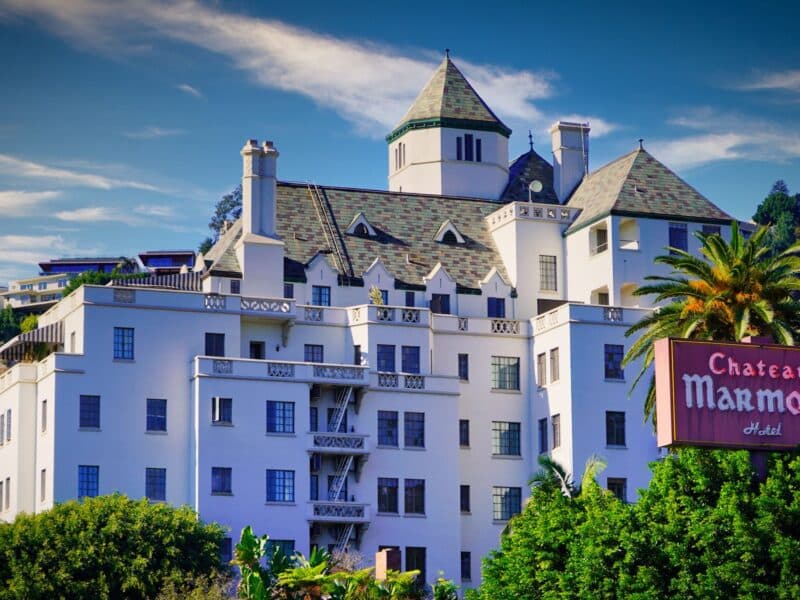
Jules filed discrimination claims with the Equal Employment Opportunity Commission after being fired from the Chateau Marmont, a famous hotel in Los Angeles. The commission gave Jules a right-to-sue letter.
Despite an arbitration agreement with his employer, Jules filed a lawsuit against individuals connected to the hotel in New York, including Andre Balazs, a partial owner of the Chateau Marmont.
Balazs tried to compel arbitration, and the lower court agreed to pause Jules' lawsuit to decide whether the agreement was valid.
The court upheld the agreement, but it said it couldn't compel arbitration. According to the court, the agreement required arbitration in Los Angeles. Therefore, the New York court said it would be acting outside its authority to compel arbitration.
After both parties engaged in arbitration proceedings, an arbitrator found Jules failed to prove any of his claims, awarding him zero dollars. The arbitrator also issued monetary sanctions against Jules and his attorney for misconduct.
Balazs and Chateau Marmont asked the New York court to confirm the arbitration award. Despite Jules' claims that the court no longer had jurisdiction, the New York court agreed to confirm the award.
The complex jurisdictional dispute over arbitration awards led Justice Samuel Alito, a George W. Bush appointee, to joke about asking the AI chatbot Claude to decide the case during oral arguments in March.
The Supreme Court affirmed that holding, finding that Balazs wasn't asking for anything unusual.
"Instead, the court in this case secured federal jurisdiction, in one of the most usual ways imaginable, based on the federal claims Jules filed in federal court under 28 U. S. C. §1331," Sotomayor wrote. "Respondents merely asked the district court to use the tools provided by the FAA to finally resolve those claims."
Sotomayor said depriving courts of authority to rule on a motion related to a case that was already before them undermined courts' supervisory role over arbitration proceedings and created unnecessarily complex litigation.
"It would also undermine the efficiency interests at the heart of the FAA by forcing parties who were previously in federal court (often, as here, against their wishes) to launch a fresh state-court proceeding, complete with 'a new filing fee,' to secure confirmation or vacatur of an arbitral award," Sotomayor wrote.
And she dismissed Jules' arguments that granting courts jurisdiction over such motions would encourage parties to engage in useless federal litigation with the sole purpose of creating a jurisdictional anchor.
"There is no evidence suggesting that Jules' concerns about manufactured federal jurisdiction will come to pass," Sotomayor said. "There thus seems to be little risk that confirm-or-vacate litigation will flood federal courts."