Study links biggest black holes to repeated cosmic collisions
Researchers found the universe's biggest black holes are not formed directly from collapsing stars but instead grow through repeated mergers inside dense star clusters. They analyzed gravitational-wave data from observatories and also found evidence that supports a predicted black hole mass gap.
(CN) — Not all black holes are born as giants. Some of them grow through a series of violent cosmic crashes, according to researchers in a new study.
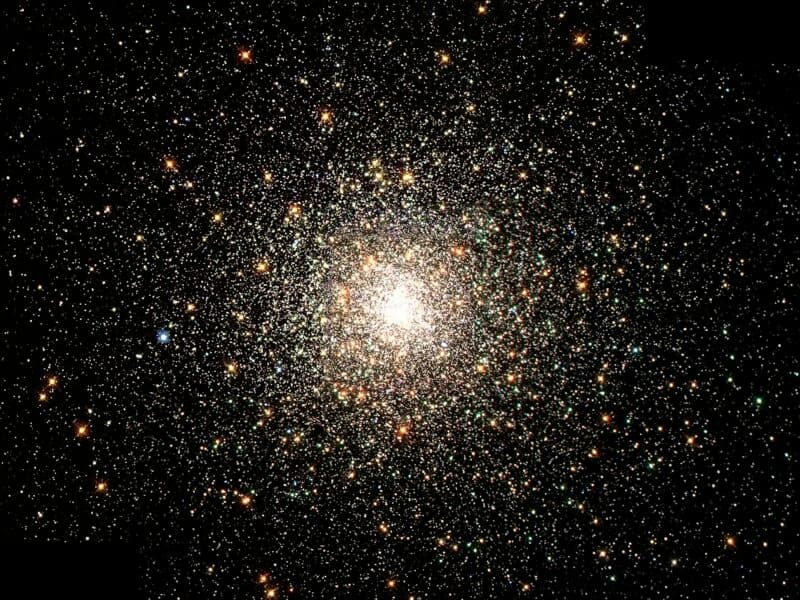
The mysterious cosmic objects, which are among the most massive objects in the universe, have previously been thought to be the direct result of collapsing stars. But in new research published in Nature Astronomy Thursday, researchers found that the biggest black holes in the universe were not born from collapsing massive stars but were instead the result of violent stellar collisions in densely populated star clusters that cause them to grow increasingly larger.
In the study led by Cardiff University in Wales, researchers analyzed a dataset of black hole merger detections captured by a network of international observatories.
"Gravitational-wave astronomy is now doing more than counting black hole mergers," said lead author Fabio Antonini of Cardiff University's School of Physics and Astronomy. "It is starting to reveal how black holes grow, where they grow, and what that tells us about the lives and deaths of massive stars. This is exciting because we can use the information to test our understanding of how stars and clusters evolve in the universe."
What Antonini and his colleagues found in the gravitational wave data was a lower-mass population of black holes commonly attributed to stellar collapse, as well as a higher-mass population of black holes whose spins appear exactly like those expected from mergers in dense star clusters.
"What surprised us most was how clearly the high mass black holes stand out as a separate population," said Isobel Romero-Shaw, a co-author also from Cardiff University. "Unlike the lower mass systems we analyzed, which were generally slowly spinning, the higher mass systems are consistent with having more rapid spins, oriented in seemingly random directions. This is the exact signature you would expect if black holes were repeatedly merging in dense star clusters. That makes the cluster origin much more compelling than it was with earlier catalogues."
Gravitational waves, first theorized by Albert Einstein, are ripples in spacetime that occur as massive objects move through space — like when two black holes collide.
Black holes, while highly studied, are still unknown. The massive objects are so dense the gravity beneath their surface, known as the event horizon, is strong enough that not even light can escape.
The researchers analyzed data from these waves that were detected by three observatories that make up a gravitational-wave network: the Laser Interferometer Gravitational-Wave Observatory, or LIGO, in Hanford, Washington, the Virgo observatory in Pisa, Italy, and the Kamioka Gravitational Wave Detector, or KAGRA, near Hida, Japan. The observatories assigned confidence ratings and then cataloged the detections.
These catalogues are produced every eight to nine months, after each LIGO detection run, Antonini explained in an email to Courthouse News. The data used in the study is the most recent, he added.
The researchers used the cataloged data to test whether the biggest black holes were second-generation objects, formed when earlier black holes merged again in dense star clusters.
In principle, even higher generations of black holes may exist if they continue to merge, though they are rare, Antonini said.
"That is because black hole mergers often produce a powerful 'recoil kick' caused by the uneven emission of gravitational waves," he wrote in an email. "This kick can fling the merger remnant out of its parent star cluster, leaving it no chance to merge again. Only a small fraction of second-generation black holes are likely to remain in the cluster and go on to take part in another merger. As a result, higher-generation black holes should exist, but they are expected to be increasingly rare, at least for the typical clusters we observe today."
Researchers say the study also provides the best evidence so far for a "mass gap" between the size of cosmic objects in the universe, where massive stars explode into supernovae instead of collapsing into black holes.
"In our study, we find evidence for the long-predicted pair-instability mass gap — a range of masses where stars are not expected to leave behind black holes at all," Antonini said. "Gravitational-wave detectors have successfully found black holes that appear to sit in or near that gap, which we identify at around 45 solar masses."
This could include a black hole produced by another black hole merger that lands in the mass range that single stars are not expected to populate.
The question, Antonini said, is whether the black holes identified in this mass gap are evidence that current models of stellar evolution are wrong or if they are being made in another way.
"The biggest black holes in the current sample seem to be telling us about cluster dynamics, not just stellar evolution," Antonini said. "Above about 45 solar masses, the spin distribution changes in a way that is hard to explain with normal stellar binaries alone but is naturally explained if these black holes have already been through earlier mergers in dense clusters."