Starmer vows to fight on after heavy election losses to right-wing Reform UK
Nigel Farage's Reform UK gained hundreds of seats in English local elections Friday as Labour suffered losses across traditional strongholds and admitted it may lose Wales after a century of control.
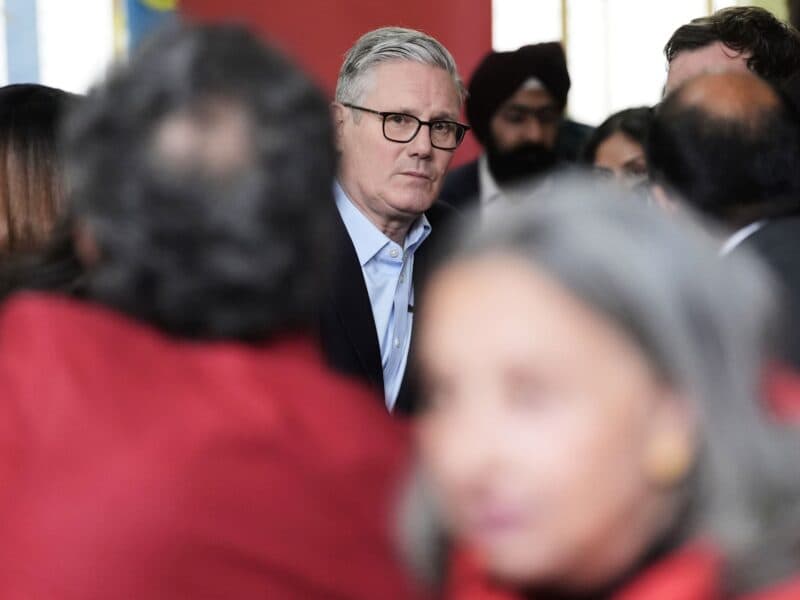
MANCHESTER, England (CN) — U.K. Prime Minister Keir Starmer said Friday he takes "responsibility" for Labour's election results after the party lost hundreds of seats in local elections across England while Nigel Farage's right-wing Reform UK made sweeping gains.
"They are very tough, and there's no sugarcoating it," Starmer said after early results showed Labour losing support in parts of northern and central England that once formed the backbone of the party's coalition.
"I'm not going to walk away and plunge the country into chaos," Starmer said Friday when asked about speculation over his leadership.
"I led our party to that victory, that is a five-year mandate to change the country," he said.
Starmer said he would "set out the further steps" Labour plans to take "in the coming days" and confirmed he intends to contest the next general election.
The elections, which include local council races in England and national parliamentary elections in Scotland and Wales, underscored the growing fragmentation of British politics as voters drift away from the country's two traditional governing parties.
About 5,000 seats were contested Thursday in 136 local councils across England. Councils oversee local services including adult social care, housing, planning, road maintenance, trash collection and leisure facilities.
England has roughly 17,000 councilors in total.
With half the results so far declared, Reform had gained about 600 seats. Labour had lost around 400 seats while the opposition Conservatives lost almost 300.
The Green Party gained more than 60 seats and the Liberal Democrats added about 30.
The full results are not expected until Saturday.
Farage hailed the outcome as a "truly historic shift in British politics" as Reform seized councils from both Labour and the Conservatives, including Essex County Council, long considered a Conservative stronghold.
Speaking in Havering, east London, where Reform took control of the local council, Farage said Labour was being "wiped out by Reform in many of their most traditional areas."
Farage argued the results showed Reform had become a national force capable of winning support across ideological and geographic divides.
"We're proving in a way we can win in areas that Labour have dominated," he said.
Early voting patterns suggested Reform performed especially well in areas that heavily backed Brexit in the 2016 referendum.
The Conservative Party also suffered heavy losses to Reform, though party leader Kemi Badenoch pointed to pockets of recovery after the Conservatives regained control of Westminster City Council from Labour.
"I'm not saying that we're there yet. I'm not saying that the results are perfect," Badenoch said Friday in London. "But good strategy takes time."
"The Conservatives are coming back," she added. "I promised to renew this party — I said we were going to rebuild after our worst defeat ever — and we can see those signs of renewal everywhere that we are standing."
Earlier Friday, James Cleverly, a senior Conservative lawmaker, acknowledged the party had endured a "tough night."
While Labour lost many seats directly to Reform, party officials and analysts said Labour's losses in raw vote share were even greater to left-leaning parties including the Greens and Liberal Democrats.
The Green Party gained dozens of councilors and won its first mayoral election in Hackney, a traditionally Labour area in east London.
Green Party leader Zack Polanski declared that "two-party politics is over," adding that "the new politics is Greens versus Reform."
Liberal Democrat leader Ed Davey said his party was "feeling very bullish" and warned Britain's traditional parties were losing their grip on voters.
"Both the Conservatives and Labour need to smell the coffee — the old parties are out," he said.
The prime minister said the majority of voters "know the status quo is letting them down and they're frustrated, they don't feel the changes," he added.
Some Labour lawmakers have openly questioned whether Starmer can recover politically.
John McDonnell, Labour's former shadow chancellor under left-wing former leader Jeremy Corbyn, said the party was "being hit on all sides."
"The question for Keir is, does he want to be the Labour leader that opens the door to Nigel Farage," McDonnell said. "I don't think he does. So therefore, we've got to have quite radical change."
He warned the party was losing working-class voters to Reform while progressive voters defected to the Greens and Liberal Democrats.
Analysis by the polling group Persuasion UK found for every 10 voters Labour loses to Reform, it loses 16 voters to the Greens, Liberal Democrats and other left-leaning parties.
"The animosity toward Keir on the doorstep is beyond anything I've ever experienced," McDonnell said. "People just feel let down."
He added that a debate over Starmer's leadership had become "inevitable," though he argued against removing the prime minister in a sudden internal revolt.
"If there was going to be change, there should be an orderly transition," he said.
In Wales, where Labour has governed continuously for about a century, party leaders conceded defeat even before any results were announced.
"I don't think we're going to be in that situation," Welsh Deputy First Minister Huw Irranca-Davies said when asked whether Labour would form the next Welsh government.
Labour is expecting to return just 10 of the available 96 seats.
Polling suggests the center-left nationalist party Plaid Cymru and Reform are competing for top spot in the Welsh Parliament.
Only a handful of seats had been declared in Scotland's devolved Parliament, though pro-independence Scottish National Party was expected to remain the largest party there, with a close battle emerging for second place between Reform and Labour.
Despite heavy losses for Labour, change in the short term is unlikely given the lack of challengers waiting in the wings.
One of the potential challengers, Andy Burnham, the mayor of Greater Manchester, has built a strong national profile by overseeing rapid economic growth in one of Britain's fastest-growing urban economies.
Burnham, a former Labour cabinet minister popular with the party's left wing, has occasionally challenged Starmer publicly on transport, austerity and regional funding.
However, earlier this year Labour's governing National Executive Committee blocked him from contesting a parliamentary by-election, a move widely seen as preventing him from returning to Parliament and mounting a future leadership challenge.
Angela Rayner, Britain's former deputy prime minister, had also been viewed as a possible rival before her political standing weakened after it was revealed that she had underpaid property tax, ending in her dismissal from government.
Pressure also mounted from Britain's labor unions, which are historically linked to Labour.
Maryam Eslamdoust, general secretary of the Transport Salaried Staffs' Association union, called for Starmer to resign and compared Labour's struggles to former President Joe Biden's loss of support in the United States.
"Unions like the TSSA will not stand by in the wake of this electoral disaster and let Keir Starmer pave the way for a hard-right government led by Nigel Farage," she said. That's why Labour urgently needs a leadership election to allow members to pick a candidate who is much more responsive to the needs of working people."
Courthouse News reporter James Francis Whitehead is based in England.