Senate Republicans reject claims DHS budget deal funds Trump ballroom
Republicans said their bill blocks the White House from spending on "non-security" features of the East Wing construction project — but the Trump administration has already argued the proposed ballroom provides a security function.
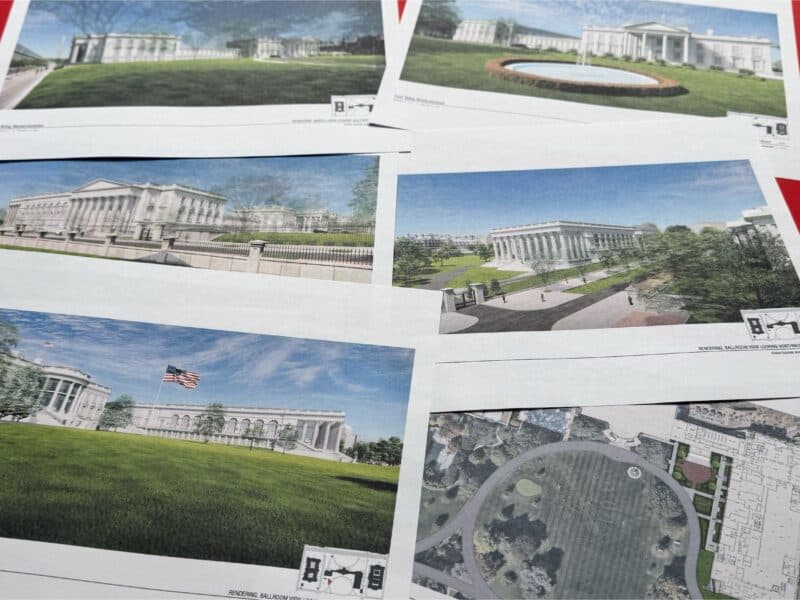
WASHINGTON (CN) — Senate Republicans on Tuesday roundly rejected reports that a proposed Homeland Security funding bill authorizes congressional appropriations for President Donald Trump's White House ballroom project.
But while the Senate Judiciary Committee's GOP majority pointed to a provision in their new legislation barring the $1 billion in new spending for use on "non-security elements" of the East Wing modernization effort, the measure's language is vague in its prohibition on ballroom construction.
And the proposed legislation similarly does not appear to address the administration's arguments, made repeatedly before a federal judge, that the ballroom itself should be considered a security structure.
In the budget reconciliation measure, unveiled Monday night by Judiciary Committee chairman and Iowa Senator Chuck Grassley, lawmakers proposed a billion-dollar line item they said would support the White House's "East Wing Modernization Project," a construction job that aims to build a 90,000-square-foot ballroom attached to the executive residence. According to the Trump administration, the project would also include some below-ground structures, such as a drone-proof bunker for the president.
According to the Judiciary Committee bill, the new funding appropriated to the U.S. Secret Service could be used to support "security adjustments and upgrades" to the East Wing, "including above-ground and below-ground security features."
The legislation also lays out limitations on the new spending. "None of the funds made available under this section may be used for non-security elements of the East Wing Modernization Project," lawmakers wrote.
Senate Republicans have held that the bill's language precludes the White House from using the $1 billion in East Wing construction funds to build Trump's much-vaunted ballroom, and slammed media reports suggesting otherwise.
"Serious legislating requires basic reading," the Judiciary Committee's GOP majority wrote in a post on its official X account. "The bill funds Secret Service enhancements, not ballroom construction." And Grassley spokesperson Clare Slattery wrote in a separate post that the measure "explicitly prohibits" funds from being used on "ballroom" elements.
The word "ballroom" does not appear in the bill text released Monday night, and spokespeople for the Judiciary Committee chairman did not return a request for comment about whether lawmakers plan to specifically rule out ballroom construction from reconciliation funding. Committee spokespeople also did not return a request for comment about whether Grassley will release more detailed budget figures ahead of a panel markup.
The Trump administration, for its part, has repeatedly argued that the proposed ballroom does in fact fulfill a security purpose. The White House told a federal judge in April that the proposed ballroom and bunker beneath it were integrated and that both advance "critical national-security objectives." The enormous event space, government lawyers argued, would feature bulletproof windows and a missile-resistant construction that would provide an "appropriate structure" to protect the president's underground bunker.
A D.C. federal judge last month lifted part of a judicial order blocking Trump's ballroom project, allowing the administration to proceed on "below-ground construction of national security facilities." The George W. Bush-appointed judge upbraided the White House for what he called "extraordinary, if not disingenuous" claims that the proposed ballroom had security functions.
Trump himself has long said that his ballroom project would be crucial for national security. Those claims were supercharged late last month after a would-be assassin charged a security checkpoint at the annual White House Correspondents' Dinner. The president and Republicans argued that the incident demonstrated the need for secure event space in the nation's capital.
Meanwhile, Democrats panned the Republican reconciliation bill — which also sets funding levels for immigration enforcement and Justice Department programs — as a rubber stamp for Trump's policy agenda.
"It's clear the White House wants nothing more than an unregulated slush fund for Trump's unpopular pet projects, including his vanity ballroom and cruel mass deportation campaign," said a spokesperson for Illinois Senator Dick Durbin, the top Democrat on the Judiciary Committee. "If Republicans weren't afraid of the American people, they'd go through the usual bipartisan appropriations process and require the Administration to provide details to back up this request."
Connecticut Representative Rosa DeLauro, the top Democrat on the House Appropriations Committee, said in a statement Democrats would not support any funding for what she called the president's "vanity project."
"We have been told that the president's ballroom would be privately funded, that it would not cost taxpayers a dime. Now it turns out that actually it is going to cost taxpayers $1 billion," said DeLauro, adding that the National Capital Planning Commission has referred to the East Wing project as a "permanent, secure event space." and that the entire ballroom could be interpreted by the Trump administration as a security adjustment.
Following a record 76-day funding lapse that shut down the Homeland Security Department, Congress last week approved a two-step plan to reopen the agency under which lawmakers would fund immigration enforcement agencies through the budget reconciliation process.
The budgetary mechanism allows congressional Republicans to approve that funding without any Democratic input. Lawmakers last week passed a separate appropriations bill which set the budget for other DHS programs, such as federal disaster response and airport security services.
The Judiciary Committee's reconciliation measure lays out roughly $31 billion for U.S. Immigration and Customs Enforcement operations. A separate budget bill released by the Senate Homeland Security and Government Affairs Committee greenlights an additional $19 billion for Border Patrol and another $7.5 billion for Homeland Security Investigations.