Robot wars - what an operation in Ukraine tells us about the battlefield of the near future
After Ukraine's President Zelensky said territory had been captured using just robots and drones, what is the future of unmanned warfare?
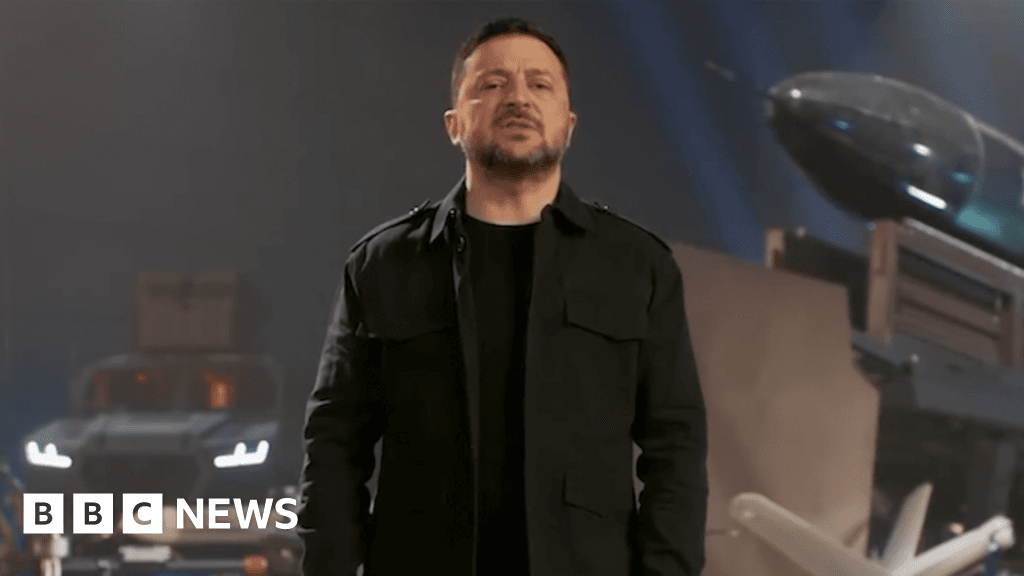
The battlefield in Ukraine could soon feature more robot than human soldiers - that is the startling claim made by a Ukrainian-British military start-up.
The BBC visited UFORCE at its London premises, which are unbranded and discreet, a measure the company says is intended to protect it from potential Russian sabotage.
I wanted to know more about the company because of its involvement in what Ukraine says was an unprecedented military operation: enemy territory being seized using only robots and drones.
The claim was made by Ukraine's President Zelensky in a video last month highlighting Ukraine's newly developed robotic weapons.
Both sides have made extensive use of unmanned aerial and land systems throughout the conflict, with analysts saying the war has dramatically accelerated the development of military technology.
It has also intensified the debate about the future of warfare and its implications for soldiers, robot as well as human.
Zelensky has been keen to publicise what he says was a first in the history of war - but Ukraine's military has declined to provide details of the operation.
Similarly, a UFORCE representative would not comment on the robotic battle described in Zelensky's video, but said UFORCE's air, land and sea drones are currently being used in combat operations.
"I can't go into specifics about the operation or how UFORCE was involved, but we've conducted more than 150,000 successful combat missions since the full-scale Russian invasion in 2022," said Rhiannon Padley, the firm's UK director of strategic partnerships.
What is clear though is that robotic weapon systems are big business.
The company has expanded rapidly and recently achieved "unicorn" status - a valuation of more than $1bn (£730m).
She added that the phenomenon of robots fighting robots was likely to become more common, with unmanned systems even outnumbering human soldiers.
Russia is also deploying robots designed to deliver explosives into Ukrainian positions, and analysts say advances in this technology are likely to reshape how future wars are fought.
"I really consider Ukraine to be a major teacher in the future of national defence and armaments," said Melanie Sisson, a senior fellow at the Brookings Institution. "It's an impressive case study in how necessity drives invention."
UFORCE is part of a growing group of so-called Neo-Prime defence companies, challenging established firms such as BAE Systems, Boeing and Lockheed Martin.
Another is Anduril, a US defence technology company which carried out its first test flight of a fighter jet without a pilot in February.
While most drones are still operated remotely by humans, companies such as Anduril are increasingly incorporating artificial intelligence into weapons systems.
UFORCE's land-based drones use software designed to assist with targeting, while Anduril says some of its systems can autonomously complete the final phase of an attack.
The US government has publicly urged its military to adopt artificial intelligence aggressively.
In January, US Defence Secretary Pete Hegseth said the country needs to become an "AI-first warfighting force".
China is also increasing its use of AI-enabled military systems, according to a US Department of Defense assessment published last year.
Analysts say a future in which robots directly engage one another on the battlefield may be difficult to avoid.
"Ukrainian and Russian drones already fight each other," said Jacob Parakilas of RAND Europe, a think tank. "Seeing that extend to land and maritime warfare seems extremely likely, if not inevitable."
Human rights groups, however, warn that greater autonomy in weapons systems raises serious concerns about accountability.
"Militaries adopt AI to speed up processes such as target identification. But delegating life-and-death decisions to machines poses profound ethical and human rights risks," said Patrick Wilcken of Amnesty International.
Weapons manufacturers argue that keeping a "human in the loop" addresses such concerns, insisting that decisions to deploy force remain with military personnel.
"Humans need rest and food, and under combat conditions those needs aren't always met," said Dr Rich Drake, UK general manager at Anduril Industries. "Computing allows us to reduce errors across what we call the kill chain."