Parsing Fact From Fiction on Ireland's Magdalene Laundries
The last of Ireland's Magdalene laundries, workhouses for "morally wayward" women, closed in 1996. Since then, the institutions' many horrors have come to light, but misinformation has also been endemic. A new book provides a granular, factual account.
According to a 2013 Irish government report, more than ten thousand women and girls passed through Ireland's Magdalene laundries. Primarily run by Roman Catholic orders in Ireland, the laundries were institutions where women and girls deemed "wayward" were incarcerated and subjected to forced labor. These included unmarried mothers, women who had been sexually abused, women considered too flirtatious or promiscuous, and girls referred simply for being poor, orphaned, or difficult to manage.
But like so much else about the laundries, that number is disputed. The Catholic orders that ran most laundries remain under no legal obligation to open their archives, and the 2013 figure excluded those who entered before 1922, among other gaps. Some researchers and advocacy groups estimate that it may have even exceeded 30,000. The ending of Small Things Like These, a 2024 cinematic adaptation of a novella by Claire Keegan about the laundries, dedicates the film to the "more than 56,000 young women who were sent to the Magdalene Laundries" and "the children who were taken from them."
"Upon seeing that erroneous fact projected on a big screen in a packed cinema," writes Louise Brangan in her new book, The Fallen: The Lost Girls of Ireland's Magdalene Laundries and a Legacy of Silence, "I felt my mind listing, as if I had vertigo." The book offers many such correctives in an effort to develop an accurate portrayal of what Brangan calls Ireland's "main carceral institution" for much of the twentieth century.
Narrowing her focus to the lives of six women — Carmel, Nora, Catherine, Brigid, Katie, and Eileen — Brangan offers a granular, humanizing account of what it meant to be incarcerated within the laundries and, in some cases, to never leave. This is no simple feat given the scarcity of records, but Brangan draws on thousands of pages of survivor testimony — gathered by the artist Evelyn Glynn, the Waterford Memories Project, and the activist group Justice for Magdalenes between 2009 and 2015, to name a few — with immense care and precision.
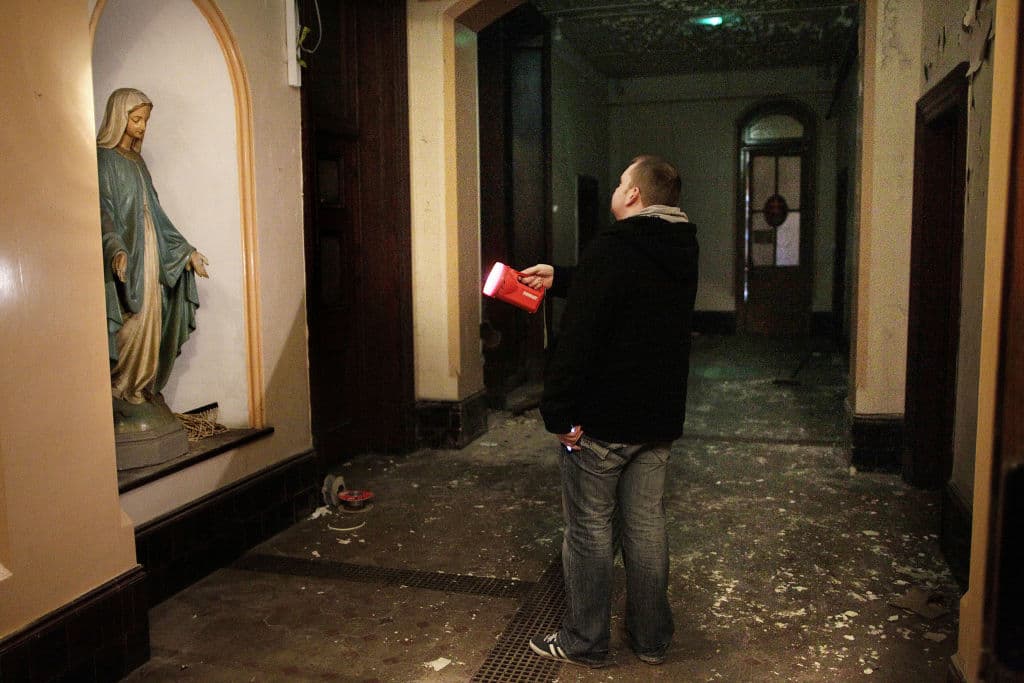
In addition to the six women Brangan profiles, there is a seventh, always hovering just out of frame. In twentieth-century Ireland, the Mother Mary was venerated with such ardor that, as Brangan puts it, "Christ sometimes had the appearance of a second-tier messiah in his own religion." When Pope Pius XII declared 1954 a Marian year, the Irish response was unmatched anywhere in the world. People painted their houses in shades of Marian blue. A craze for statue-building saw Marian grottos cut into rock faces and roadsides across the country. They portrayed her hands clasped, head bowed, blank and fair of face — each one an emblem of the "silent, mothering, virginal womanhood that Ireland had come to worship."
Such prescriptive ideas of femininity were weaponized against women at every level of Irish society. Brangan traces how the new Irish Free State, after independence in 1922, became gripped by a fanatical fervor for social purity in which women's bodies were the primary battleground. The 1931 Carrigan Report, a government-commissioned review of criminal law, declared that girls leaving industrial schools "drift into evil ways" and are "mentally and emotionally unstable," incapable of resisting vice. Volunteer organizations like the Legion of Mary took it upon themselves to patrol streets and neighborhoods, identifying women and girls they deemed at risk of "pre-delinquency." This category was so broad — and so subjective — that it could include almost anyone classed as female.
Women's bodies have, of course, often been extolled with latent eroticism throughout history. But in twentieth-century Ireland, simply existing as a woman could be grounds for detainment, regardless of whether you had actually engaged in any acts of sexual "misconduct." The laundries — also called penitentiaries, refuges, and asylums — were set up and run entirely on the conviction that women who had sex, or were perceived as sexual beings in any way, were mentally unstable and incapable of managing their own lives and were thus justly subjugated to external control by the state. Many were described as "mental defectives," or "simplí" in Irish, sent in by families who "knew that the Magdalene Laundry was a place of last resort if they were beyond coping," writes Brangan, "and maybe, on occasion, also beyond caring."
One of The Fallen's most important clarifications concerns the widespread misconception about what the laundries actually were. Small Things Like These's inaccurate dedication owes to the apparent fact that Keegan and director Tim Mielants collapsed the distinction between the laundries and Ireland's Mother and Baby Homes: two very separate institutions, even if both were run by religious orders.
This is a fairly shocking blunder, considering that it was long-listed for the Booker Prize and won the Orwell Prize for Political Fiction. The Mother and Baby Homes cared for women and girls who were pregnant outside of marriage; after giving birth, most were expected to leave their children behind and return to their ordinary lives, "carrying private shame, but with social standing intact." The nuns would then make arrangements for the "illegitimate" children: sending some to industrial schools, placing others with families or religious institutions and, in some cases, facilitating adoptions — often across the Atlantic — through what Brangan describes as a system of "clandestine adoption" that the women themselves had no power to refuse.
Unlike Mother and Baby Homes, the Magdalene laundries weren't maternity institutions, and as Brangan repeats throughout, no babies were born there. There's also a popular misapprehension that the laundries served as overflow facilities for these homes, when in truth it was rare for those discharged from a laundry to go straight to a home. This was a measure reserved, clarifies Brangan, only for "repeat offenders" and the women and girls who'd had multiple illegitimate pregnancies.
As Brangan details, the grounds for ending up in a laundry were, for the most part, capricious. Carmel ended up there because, at eighteen, she returned to the Good Shepherd nuns who'd raised her in an industrial school (the order ran institutions for orphaned and abandoned children) to ask for different work. They put her in a car and drove her to a laundry in another county without explanation. "The violence and neglect in the industrial schools were among the most heinously excessive of all these institutions; regimented beatings, force-feeding, sexual abuse," Brangan writes. Still, the laundries were widely regarded to be far worse than the industrial schools themselves.
Brigid was sent to one at twelve for truancy. Catherine was deposited by her father on the crossbar of his bicycle at fourteen, regarding her as a surplus to requirements after he remarried. Eileen was brought by two women from the Legion of Mary who decided that the fifteen-year-old maid, spotted alone in a Dublin bed and breakfast on a Sunday evening, was in "imminent moral danger." The eldest woman ever received at a laundry was ninety-eight, Brangan records; the youngest, nine. In an Internal Departmental Memorandum in 1973, some civil servants suggested that these institutions also provided "worthwhile services for a large no. of women who are unfit for work," such as "OAPs [old-age pensioners], mentally or physically retarded women, mildly handicapped and delicate women and women who are unstable for social or moral reasons."
The first laundry was Protestant-run, intended as a "program of reform with prostitutes and other 'fallen women', as well as the homeless and alcoholics — all of whom were deemed in need of moral and spiritual recovery, heroically described as 'rescue work.'" They were so named after Mary Magdalene: a follower of Jesus who, through centuries of ecclesiastical interpretation, was transformed into an emblem of female sexual transgression. While the Gospels never describe her as a prostitute — she instead appears as a woman from whom Jesus cast out seven demons, a disciple present at the Crucifixion, and the first witness to the Resurrection — Pope Gregory the Great identified her with the unnamed "sinful woman" of Luke 7, likely a prostitute. Though this conflation was not accepted everywhere in Christianity, it became dominant in Western Catholicism for more than a millennium, including in Ireland. In the Bible, Mary Magdalene and the Virgin Mary are both beloved intimates of Jesus, both integral to his divine arc. But in twentieth-century Ireland, they were polar opposite icons of feminine virtue or lack thereof.
By the 1950s, more women were held in laundries than men in prison: for every one hundred thousand Irish women, seventy were detained in a laundry, while for every one hundred thousand men, only twenty-seven were in prison. In many cases, the laundries' living and working conditions were comparable to, if not indistinguishable, those of the British-run penal colonies from the nineteenth century, though what took place inside there was strictly "spoken about in taut euphemisms — charity, redemption."
On arrival, the women and girls imprisoned in the laundries were generally shorn of their hair and stripped of their given names and given a saint's name — or, more heinously, just a number. Subjected to a strict rule of silence, they worked six days a week — washing, ironing, packing — using mostly heavy, unwieldy machines. They cleaned the vestments and uniforms of priests and prisoners, and "the linens of hotels, restaurants and family dining rooms passed through these women's hands. They endured Ireland's stench and dirt, the stains that wanted removing, to be made pristine, and professionally transformed."
The women and girls received no pay for this work, nor was there any clear prospect of release. The smallest infractions were met with physical punishment and solitary confinement. Sinéad O'Connor, who was sent to a laundry as a teenager, recalled in a 2013 interview being "locked in, cut off from life, deprived of a normal childhood." It was little wonder, then, that many women believed they were going to die inside the laundries, and many did. Brangan's own research on this is grimmer still. The official McAleese Report estimated 879 deaths from 1922 onward — but that figure excludes women transferred to hospitals or nursing homes before they died, and those who entered before independence. At High Park Laundry in Drumcondra, seventy-five death certificates corresponded to 155 bodies in the ground. Activists who have counted names on gravestones put the figure as high as 1,837.
"Rosaries and ovaries," wrote Edna O'Brien in her 1997 novel, Down by the River; "I don't know which does the most damage to this country." Released only a year after the country's last laundry permanently shuttered its doors, O'Brien was writing from a lifetime of experience. Her Country Girls trilogy, published between 1960 and 1964, was banned by the Irish censor for its lewd content, scandalizing the country with its unflinching portrayal of female sexual desire, and was later burned in her home county of Clare. "There was something didactic about this whole pitiless fiasco with O'Brien and her condemned novel," Brangan tells us. "Women's voices and women's lives that could be seen or heard were to be handled with contempt. If a woman wanted to belong, she must contain herself — those were the rules."
The controversy surrounding O'Brien became a national cause célèbre — and a damning indictment of the Catholic Church's prurient authority over women's sexual and reproductive lives. Throughout the twentieth century, Ireland's rigid abortion laws, coupled with its constitutional ideal of the family, had extended control over women's bodies to sex itself: an act only socially permissible if it was for procreation. Contraception remained illegal until 1979, and only then was allowed for married women; sex education was virtually absent from church-run schools; women who reported sexual abuse were as likely to be institutionalized as believed. The 1937 Irish Constitution, still in use today, declared that "the State recognizes that by her life within the home, woman gives to the State a support without which the common good cannot be achieved." Women who refused this role, or who simply failed to perform it with sufficient virtue, were seen as a problem to be managed.
While The Fallen's attentiveness and compassion to its subjects is remarkable, perhaps Brangan's greatest achievement is her portrait of a fractured nation. The state that enshrined the sanctity of motherhood simultaneously built a system for disappearing the mothers it found inconvenient, and many other women along the way. And Ireland's singularly punitive brand of Catholicism — a faith that supposedly affirms the universal dignity of all human life — ran institutions that abused and incarcerated tens of thousands of women and girls.
The laundries were, as John Banville describes, an open secret; they ran as long as they did because the public was all too willing to turn a blind eye. This was, in effect, Ireland's parochial moral order in miniature: a system that hid women away for transgressing codes of its own invention and proclaimed it salvation.