Orbán's legacy: His Hungarian illiberal 'revolution' lives on despite loss
Viktor Orbán, Hungary's strongman dubbed the "Trump before Trump," has been defeated. But that doesn't mean his illiberal nationalist-conservative ideology has been buried — instead, it's being recalibrated.
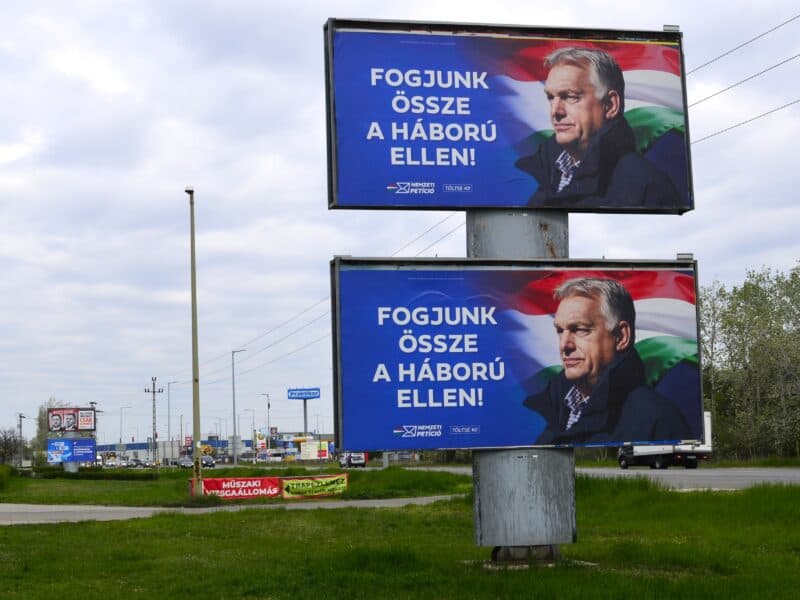
BUDAPEST, Hungary (CN) — Shortly after Viktor Orbán came to power in 2010 by winning national elections in a landslide, he came to Kossuth Square, the place of Hungary's grandiose neo-Gothic Parliament on the Danube River, and called his Fidesz party's win a "revolution" that had finally ended the country's rule by "communists."
"We have now become strong enough and smart enough to close the era of transition and turn Hungary in a new direction," a 46-year-old Orbán said to his followers who mostly came, like he did, from Hungary's conservative countryside of grain fields, church spires and folk songs.
"Everyone must know that without those who are here today, this could not have happened. Without you, the two-thirds revolution could not have happened," Orbán said, nodding to Fidesz's historic two-thirds majority in Parliament.
This supermajority was so important a threshold because it allowed Fidesz to rewrite Hungary's constitution, which still retained elements from the country's communist-era 1949 Constitution.
On that sunny day in May, the world was in the grip of the Great Recession and it paid little attention to what was happening in small Hungary, a landlocked Central European country of 10 million people slowly and painfully getting integrated into the European Union and NATO after decades behind the Iron Curtain.
The square fluttered with Hungarian flags but also a smattering of banners emblazoned with nationalist and irredentist symbols invoking "Greater Hungary," the old Kingdom of Hungary — a feudalistic, religious and agrarian "homeland" Orbán's movement felt it was reclaiming — that existed before the loss of vast territories following World War I and the collapse of the Austro-Hungarian empire.
Orbán, who'd ironically first gained prominence in the late 1980s as a Western-backed pro-liberal law student speaking out against communist rule, vowed to transform Hungary and, in his words, purge it of "a foreign plague" brought in "with communism and occupation which has distorted our true nature."
By 2010, his politics and rhetoric had drifted ever further to the right and become brazenly extremist — from liberal to liberal-conservative to conservative-nationalist. He now called for stamping out a left-liberal "oligarchy" that was built on, as he said, "lies, propaganda and corruption."
A few experts and critics saw ominous signs of an autocracy in the making, but Orbán insisted his "revolution" was about restoring the nation's soul.
But who could stop him anyway? In Brussels, he was aligned with the bloc's ruling mainstream conservatives, the European People's Party, and it turned out they'd turn a blind eye to what was happening in Budapest for years to come. In Hungary, voters had unshackled him on purpose to shake things up.
Orban denounced the old power structure he said was made up of the same cosmopolitan Budapest elites who'd run the country since the end of World War II under Soviet-imposed communism and ignored the needs of ordinary Hungarians.
At the time, his primary target was his old rival, the center-left Hungarian Socialist Party, an offshoot of the communist-era ruling party.
To the dismay and anger of Hungary's post-communist right wing, the Socialists won the 1994 elections and proceeded to hold sway over Hungary until Orbán's win in 2010, except between 1998 and 2002 when a 35-year-old Orbán had served as prime minister in a right-wing coalition.
During its time at the helm, the Socialists, a center-left party favored by Budapest liberals, had become deeply unpopular for carrying out the country's post-communist transition toward a Western-oriented free market liberal democracy by imposing austerity, selling off state assets and embracing economic and social liberalization.
By 2010, the Socialists were deeply damaged by a series of corruption scandals and had sunk along with Hungary's economy, on the brink of bankruptcy. But mostly, they were mortally wounded after a recording of a confidential 2006 speech by party leader Ferenc Gyurcsány leaked out and revealed the rot at the heart of their system.
In an infamous profanity-laced tirade, known as the "Öszöd speech," Gyurcsány berated his Socialists for having achieved "nothing" while only looking after their own interests, enriching "the upper ten thousand" with public money and winning elections through "tricks, lies" and easy credit from international banks.
"You cannot name any significant government measures that we can be proud of except pulling our administration out of the shit at the end," Gyurcsány said. "Nothing!"
Most damning, he stated: "I almost perished because I had to pretend for 18 months that we were governing. Instead, we lied morning, night and evening."
The leaked audio sparked violent protests in late 2006 and made it only a matter of time before Orbán and his nationalists would storm into office.
In his Kossuth Square speech, Orbán assured that Fidesz would build an "entirely new system" focused "on national unity, togetherness, and cooperation" in which "national interests take precedence over all other interests, and in which patriotism is the first point of the constitution."
"You cannot change a regime," he expounded. "The bad system must be overthrown and in its place a new one must be founded."
Thus began the 16 years of Orbán's conservative-nationalist revolution.
That era ended last Sunday when Orbán was, at long last, overthrown by a political force that in many ways resembled Orbán's own feat when he won in a landslide 16 years ago. This new force is led by Péter Magyar, a 45-year-old Budapest lawyer turned politician who spent two decades with Fidesz before defecting and mounting a grassroots challenge to Orbán.
Yet his rhetoric was uncannily similar, though different in key respects, to Orbán's in 2010.
"Together, we have ousted the Orbán regime and liberated Hungary; we have reclaimed our homeland," Magyar said in a nighttime victory speech at a square across the Danube from Hungary's neo-Gothic Parliament, glowing bright in floodlights.
Magyar's landslide win was greeted by wild cheers from his supporters, who came from across the political spectrum and united behind his newly founded Tizsa party by a common desire to end Orbán's rule.
Across Hungary, anger against Fidesz and Orbán had reached boiling point.
Corruption — on a scale outstripping anything the Socialists got up to — was the No. 1 gripe. During 16 years in power, Orbán, his family and his friends had become fabulously wealthy.
His personal corruption was exemplified by the construction in 2014 of a massive cathedral-like luxury soccer stadium and surrounding sports academy built next to his childhood home in Felcsút, a village of 1,700 people.
A construction company owned by Löric Mészáros, a childhood friend of Orbán's from Felcsút, built the stadium. Today, Mészáros is one of Hungary's richest people thanks in large part to state contracts. He once quipped: "God, luck and Viktor Orbán" had made him wealthy.
When a Courthouse News reporter went to the stadium last week and photographed it from the street, he was harassed by a worker on the grounds. Upon closer inspection, the stadium resembled a maximum-security prison due to the sheer number of security cameras around its perimeter.
The extent of the Orbán regime's corruption was shameless and ruthless: Journalists compiled thick books outlining the details of a series of scandals; investigations revealed wide-scale vote-buying schemes in the countryside; Orbán's secret police monitored critics and political opponents; dissident voices were shut down; and the regime controlled most major newspapers and television stations, using them to spread propaganda and attack the regime's enemies.
Nonetheless, Fidesz won election after election, in part thanks to an economy that saw steady growth and falling unemployment until the coronavirus pandemic hit in 2020 and Brussels began turning the screw on Orbán by withholding billions of euros in EU funds due to his lawlessness.
Meanwhile, Orbán became ever more extreme as he railed against "enemies" — communists at home, Muslim migrants at the borders, wealthy Jews like George Soros spreading liberalism. His fearmongering stirred a deep and historical angst felt by many Hungarians: Dread of invasion. Hungary's history is defined by cruel conquest by the Ottoman Turks, the Habsburg empire and the Soviets.
Last Sunday, more than 3 million Hungarians voted to oust Orbán from office in an election that saw a record turnout of 77%. Still, 2.3 million Hungarians also voted to keep Fidesz in power, a testament to Orbán's lasting appeal.
"Let this too be a date inscribed in gold in the history of Hungarian freedom — not the victory of one party over another, but the victory of Hungarians over those who betrayed them, the victory of freedom over those who betrayed them," Magyar declared.
Orbán's era is over, and yet his shadow and legacy seem set to endure and influence the future of Hungary and Europe even as Orbán retreats into opposition, now a 62-year-old politician with a potbelly and a gargantuan international reputation as the "Trump before Trump," as Steve Bannon described him during a 2018 speech in Budapest.
Indeed, it seems that Orbán's fall from power consolidated his right-wing revolution: The incoming Parliament will, for the first time in nearly 80 years, be composed without left-leaning or liberal parties occupying a single seat.
Instead, the 199-seat National Assembly will be made up entirely of right-wing parties: the center-right Tisza with 140 seats, Fidesz with 53 and Our Homeland Movement, a party even farther to the right than Fidesz, with six.
As a former Orbán ally before he turned into a Fidesz whistleblower, Magyar advocates many of Orbán's positions, including an anti-immigration stance, a coldness toward LGBTQ rights and a defense of special rights for ethnic Hungarian minorities in neighboring countries.
Similar to Orbán, Magyar wraps himself in the Hungarian flag, speaks of his religiosity and cultivates the image of a right-wing populist.
A major difference, for now at least, is Magyar's openness toward working with the EU, though that may be mostly a necessity to ensure Brussels releases more than $20 billion in frozen funds.
In the wake of Magyar's win, the possibility that this election represented a continuation of the Orbán revolution under a new banner was largely ignored in the euphoria expressed by Europe's liberal media and the many left-leaning Tisza supporters. For them, they chose to see Orbán's defeat as a definitive victory for liberalism against far-right populism and nationalism.
But the continuation of Orbán's legacy was not lost on far-right ideologues.
"What Hungary is now stuck with is the most right-wing Parliament in Europe," said Richard Schenk, a researcher at MCC Brussels, a think tank Orbán and his allies set up in Brussels to champion far-right politics, speaking at a post-election forum.
"Literally zero parties of the political left, zero liberals," he said. "No social democrats, no greens, no leftists."
He added: "In this regard, Orbán's legacy was not fundamentally defeated; it has reached its new iteration, and this iteration is also resonating with other party systems in Central and Eastern Europe."
In many ways, then, Hungary seems set to remain dyed in Orbán's conservatism and nationalism. The Constitution, as rewritten by Fidesz, now opens with the words, "God Bless the Hungarians," the first line of the national anthem, and defines Hungary as a country that fought to be "part of Christian Europe."
With a two-thirds supermajority in Parliament, Magyar has talked about revamping the Constitution and limiting the powers of prime ministers, but not about removing such Christian nationalist language.
And Orbán's most fundamental change to Kossuth Square — the construction of the Memorial to National Unity, which sits directly in front of Parliament — isn't going to be removed.
The austere memorial lists 12,485 settlements that made up Greater Hungary, including towns and cities now sitting in neighboring countries. An eternal flame burns at the end of the monument's long sloping walkway.
Orbán liked to hold speeches and commemorations with the memorial as a backdrop. There's a good chance Magyar may follow suit.
On domestic matters, Hungarians are largely in favor of Orbán's tax policies that encouraged Hungarian mothers to have children. There's little evidence the policy drove up birthrates, but Magyar isn't likely to slash those benefits. He's talked about expanding Orbán's family-support programs.
Under pressure from a deeply conservative opposition in Parliament, Magyar seems unlikely to challenge other Orbán legacies, such as the privatization of many public schools and the creation of a caste of Hungarian-owned business empires.
Magyar's also unlikely to change course when it comes to Orbán's openness to allow Chinese electric vehicle companies to open factories in Hungary and to allow Russia supplying energy.
For many political analysts, the election in Hungary was an earthquake but not a counter-revolution.
"The evidence from every post-illiberal transition suggests the same uncomfortable truth: The system does not reset, it reconfigures," said Marlene Laruelle, an expert on populist movements at George Washington University, in analyzing the Hungarian election. "The resentments Orbán channeled, the techniques his government pioneered for capturing courts and media and electoral machinery, the intellectual framework his network built to give authoritarian instincts a respectable theoretical face: None of this disappears with his defeat."
Courthouse News reporter Cain Burdeau is based in the European Union.