New York moves to regulate surveillance pricing
A package of bills would ban AI-enabled "surveillance pricing" practices that adjust prices shoppers see based on collection of their data, both in person and online.
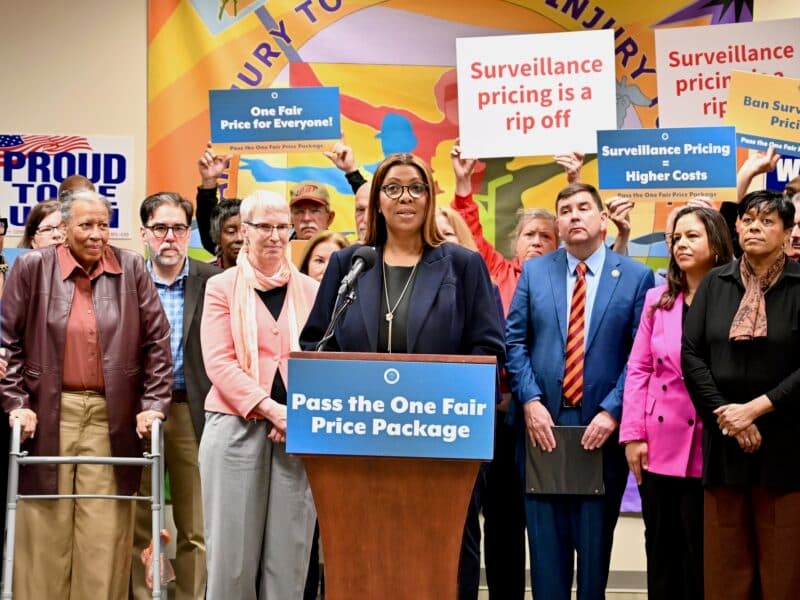
SYRACUSE, N.Y. (CN) — New York Attorney General Letitia James joined state lawmakers Tuesday to rally support for a pair of state consumer protection bills which would prevent companies from unfairly deploying so-called surveillance pricing, where customers' personal data is collected and then used to set fluctuating prices of goods and services for the person shopping.
The practice been found by the Federal Trade Commission to be used by a wide range of online retailers, pairing people's personal information with artificial intelligence-enabled algorithms to set targeted, tailored prices for goods and services based a person's location, demographics and online history, including individuals' mouse movements on a webpage.
"When it comes to Pampers and milk and eggs and the things that we all rely upon, there should be one price, and one price for all of us, and that price should be the same," James said at the rally. "The One Fair Price Package bans surveillance pricing that unfairly uses shoppers' personal data to raise prices while defending the fair discounts and promotions New Yorkers count on. We must pass this legislation to ensure one fair price for all."
Third-party intermediary tech firms enable companies to algorithmically tweak and target their prices based on personally identifiable information and data collected through online electronic surveillance technology.
James and New York Senator Rachel May joined elected officials, labor unions, advocates, and community members to support the One Fair Price Package.
The package James touted is comprised of two bills that would shield New Yorkers from surveillance pricing practices: The One Fair Price Act, sponsored by May and Assemblymember Emerita Torres, would ban surveillance pricing in New York, and the Protecting Consumers and Jobs from Discriminatory Pricing Act, carried by Deputy Majority Leader Michael Gianaris and Assemblymember Michaelle Solages, would ban the use of electronic shelf labels and prohibit surveillance pricing in grocery stores and pharmacies.
"Companies are using personal data, like browsing history, device type, and even device battery level, to charge people different prices for the same product," May said. "That kind of surveillance pricing is unfair, and we can't allow it. My bill bans it and ensures transparency in automated pricing, so consumers know they're being treated fairly."
Electronic shelf labels (ESLs) allow companies to change prices in-store, so that one shopper could buy a product like a gallon of milk at one price while another shopper might pay more for the same product later that day.
Under the proposed legislation, each instance of the use of personalized algorithmic pricing or an undisclosed automated pricing system would constitute a separate violation for purposes of calculating statutory and actual damages.
New York is among 12 states to have joined the United Food and Commercial Workers International Union's "Affordable Groceries and Good Jobs Campaign" to ban the predatory practice of surveillance pricing, target the encroachment of AI-driven technology in grocery stores, and deliver fair prices for families while preserving union grocery jobs.
Recently enacted state law already requires "clear and conspicuous disclosure" from businesses that set prices using customers' personal data, similar to other disclosure bills introduced in New Mexico (NM 285), Pennsylvania (PA HB 1779), and Texas (TX SB 2567).
Legislatures in Hawaii, Maine, Massachusetts, New Mexico, and New York have considered bills that would bar grocery stores or other food-related establishments from utilizing dynamic or surveillance pricing models.
California Attorney General Rob Bonta announced this year a probe into the use of personal data to set individualized prices, which the state found may trigger obligations under and even violate the California Consumer Privacy Act (CCPA), the state law that includes a "purpose limitation principle" limiting a business's use of personal information to purposes that are consistent with the reasonable expectations of consumers.