Nanoparticle shots helped Alzheimer's mice think more clearly
A South Carolina-led team engineered nanoparticles that convert brain support cells into working neurons, reversing memory loss in mice and offering a template for treating Alzheimer's in people.
(CN) — Mice with Alzheimer's disease symptoms that once struggled to build a proper nest or navigate a water maze started doing both again after two shots of an experimental nanoparticle treatment, scientists say in a new study.
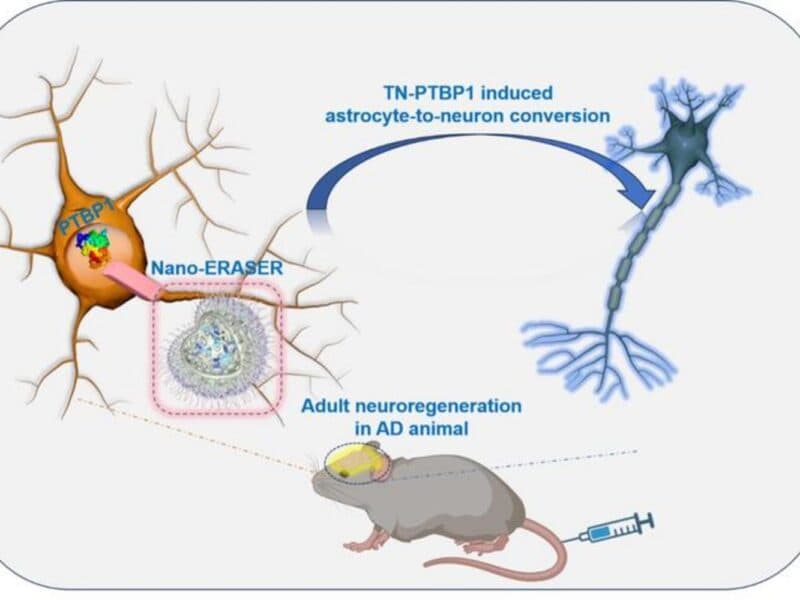
Researchers at the University of South Carolina reported Wednesday in Cell Biomaterials that the treatment, a polymer nanogel system called Nano-ERASER, regenerated neurons in human brain organoids and restored damaged neural circuits and cognitive function in mice.
Their findings suggest a potential way to do more than slow the effects of Alzheimer's by helping the brain regenerate neurons that have been lost.
Alzheimer's kills off neurons, the cells that carry signals through the brain. Existing treatments can slow disease progression, but the adult human brain has a limited capacity to repair or replace neurons once they're gone. Closing that gap is what Xu's team set out to do.
Their approach targets astrocytes, star-shaped support cells abundant throughout the central nervous system that don't normally function as neurons. The engineered nanoparticles cross the blood-brain barrier, the tight boundary that keeps most drugs and molecules out of the brain, and enter those astrocytes directly.
Once inside, the particles deploy antibodies that break down a protein called PTBP1. Reducing that protein triggers the astrocytes to convert into neurons instead.
"The new neurons can become mature and survive," said Peisheng Xu, a professor of pharmaceutics at the university and the study's corresponding author. "We also confirmed much higher neuron density in the brains of treated mice."
Unlike other gene-editing tools, Nano-ERASER doesn't alter a cell's DNA, and the cell reprogramming it triggers is reversible.
"We hope this can be more effective and also safer," Xu said. "We don't need to worry about the potential side effects caused on the genetic level."
The team first tested the treatment on human astrocyte cultures and organoids designed to mimic brain tissue affected by Alzheimer's. In both, reducing PTBP1 caused astrocytes to transform into neurons, and further tests confirmed the new neurons were functional.
Then they moved to live mice with Alzheimer's disease, tracking behavior over several weeks of treatment.
"After just two injections, these mice became smarter," Xu said. "Even after one injection, we already saw these mice's behavior differ from that of the nontreated ones."
Treated mice recovered their nesting skills and moved through a water maze more efficiently than before treatment, suggesting improvements in learning and memory.
Their brains also showed more neurons, less inflammation and lower levels of amyloid-beta, a sticky protein that builds up in the brains of people with Alzheimer's and is a characteristic of the disease.
The findings provide evidence that suppressing PTBP1 alone can trigger neuron regeneration inside a living brain, addressing a question that has been debated in regenerative neuroscience.
Xu noted the study doesn't show Nano-ERASER treats Alzheimer's in humans. He and his colleagues plan to test the platform's durability over longer periods, move into primates and then pursue human clinical trials.
"If we can advance it to the clinic, then we can have hope for patients with Alzheimer's disease," Xu said.