Multinationals Sold Kenyan Farmers a Lethal Harvest
European and US companies continued to sell pesticides abroad years after they were banned at home. Our reporter traveled to Kenya to learn how farmers are paying the price for these chemical products with their health — and how they're fighting back.
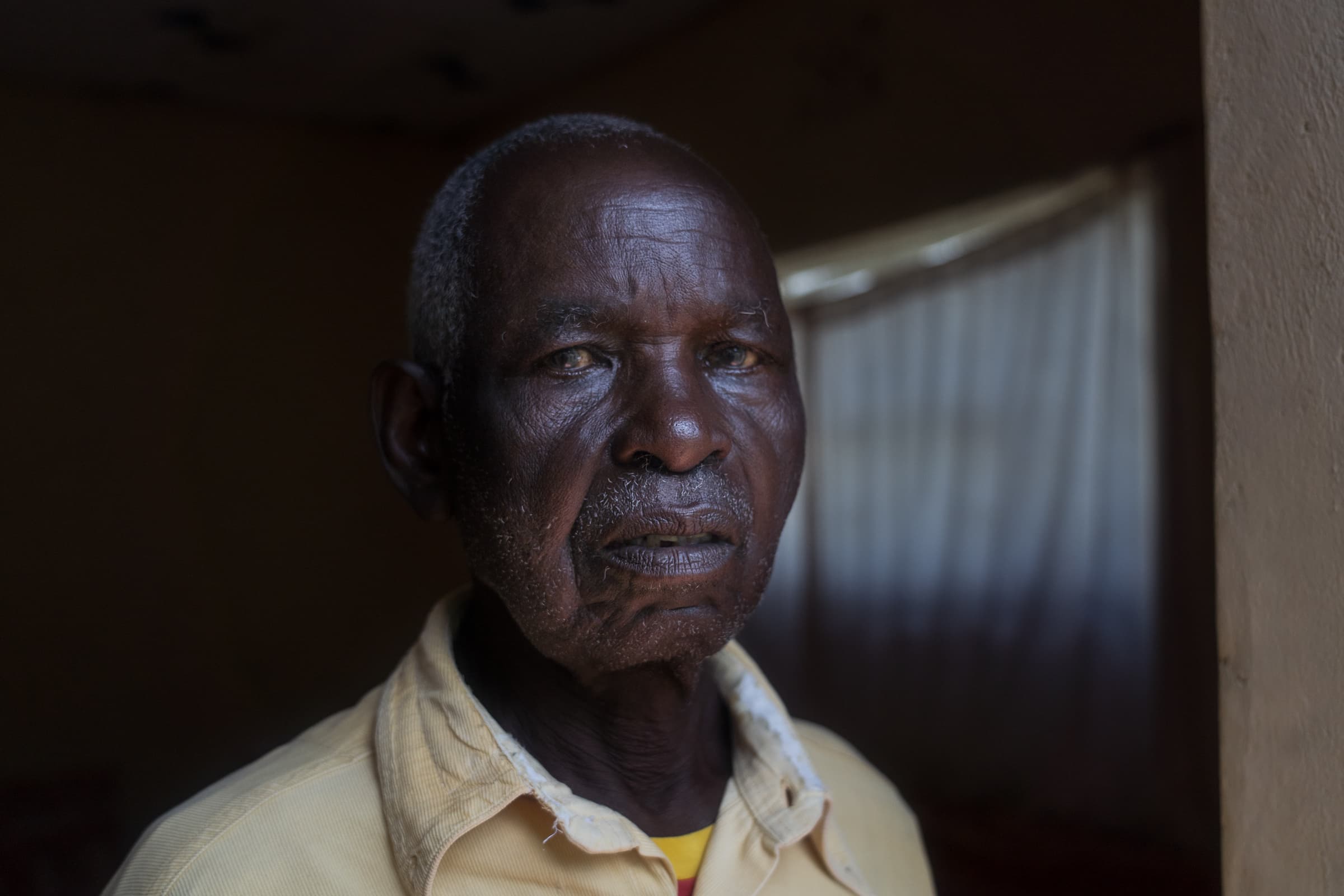
The word dawa, Swahili for "medicine," threads through Francis Marete Mboroki's speech as he describes the chemicals he spent decades spraying across his small farm on the fertile slopes of Mount Kenya. They were sold as the tools of progress: modern seeds, bigger harvests, prosperity.
Even as European and US regulators banned or restricted these chemicals at home, Mboroki kept spraying them, unaware they could be poisoning him. Today his doctors believe those pesticides caused the throat cancer slowly consuming his body. "If I knew these pesticides caused cancer, I wouldn't have used them at all," the seventy-nine-year-old says. "But no one ever informed me of the dangers."
A slight man with heavily calloused hands, Mboroki has farmed nearly his entire life. Before pesticides, he relied on indigenous pest-control methods passed down through generations: seeds stored in underground granaries lined with medicinal leaves, ash from cooking fires dusted over crops, manure used to nourish the soil.
"The indigenous crops grew well," he says softly, hands clasped in his lap. "We weren't rich from them, but we always had enough. The food was nutritious."
Mboroki is now one of eighty-seven Kenyan farmers and farmworkers who have joined a landmark constitutional petition in Kenya's courts. Many are battling cancers, respiratory illnesses, and neurological disorders they believe are tied to decades of pesticide exposure. The case represents the country's first major legal challenge to the multinational corporations that continued marketing these chemicals in Kenya long after they were banned or restricted in their home countries.
"We never imagined these chemicals could kill us like this," Mboroki adds. "The people where they came from were protected from them. Here we are only discovering the danger after they already made us sick."
As Mboroki grew up in rural Kenya in the 1950s and '60s, he had no idea that a postwar transformation was underway in the West within the chemical industry. Companies that had manufactured synthetic compounds for military purposes during World War II repurposed them for agriculture, selling pesticides as the future of farming.
At first, it was not purely a commercial project. Beginning in the 1940s, the Rockefeller and Ford Foundations funded the plant-breeding programs that became the Green Revolution, introducing high-yielding wheat and rice varieties across Mexico before expanding into India and Pakistan. By the mid-1960s, cereal yields on the Indian subcontinent were nearly 60 percent higher than they had been two decades earlier, helping avert the famines many had predicted and, by some estimates, saving up to a billion lives.
But the gains came at a cost. The new seeds depended on fertilizer, irrigation, and increasing amounts of pesticides. As yields rose, so did farmers' reliance on purchased inputs. In time, soils became degraded and water supplies dwindled, laying the foundations for the corporate control of agriculture that followed.
Scientific evidence soon began to implicate the industry's own products. Across Europe and the United States, research linked many of the chemicals to cancer, reproductive harm, developmental disorders, neurological disease, and ecological collapse. But as restrictions spread, the chemicals did not disappear.
Instead, many found new markets in the Global South, carried alongside this agricultural model built on monocultures, hybrid commercial seeds, synthetic fertilizers, and chemical pesticides. Across Africa, these packages continued to be promoted as the path to modernity, higher yields, and prosperity.
In Kenya, the shift accelerated through the 1980s and '90s as imported hybrid seeds were promoted through radio, agricultural supply stores (known as agrovets), and government extension campaigns, each variety tied to its own chemical package — marketed as dawa.
"You couldn't go anywhere without hearing about these new seeds and the medicine [chemicals] that came with them," explains Mboroki. "On the radio, at the markets — that's all they talked about." He lets out a dry scoff and shakes his head. "All of us embraced it. We thought it was going to make us rich."
In 2006, the model was formalized when the Bill & Melinda Gates and Rockefeller Foundations launched the Alliance for a Green Revolution in Africa, or AGRA, promising to double yields and incomes for thirty million smallholder households. It promoted the same input-intensive model of agriculture built on commercial seeds, synthetic fertilizers, and pesticides, even as many of the chemicals it relied on were already being restricted in the countries that produced them.
In one sense it succeeded: commercial seeds spread through subsidy programs and village extension officers. What never arrived, however, was the promised prosperity. By AGRA's own 2020 deadline, neither yields nor incomes had doubled, and across its priority countries the number of hungry people had risen, leaving farmers with debt, degrading soils and dependence on inputs they could no longer afford or abandon.
For Mboroki, the true consequences arrived decades later.
In the front room of his concrete house in Meru County, chemotherapy printouts, hospital receipts, and lab reports lie scattered across a table. Together they document paraquat and glyphosate in his urine at eighty-eight and twenty-one times the international reference limits.
Glyphosate — the active ingredient in Roundup, developed by Monsanto and now owned by Bayer — was classified by the International Agency for Research on Cancer (IARC), part of the World Health Organization (WHO), in 2015 as "probably carcinogenic to humans," yet remains legal across much of the world.
Switzerland, home to Syngenta, had outlawed paraquat, a weed killer that can be fatal after a single swallow, from its own fields in 1989. Two decades later, in 2007, the EU also banned it. Chronic paraquat exposure has been linked to Parkinson's disease and kidney failure. Yet Syngenta kept manufacturing it for export to Asia, Africa, and the Americas.
The Paraquat Papers revealed in 2021 that Syngenta knew for decades of evidence linking paraquat to brain and nervous-system damage, suppressed its own internal findings, and worked covertly to influence regulators. Earlier this year, facing thousands of US lawsuits, the company announced it would close its last paraquat facility in Huddersfield, England, by the end of June 2026.
Dimethoate and chlorpyrifos — organophosphate insecticides from the same chemical family whose development produced the first nerve agents — were linked to neurological, endocrine, and reproductive harm, and were removed from the European market in 2019 and 2020. In the United States, chlorpyrifos was pulled from food crops in 2021 over harm to children's developing brains but was reinstated in 2023 after a federal court overturned the ban, and it continues to be used on a wide range of food crops.
Unaware of the risks, Mboroki sprayed his maize, beans, and coffee with products like Gramoxone, Roundup, dimethoate and Karate — with no mask, gloves, or protective gear.
The imported hybrid seeds initially produced higher yields, Mboroki says, though many farmers say the crops lacked the nutrition of those they replaced. But they could not be reliably replanted: seed saved from one season often produced weak harvests the next, forcing farmers to buy new seed, fertilizer, and pesticides for each growing season.
Drought-hardy traditional staples that had sustained communities for generations — sorghum, finger millet, cowpea — disappeared from fields and markets. Land that had once produced reliably became harder and less fertile, demanding ever more fertilizer for the same yields. To stop buying the chemicals was to gamble with the next harvest.
"Before, the yields were lower, but the crops were nutritious," Mboroki tells me. "Then the yields become higher, and everybody is now getting sick. But we have no choice. Our indigenous seeds in this area are mostly gone. We can only plant what is available now, and those crops depend on the chemicals. If we stop spraying, they won't grow."
This dependence extends beyond individual farms. Kenya's pesticide imports rose from 6,400 metric tons in 2015 to 15,600 metric tons in 2018. A 2023 Route to Food Initiative report found that 76 percent of pesticides sold in Kenya contained at least one highly hazardous ingredient, while 44 percent of the pesticide volume consisted of products already banned in Europe. Safer biopesticides were just 2 percent of the market. Five companies led the sector, headed by Switzerland's Syngenta and Germany's Bayer. Nearly 68 percent of Syngenta's pesticide volume in Kenya was classified as highly hazardous.
The Swiss organization Public Eye, with the Greenpeace UK unit Unearthed, found European companies filed notifications to export roughly 122,000 metric tons of pesticides in 2024 containing seventy-five active ingredients banned on European farms — a 50 percent increase from 81,000 metric tons in 2018. Roughly 9,000 metric tons were bound for Africa, with Kenya alone set to receive 473,000 kilograms.
None of that was visible from Mboroki's farm in the eastern highlands. The scientific studies, regulatory restrictions, and legal battles unfolding abroad were far removed from the Kenyan farmers using the chemicals every day.
Mboroki pauses, staring through the open doorway toward the patchwork of green fields beyond. "I've learned the hard way that you should never go looking for gold," he says, almost to himself. "There's never gold on the other side of promises."
Older residents across Meru say cancer was once so rare that people often associated it with witchcraft; today many describe cancers, respiratory illnesses and neurological problems as commonplace.
For Dr Zakayo Thaimuta, a forensic pathologist at the University of Nairobi who codeveloped a screening method for pesticide-related illness, the pattern became impossible to ignore. "There is a very sharp spike in cancer in Meru," says Thaimuta, a Meru native who has watched the trend unfold firsthand. "The levels are far outside anything you would expect to observe in a normal population."
In a study of seventy farmers in the Meru village of Mbaria last year, Thaimuta and colleagues found that all of them carried paraquat in their blood and urine. Within the group, he documented clusters of respiratory disease, kidney failure, liver damage, anemia, Parkinson's disease, and profound toxicant-induced immunosuppression.
Local clinics, however, lacked the diagnostic capacity to identify chemical injuries, and many cases were repeatedly misdiagnosed. "Chemical pharyngitis [severe throat inflammation caused by airborne pesticide exposure] was consistently misidentified and treated as pneumonia," Thaimuta explains. "When patients failed to respond to pneumonia treatments, doctors routinely rotated them onto tuberculosis treatments." When those failed, patients were referred to specialized medical centers in Nairobi.
Of the seventy farmers in Mbaria, only two could afford the trip. The undiagnosed never enter the medical record.
This blind spot has masked the rapid development of toxicant-induced pulmonary fibrosis, Thaimuta says. Driven by paraquat accumulating in the lungs' alveolar cells, the disease scars lung tissue, leaving victims unable to oxygenate their blood. It was the most pervasive severe injury found across the cohort.
Thaimuta describes a sixteen-year-old boy whose mother spent more than twenty years on pesticide-intensive farms. The teenager tested positive for paraquat and glyphosate, suffered kidney failure and severe reproductive abnormalities, and later had his testes removed. Thaimuta suspects the teenager's exposure began in the womb and continued through breastfeeding, raising concerns that the effects of the pesticides may already be crossing generations.
"Collecting the history around these places, you will find that they have experienced many deaths, some of which have not even been documented," Thaimuta tells me. "And I'm afraid that most of these deaths are related to exposure to these chemicals."
Nancy Wanjiru, seventy-two, is among the people behind those statistics. She spent thirty years with a sprayer strapped to her back. For five of those years, she worked at Ibis Farm, a high-altitude vegetable farm operated by Flamingo Horticulture Kenya Ltd. There she sprayed crops destined for British and other European supermarket shelves, including Tesco and Marks & Spencer. For the remaining twenty-five years she sprayed for local farmers, working almost every day without a mask or gloves.
Wanjiru had little reason to question what she was handling. "I never thought it was harmful," she says from her small home in rural Meru. "There was no basic education about the chemicals. And you could not ask too many questions."
"The pay was very little," she adds, "and if you caused problems or complained openly, someone else would take your place."
Years ago, her health began to deteriorate: chest pain, weakness in her arms and legs, tremors, hands too weak to grip, failing eyesight, and stomach problems that eventually required surgery. Doctors told her the cause was the pesticides she had sprayed for decades. She now depends on her children to survive.
"If I didn't have my children to help me and take me to the hospital," she says, "I would have surely died by now."
Nowhere is exposure more direct than on Kenya's flower farms, where workers spray chemicals banned in Europe onto blooms cut, boxed, and flown to European supermarkets the next morning. The trade exploits a regulatory gap: cut flowers are ornamental, not food, so the EU, UK, and United States set no pesticide residue limits for them. A rose grown with a chemical banned on European farms can be sold freely in a European shop the next day because, unlike screened fruit and vegetables, it was never meant to be eaten.
Stephen Muriungi, forty-seven, spent two and a half years as one of these workers. At an export-oriented flower farm he sprayed cut blooms daily with a mix of organophosphates banned in the EU, including dimethoate and chlorpyrifos. He wore no protective equipment, earning 9,000 Kenyan shillings a month (about $70).
When that contract ended, he spent another year spraying for smallholder farms, earning 250 to 300 shillings a day — less than $3. "You could feel the chemicals entering your body, but the reactions did not seem serious at first, so we just kept working," Muriungi tells me. "After a while, I could smell the chemicals coming out through my sweat."
Then his body began to swell. First his legs, then his torso, then his hands. He gradually lost the ability to walk and speak normally. "It felt as if my skin was on fire," he says, lifting his trousers to reveal what appear to be chemical burns running down both legs.
"For the last three years, I have not been able to work," he continues. "I still struggle to walk and sometimes it's difficult to speak. My hands shake and my legs are in constant pain."
Doctors tested him for tuberculosis and HIV; both came back negative. No diagnosis followed. "Up to now, the doctors have never been able to tell me exactly what I'm suffering from," Muriungi says. The link to pesticides emerged only after a doctor connected his symptoms to other agricultural workers.
He now lives in his sister's house, where she feeds and bathes him on the days he cannot manage. "This has caused me so much pain and misery," he says, slumped on a bed inside a cramped one-room shack on his sister's property. "I have been left to deal with this alone. The companies are not helping me, my former employers are not helping me, and neither is the government."
Muriungi's case is not unique in Kenya. In Naivasha, ninety kilometers northwest of Nairobi and the center of the country's flower industry, advocate Gilbert Njoroge arranged testing for sixty-three flower-farm clients; fifteen showed dangerously elevated levels of glyphosate and paraquat. In Thika, legal advocates represent more than one hundred cancer patients who trace their illnesses to flower plantations, where workers describe mixing chemicals with bare hands and being issued little more than gunny bags and dust masks.
In a region where nearly everyone depends on farming, avoiding the chemicals feels impossible.
"The doctors tell me to stay away from the pesticides," Muriungi says. "But I still smell them everywhere — in food, when I walk around, when people are working nearby. It affects me so much."
Wanjiru and Muriungi are among the petitioners named in a constitutional case before Kenya's Environment and Land Court. The petition — Petition E048 of 2022 — seeks the withdrawal of harmful pesticide active ingredients, including glyphosate, paraquat, chlorpyrifos, and imidacloprid, a widely used neurotoxic insecticide. Several are classified as highly hazardous under the joint criteria of the United Nations Food and Agriculture Organization (FAO) and the WHO; several of the others are banned in the EU over risks to human health and pollinators.
It names fourteen respondents, including the local subsidiaries and distributors of Monsanto, Syngenta, Bayer, and BASF, along with Twiga Chemicals, the Agrochemicals Association of Kenya, and several state regulators. The petition argues that they failed to warn farmers and consumers and allowed hazardous pesticides to remain on the market long after their risks were clear.
When Wanjiru's urine was tested this year as part of the case, paraquat came back more than ninety times the reference limit and glyphosate more than twenty. Every other petitioner whose urine was tested also showed both chemicals above laboratory reference levels, with no exceptions.
Paraquat readings reached more than five hundred times the reference limit, while glyphosate readings reached up to 128 times. Two independent international laboratories corroborated the findings.
"When I learned these chemicals were banned in Europe," Wanjiru says, "I could not understand it. If they are too dangerous for the people there, why are they being sold to us here? And where is our government? Isn't it supposed to protect us?"
Last year the court granted the petition class-action status, ordering the case advertised in national newspapers so that any Kenyan claiming harm from the chemicals could join. "Thousands of Kenyan farmers and consumers who have been directly or indirectly affected by these highly hazardous pesticides now have legal recourse similar to that accorded to American citizens," says Kelvin Mugambi Kubai, the advocate heading the case.
In the United States, Bayer has paid more than $10 billion since acquiring Monsanto in 2018 to settle claims that glyphosate-based Roundup caused cancer, while tens of thousands of cases remain active in US courts. Kenyan farmers have used the same chemical for decades. Yet while US plaintiffs have secured settlements and jury awards, Kenyan victims have received neither compensation nor acknowledgment from the companies involved.
Beyond withdrawing the pesticides, the petitioners are seeking compensation for those already sickened, court-ordered medical coverage for affected communities, and a declaration that both the state and the manufacturers violated Kenyans' constitutional rights to life, health, and a clean environment by allowing the products to remain on the market. The companies and government agencies named in the case deny the chemicals are unsafe.
"The [Kenyan] government's response has largely been to shift responsibility onto the users rather than acting as a regulator," explains Kubai. "They blame the victims and say that if the pesticides had been used properly, these harms would not have occurred."
"The industry often talks about safe use, but that assumes a level of protection that simply does not exist for many smallholder farmers," he continues. "When highly hazardous pesticides are used without adequate safeguards, exposure is not an accident. It is a predictable outcome."
Last year, the Kenyan government announced the withdrawal of seventy-seven pesticide products, the restriction of 202 others, and the suspension of 151 pending further review following the Pest Control Products Board assessment of 430 products on the market. Many of the chemicals targeted, however, had already fallen out of use or been banned globally decades earlier. Campaigners welcomed the review but argued it left the pesticides of greatest concern largely intact. Glyphosate and paraquat — the two chemicals most heavily detected in the petitioners' urine — remained on sale, while chlorpyrifos was merely restricted to termite control rather than withdrawn altogether.
For Silke Bollmohr, an ecotoxicologist whose 2023 Route to Food Initiative study documented the scale of highly hazardous pesticide use in Kenya, the key question is why some hazardous pesticides were targeted while others were not.
"What remains unclear is why the government chose to ban specific products that seem to protect export markets and look good for the public, while leaving high-use, health-ravaging pesticides on the market," she says. The chemicals left on the market, she adds, are killing pollinators and soil life — the foundation of resilient food production — placing farmers under further pressure.
Bollmohr believes the move was driven as much by efforts to safeguard export markets as by concerns about human health. Kenyan agricultural exports, including coffee, have faced restrictions and rejections abroad over pesticide residues, raising questions about whether protecting export markets has taken precedence over protecting the health of Kenyan consumers and farmworkers.
For Kubai, the withdrawal reinforces the case. "It appears the government is agreeing with the gist of our petition," he tells me. "These pesticides are highly hazardous and should not be sold within the Kenyan market."
The move, he argues, also undermines the claims that tighter regulation would cripple agriculture. "The government has spent years arguing that banning these pesticides would devastate the sector," he says. "Yet dozens have now been withdrawn, and that disruption has not occurred."
The contamination does not stop at the edge of the field. It moves through soil and waterways, enters food supply chains, and travels hundreds of kilometers from the farms where it was first sprayed. Tomatoes grown in Meru are sold in Nairobi. Rice cultivated in central Kenya is distributed across the country. By the time the chemicals arrive on dinner tables, they are no longer a problem confined to farmers — they have become part of the daily diet of millions of Kenyans.
"Herbicides are omnipresent," says Thaimuta, from the University of Nairobi. "They are everywhere." Rainfall and runoff carry paraquat far beyond where it is first applied, and once in the water it moves downstream.
"If water in Mount Kenya comes into contact with paraquat, it will be transported downstream," Thaimuta says. "Anybody who eats fresh vegetables and fruits would likely have these chemicals in their blood as well."
The sick farmers, he says, are only the most visible part of the problem. "What we know so far is just the tip of the iceberg. It's a growing health crisis. [These chemicals] contaminate the environment and the plants. And the consumers — the human beings — are paying a heavy price for it."
Rosaria Rigiri spent more than three decades spraying her Meru farm, raising onions, potatoes, beans, and maize. Two years ago, her hand began to swell, then came pain beneath her arm and breast. She was diagnosed with cancer and underwent a mastectomy; it spread, and a later scan found tumors in her brain.
At sixty-four she can no longer work and, in recent months, has experienced periods of unconsciousness. The family's livelihood has gone into scans, surgery, and chemotherapy — one course of medication alone runs more than 125,000 Kenyan shillings (more than $900) a month — and for over six months she has gone without treatment, because the family has run out of money.
Rigiri's urine showed paraquat more than sixty-six times the laboratory's reference limit and glyphosate more than fifteen. She learned what the chemicals had done to her only when researchers came to the village and explained it.
"As things are now, there is no possibility of stopping the chemicals," she tells me, seated in her home in Meru, where medicine bottles and blister packs crowd a table. "We know they are harmful, but if we stop using them, nothing will grow."
"I really wonder, if these companies can make these chemicals that kill us, why can't they make ones that are safe for human beings?"
Uncertainty hangs over the next generation, already stooped in the fields. Rigiri's daughter, forty-seven-year-old Lucy Makena, farms the same land — and has tested positive for the same chemicals herself.
"I'm very worried about my own health," Makena says. "I see my mother's situation, and she is the one who gave birth to me. I'm using the same pesticides that did this to her."
Yet she keeps spraying. "I don't have any choice. We can't grow anymore in the traditional way, and no one can shift to organic without outside or government support. I would give up farming to save my health, but there are no other jobs here. . . . We are stuck."
The family wears protective equipment when it can afford it, but Makena says that means little where every field is sprayed. "There's nothing you can do to protect yourself when the medicine [chemicals] are all around you," she says.
A community that once attributed cancer to witchcraft has become one where sickness no longer shocks anyone. Neighbors who once pooled money for a stricken family now have stricken families of their own. "Sickness has become a lifestyle here," Makena explains.
Even now, as Makena describes the cancer that has ravaged her mother's body and her fears of what the chemicals may do to her next, she keeps returning to the word dawa.
Rigiri listens quietly, visibly worn by fatigue. For decades, the pesticides promised bigger harvests and a better life. Now she watches her daughter walk into the same fields carrying the same chemicals — armed with the knowledge she never had, yet caught in the same trap.