Michael Is Not Rooted in Reality
The average successful Hollywood biopic is cynically dishonest and rote in its formulaic box-checking. Michael, the new film on the life of Michael Jackson, is all that and worse.
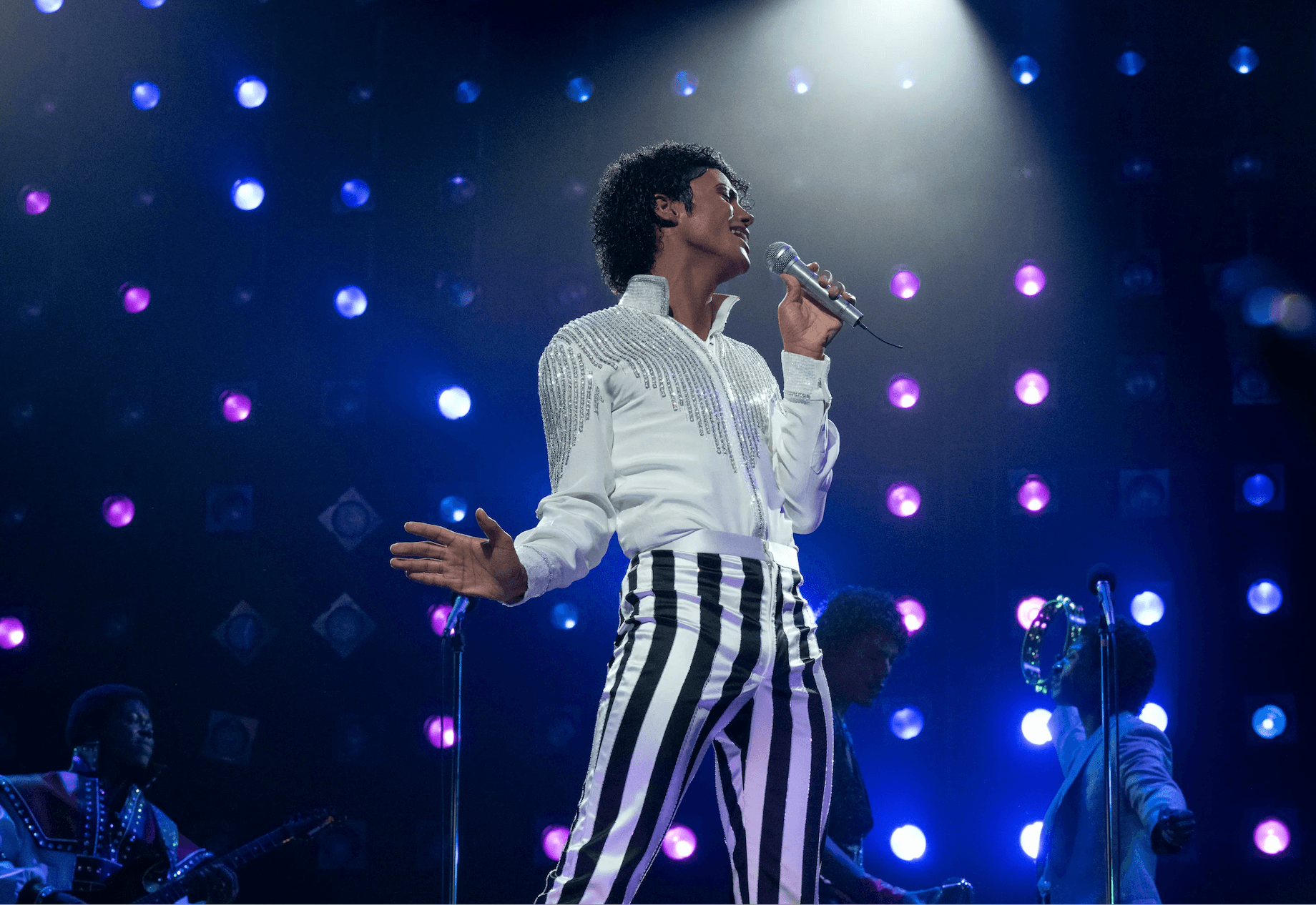
Michael, the new biopic of "King of Pop" Michael Jackson, has gotten scathing reviews, which it deserves. Nevertheless, it's a huge hit. This figures, in part because critics are more and more aware of the biopic as a rotten film formula, while the viewing public tends to like biopics, though they're just about the lowest form of all currently popular genres.
They're typically deliberately dishonest, sticking to rote fantasy narratives about saintly talented figures who withstand personal crises and societal prejudices in order to become stars of such unquestioned superiority, it's as if God himself had willed their canonization. The interesting, complicated, and controversial aspects of the celebrity's life and social circumstances are almost invariably suppressed.
In fact, one way of making a biopic that fails at the box office is to defy the formula and try to create something a bit more honest and complex. Looking at you Springsteen: Deliver Me from Nowhere (2025), a fascinating exploration of Bruce Springsteen's deep depression out of which he created his now-legendary Nebraska album. It was a box-office bomb.
Michael is even lower than the average successful biopic — more cynically dishonest, more rote in its formulaic box-checking. Michael covers Jackson's life up until the end of the Jackson family's fraught 1984 "Victory Tour," after which Jackson went completely solo. Ending there, as everyone knows, prevents screenwriter John Logan (Skyfall, Sweeney Todd, Gladiator), director Antoine Fuqua (The Equalizer franchise, Training Day), and the rest of the filmmaking team from having to deal with the many accusations of child sexual abuse brought against Jackson.
As Jackson's daughter Paris has said in bitter condemnation, the film made in cooperation with the Michael Jackson Estate is "sugar-coated" in a way typical of biopics:
A big section of the film panders to a very specific section of my dad's fandom that still lives in the fantasy, and they're gonna be happy with it. . . . The narrative is being controlled and there's a lot of inaccuracy and there's a lot of just full-blown lies. At the end of the day, that doesn't really fly with me. Go enjoy it. Do whatever. Leave me out of it.
Even more firmly determined to be left out of it is Janet Jackson, who's notably absent from the project, to the point that she's not portrayed in the film at all and hasn't commented publicly. La Toya Jackson is the only sister represented in Michael, and even as rumors of family dissension swirl, she speciously insists that there's no behind-the-scenes controversy.
The people involved with getting this film made and expecting to profit by it are both driving and benefiting from the "MJ renaissance" of recent years. I had no idea it was happening until this movie came out.
For example, I didn't realize there was a hit Broadway show called MJ: The Musical that's been running since 2022. The show is such a success, it makes apparent that there's been a kind of collective agreement in the entertainment world and the general public, since Jackson's death when public repudiation of him was at its height, to forget all about the twenty-five years of pedophilia charges brought by many, many people against Michael Jackson.
And this is happening in the era of Jeffrey Epstein, when indignation at the way privileged and powerful people get away with systematic rape and pedophilic abuse has been foaming over. So my question in response to all this unequivocal Michael Jackson love is: "Are you all crazy?"
Vast numbers of people are demonstrating that they still love Jackson — not just his music and performances but him — no matter how well-documented the many bizarre, sordid, and appalling aspects of his life are. Of course, there are Jackson songs that will give almost everyone in contemporary life the automatic impulse to leap to their feet and dance: "Billie Jean," "Beat It," "Thriller," "Don't Stop 'til You Get Enough" — you know the songs as well as I do. But the gushing fan reactions seem to indicate there are no longer any qualms at all about Jackson's shocking personal history that had once so badly tarnished his legacy; his premature death at age fifty seemed merciful.
At my local multiplex, the parking lot was full and crowds were going to see the movie in IMAX. One young black man was dressed in head-to-toe MJ-wear from his black fedora to his rhinestone-studded gloves to his high-water black pants, white socks, and black shoes — the outfit he wore when he awed everybody doing the moonwalk for the first time at the Motown 25: Yesterday, Today, Forever TV special in 1983. Admittedly, it's still a good look.
Such voluntary, selective amnesia is a real national tendency. Americans in particular embrace this delusional state, a kind of unspoken collective decision to give one special somebody a free pass. Otherwise, we're far more inclined to turn into torch-bearing mobs over any perceived infraction of what we claim to be our values. How many celebrity careers have been ended or seriously damaged in recent years because of accusations of sexual transgression that, though often heinous, don't amount to a fraction of what Jackson has been both accused of and charged with over the decades? Remember Louis C. K., for example? Or Al Franken?
Though, on the other hand, there's the case of Kevin Spacey, whose career has withered while he defends himself from numerous charges of sexual assault of young men and boys over many years. There are currently many predictions of a comeback that include statements by famous fellow actors calling for him to be reinstated as a top actor in his profession. Is a KS renaissance likely? He's never been convicted of any of the charges against him, in either US or UK trials, in case you're mentally noting that Jackson was acquitted of charges of sex crimes against children in his 2005 trial.
Like Jackson, Spacey "settled out of court" with several accusers. This just happened in March 2026 as a result of the civil charges brought by three men against Spacey when criminal charges failed to get a conviction.
As part of his testimony in the UK case brought by actor Anthony Rapp, Spacey retracted his earlier claim that he didn't remember any sexually aggressive behavior toward the then-fourteen-year-old Rapp, but apologized if he'd committed it, because it would've been part of his "deeply inappropriate drunken behavior" over the years. In general, Spacey has blamed his upbringing for any of his transgressive sexual behaviors because of his twisted home life as a child: "My father was a white supremacist and neo-Nazi. . . . It meant that my siblings and I were forced to listen to hours and hours of my father lecturing us about his beliefs."
Also similar to Spacey's case is the way more accusers keep emerging, keeping the saga of Jackson's sexual transgressions current and roiling. Practically running alongside articles about the huge box-office success of Michael are reports of the Cascios, brothers Dominic, Aldo and Eddie and sister Marie Nicole Porte, who have brought forward new charges in a lawsuit filed in February that details their childhood sexual abuse at the hands of Jackson.
In his lifetime, Jackson seemed eager to share with the public his deeply troubling relationships with children that tended to involve public rationalizations for his Neverland "lifestyle." That included regularly sleeping with the children, usually small boys, whose company he openly sought:
[I]n reputationally disastrous interviews around that time, Jackson repeatedly defended his habit of sleeping in the same bedroom with other people's children: "Why can't you share your bed?" he asked the journalist Martin Bashir in a 2003 television special while holding hands with 13-year-old Gavin Arvizo, who would later accuse him of abuse.
We're all familiar with the story of Jackson's lost childhood, sacrificed by his abusive father, Joe Jackson, who forced him and his brothers into a life of performing as the ultrasuccessful family band. the Jackson 5. That narrative has always been offered as the explanation of Michael Jackson's creepy fixation on little boys and perpetual immaturity, and it's central to the movie Michael.
In the film, the villain of the piece is Michael's controlling father, Joe, played by Colman Domingo in a strangely exaggerated, even hammy, performance, which is odd given Domingo's tremendous acting skills. It seems probable that the direction called for extra villainy, to the point of moustache-twirling, if Joe hadn't had a pencil-thin John Waters–like moustache that couldn't be twirled. But watch the actual Joe in interviews and you see that he might be a bit ostentatiously dressed in flashy gold jewelry and accessories, but he's generally quiet, not at all flamboyant in speech or behavior, as he is in the film.
He was often asked about the abuse Michael charged him with, but both he and Katherine Jackson — Michael's beloved mother (played by Nia Long), noted for her gentle nature and devout religious views — defended their use of corporal punishment to discipline their ten kids. At one point in an interview with Piers Morgan, Katherine noted that it was a common practice among parents of their generation and added that it was necessary in order to raise well-behaved children.
"But sometimes if it wasn't for the strap, what would the world be like today?" she asked. It's a chilling statement by current standards, and there's no reason to doubt that most would agree that the Jackson kids were abused. But there were complications that included Michael's mother, and the larger culture.
In an Oprah Winfrey interview with Michael's parents, Winfrey acknowledged the practice of "whippings" in the specific context of black culture in America for certain generations:
Oprah announced, "I was beaten as a kid because that was the culture, that was the way we were raised." [ . . . ] Michael's mother Katherine said, "You might as well admit it: that's the way black people raised their children."
No such complications are represented in Michael. Sociopolitical context is, as usual in biopics, brushed aside. For example, another criticism leveled at Joe was the way his children were raised in isolation, none of them playing outside or having friends, spending most of their time together inside, singing, dancing, playing musical instruments, and rehearsing their act.
In interviews, he always argued that, especially early on, he worked two jobs and they lived on what he could make as a welder in a rough working-class neighborhood in Gary, Indiana, where widespread financial precarity meant there was a lot of street crime putting children at risk. He and Katherine were determined to keep their kids off the street.
I find these reality-check accounts to be of absorbing interest when considering the life story of Michael Jackson, and I state that as a fan of his stellar performing talents going way back. My first record album — the Jackson 5's Maybe Tomorrow — was a gift for my ninth birthday, and a few years before that, Michael Jackson was my first human crush. (Bugs Bunny preceded him.) I don't struggle to balance my affection for his music and aspects of his stardom with the grimmer realities of his personal life, but many fans do.
An op-ed published in the New York Times entitled "Why I Still Love Michael Jackson" is a combination heart-cry and earnest rationalization that can stand as Exhibit A in a particular type of tortured fandom dealing with the release of this film. The author, Nekesa Mumbi Moody, attended the Los Angeles premiere of the film, but asks herself, "How could a proud black woman, a professional journalist no less, rep for him so hard? Still?"
She charts how intertwined Jackson's music is with her life and the lives of black people in America with its extraordinary music and performing arts history. She acknowledges the miserable complicating realities of not being able to sustain being "an expert Jackson defender" after a certain point in his scandal-plagued trajectory. But she comes out in the end thinking that after absorbing and acknowledging all the troubling aspects of Jackson's life and stardom, "maybe it's okay to be an out and proud Jackson fan again," still holding on to her Jackson memorabilia and adding to it now that there is an "MJ renaissance."
But it's doubtful that the vast majority of audience members flocking to see Michael are experiencing any such qualms. As part of the film's strategy of catering to the fans, a sequel is promised. The final image in Michael, of the ecstatic face of Michael Jackson as a young man in freeze-frame as he contemplates a dazzling future free of his obsessively ambitious and cruel father, features the superimposed words "THE STORY CONTINUES." It makes clear the temptation to go on with the lucrative Michael story is overwhelming. Are they really going to try to deal with the sickening scandals of Jackson's later life, which are impossible to avoid entirely?
There are lesser weirdnesses about Jackson's life that are already being built into the narrative of Michael. The plot setup for Michael's incapacitating drug addictions, resulting from the pain he endured when his hair caught on fire during the filming of a Pepsi commercial, leading to many surgeries and an increasing reliance on pain pills. The first of a long series of plastic surgeries is represented as well as an explanation for what was later rumored to be skin-whitening treatments — apparently to treat his vitiligo, a condition which creates a loss of skin pigmentation.
In the end, these surgeries and treatments left him looking like an almost-noseless variation on the Phantom of the Opera. And the film lays the foundation for Jackson's ever-creepier state of isolation at Neverland, his estate running like a mad version of a personal Disneyland with touches of Citizen Kane's Xanadu, including theme park rides and a personal zoo, costing so much to maintain that it strained even Jackson's immense wealth to keep it going.
In Michael, the beginnings of the Neverland obsession are ostentatiously planted as adorable in the form of his love of the Disney Peter Pan character and a very badly CGIed Bubbles the chimp as a diapered baby. That's just one of Michael's many exotic animal pets that the film includes for their supposed cuteness, as if the world is a child's storybook and it's an endearing practice in real life to keep a full-grown python in your house and a giraffe in your yard.
But even if the film's creative team can find a way to spin all that, there's still the twenty-five years of accusations of pedophilic abuse against Jackson. The alleged victims were believed by many, perhaps even by the majority, at the time of Jackson's death in 2009. Back then, there seemed to be nothing stopping a very different progression of public disgust, which made Jackson something like the Jimmy Savile of the United States.
Savile, if you recall, was the super popular English entertainer and host of the long-running BBC show Top of the Pops. His extensive charity work made him an even more beloved figure. Then, after his death, hundreds of allegations of child abuse and the rape of minors as well as the elderly — ignored by the justice system and the public in his lifetime, while treated as common knowledge in the music industry — were finally investigated.
It was too late to try Savile in a court of law, much less mete out legal punishment. But the accounts of his victims, plus a wide array of witness statements, were gathered and taken seriously. Savile was revealed to have been a rampant sexual predator for sixty years, enabled by his celebrity and his charity work, with countless victims who were children when he raped them.
As a result of the scandal that followed, he's been thoroughly reviled in the UK as "a sickening and prolific sexual abuser who repeatedly exploited the trust of a nation for his own vile purposes." His former fans disavowed him, honors he'd been given were posthumously revoked, and his TV appearances were withdrawn from circulation.
Yet the MJ renaissance rocks on. All of which is to say: good luck, Hollywood, with Michael, Part II. You're going to need it.