Macron 'rolls out red carpet' for Trump after months of geopolitical friction
After sparring for months, French President Emmanuel Macron will host U.S. President Donald Trump for dinner at the Palace of Versailles. Experts see a dual strategy in managing the complicated relationship.
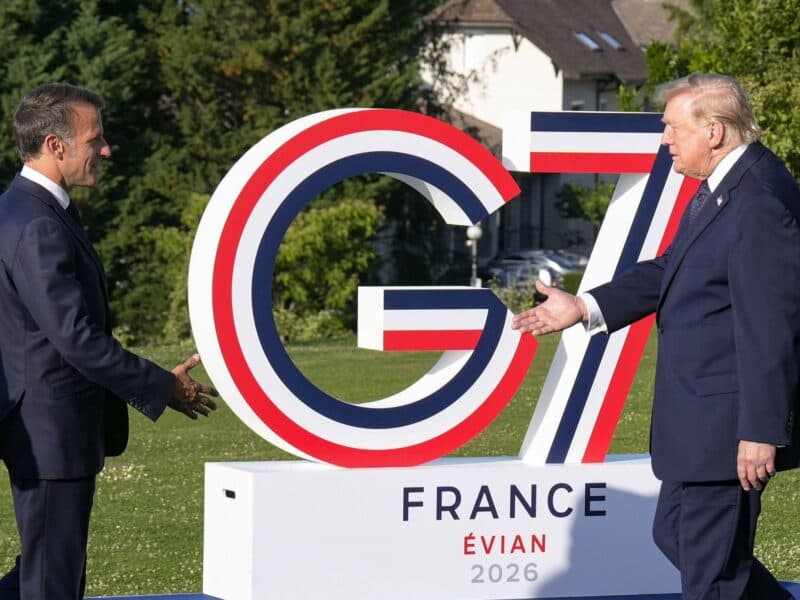
PARIS (CN) — Fresh off the heels of the G7 summit, French President Emmanuel Macron will continue the soft-power diplomacy tour on Wednesday night.
Despite months of geopolitical tensions, he invited U.S. President Donald Trump for a banquet at the Palace of Versailles to commemorate the longstanding transatlantic relationship.
"This isn't a gala dinner or anything like that … No, it's a dinner to celebrate the 250th anniversary of American independence, because France played a role in it," Macron said in an interview with the French station Tf1 on Monday. "This will be our moment to celebrate the friendship [between the two countries]."
However, the meeting comes against the backdrop of public discontent that Macron has been voicing for months. He has made no secret of his opposition to the Iran war, which the U.S. and Israel launched on Feb. 28 without consulting allies, including France, beforehand.
And amid a fragile ceasefire, the French president has repeatedly framed the country as reliable and loyal in an apparent contrast to the current U.S. administration.
"I call the relationship between the U.S. and France geopolitical theater, that for the cameras, it's a lot of 'we're friends, we're here to cut deals, we've been working together for a long time,'" Abishur Prakash, author of "The Great Fracturing: How Geopolitics is Breaking the World," said. "But in the background, they're not aligned on a single issue — there's immense friction between the U.S. and France."
Prakash recounted how France refused to send warships to support the U.S. effort on the Strait of Hormuz, which "completely strained the relationship," despite directing ships to the region in a defensive mission. On the economic side, just before the start of the G7 summit Monday, Trump threatened French wine with 100% tariffs if it refuses to scrap a digital services tax on U.S. technology companies.
Background tensions continued on Tuesday — on the sidelines of the G7 summit — when French Prime Minister Sébastien Lecornu announced the French group ChapsVision has been chosen to replace its intelligence services' existing contract with Palantir. The U.S. company, which reportedly learned about the change through the press, maintained their contract "remains fully in effect."
On the international stage, however, the strategy is to "shower Trump with praise," according to Prakash. This seems to extend to other European leaders; on Tuesday, German Chancellor Friedrich Merz gave Trump a customized soccer jersey with his name and the number 47, an apparent reference to his position as the 47th president of the U.S.
When Trump declared "I'm the boss" at a G7 roundtable meeting on Wednesday — despite Macron hosting the summit — his counterparts laughed convivially.
At the European level, Macron has a unique advantage in his relationship with Trump: time. The two met in 2017, when Macron took office and Trump was serving his first term. Since then, most of the EU leadership has changed.
"He's the one Donald Trump knows best, given that he knew him during his first term," Ludovic Renard, a political scientist at Sciences Po Bordeaux, said. "He has known him for a long time, so that gives French diplomacy a unique role."
Maxime Lefebvre, a diplomat and professor at the ESCP Business School in Paris, recalled that Macron has been trying maintain a relationship with Trump for years that could allow him to influence the U.S. position on Ukraine, for example.
"He doesn't want to be confrontational with the U.S., but at the same time he wants to defend French and European interests, including by being firm in certain circumstances," he said. "But he doesn't want to overplay this confrontation."
Critics are skeptical whether the balancing act will work.
"Macron, with this dual strategy of being in disagreement on the one hand, yet rolling out the red carpet on the other, sometimes lacks a certain consistency and credibility, both with his European partners and with French public opinion," Gilbert Casasus, a prominent political scientist, said. "In doing so, he's playing into Donald Trump's hands, in a way."
In Casasus' view, the relationship has been "a lot about playing with image" and "opulence" as a way to demonstrate a country's strength. This strategy seems to go down well with Trump, who commented that "Versailles is not gold-plated, it's the real thing" at the G7 summit, ahead of the dinner on Wednesday.
Despite their differences, the two leaders might have some traits in common.
"I think Trump is playing the strongman of the United States and Macron is trying to play the strongman of Europe," Casasus said. "What always strikes me about Macron, who is an intelligent man, is that in his international communications, he always puts himself at the center stage — and Trump does it too."