Legal heavyweights duke it out at high court over federalism
Each with dozens of arguments under their belts, the two esteemed attorneys left the justices seemingly divided in an otherwise lower profile appeal.
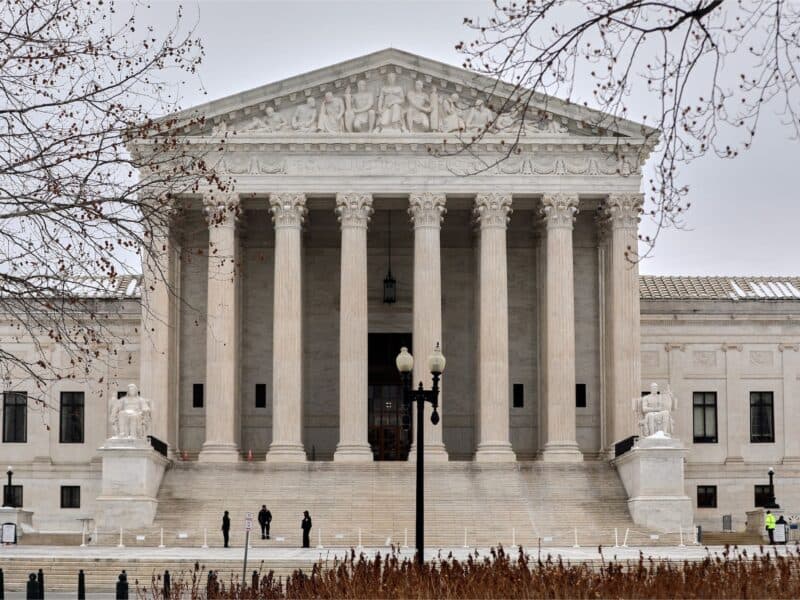
WASHINGTON (CN) — An under-the-radar dispute over federal jurisdiction turned into a Supreme Court showcase Monday as two veteran advocates dueled over federalism.
Former U.S. solicitor general Elizabeth Prelogar and legendary high court litigator Lisa Blatt have collectively argued nearly 100 cases before the justices — with the latter holding the record for the most of any woman in U.S. history.
Both women are acclaimed for their oral advocacy prowess, having stood at the podium in many high-profile disputes over the last decade. On Monday, however, Prelogar, now with Cooley, and Blatt, with Williams & Connolly, went head to head in a case absent from any list of closely watched appeals.
In T.M. v. University of Maryland Medical System Corp., the justices were asked to clarify the Rooker-Feldman doctrine, a legal principle limiting federal court jurisdiction over state court judgments.
Arguing in favor of a Maryland resident who was involuntarily admitted and medicated for psychiatric issues, Prelogar said a lower court erroneously dismissed her client's case under an expansive interpretation of the doctrine. She argued the decision prevented the woman identified as T.M. from seeking redress for violations of her federal constitutional rights.
"There is a significant value in ensuring that federal courts are available to vindicate federal rights, including when state court judgments themselves give rise to that kind of constitutional violation," Prelogar said.
On the other side of the aisle, Blatt, representing the University of Maryland Medical System, said the Rooker-Feldman doctrine existed for cases like T.M.'s. She argued that Congress channelled state court judgments to the U.S. Supreme Court and prohibited federal courts from reviewing them until the state's highest court weighed in.
"Petitioner's rule flouts that scheme and damages the integrity of the state appellate process," Blatt said. "Like Petitioner, litigants could jettison state court appeals and invoke the mandatory jurisdiction of 94 district courts to invalidate state court judgments."
The justices seemed equally critical of both arguments. Justice Ketanji Brown Jackson, a Joe Biden appointee, worried the court would disincentivize state court losers from proceeding in state courts.
"Why would anybody stay in the state system and get all the way to the state high court under your rule when they could just bring a collateral attack along the way?" Jackson asked. "It just seems to undermine the whole point in my view."
But Justice Elena Kagan, a Barack Obama appointee, said the court's 2005 ruling in Exxon Mobil Corp. v. Saudi Basic Indus. Corp was supposed to be the end of Rooker-Feldman altogether.
"If we issue a decision that goes your way," Kagan told Blatt, "We are basically saying forget Exxon, it wasn't the end of it; Rooker-Feldman is alive and well. And in the context of what's happening in the circuit courts, it seems like a very odd message for this court to be sending."
The technical argument hit a snag over whether to overrule Rooker-Feldman.
"Give me your best shot for overruling Rooker-Feldman," Justice Neil Gorsuch, a Donald Trump appointee, said, asking Prelogar to "sing a few bars for me."
Jackson balked at the court deviating from the question presented, but Prelogar said it wouldn't be completely unprecedented.
"There have been occasions, like in Dobbs, where whether to overrule Roe and Casey was not in the question presented," Prelogar, who argued for the losing side of the landmark case, said. "Citizens United is another example of that. So the court has sometimes, when it's delved into a doctrine, decided that it makes sense to reconsider precedent."
"This is not Dobbs," Blatt retorted, stating that other parties would have wanted to weigh in if they knew the doctrine could be overturned.
"You don't even have any state in front of you here so, no, you're not going to overrule Rooker," Blatt said, eliciting laughter throughout the courtroom. "I mean, sorry, I don't think you're going to do that. Not in an April case. Not happening."
"Don't dare my colleagues," Justice Samuel Alito, a George W. Bush appointee, interjected.
Despite any sharp barbs from the podium, Prelogar and Blatt appeared cordial and embraced each other following the argument.