Justices to reconsider power of federal sentencing advice
Judges may get more discretion over how they apply sentencing guidelines for criminal defendants.
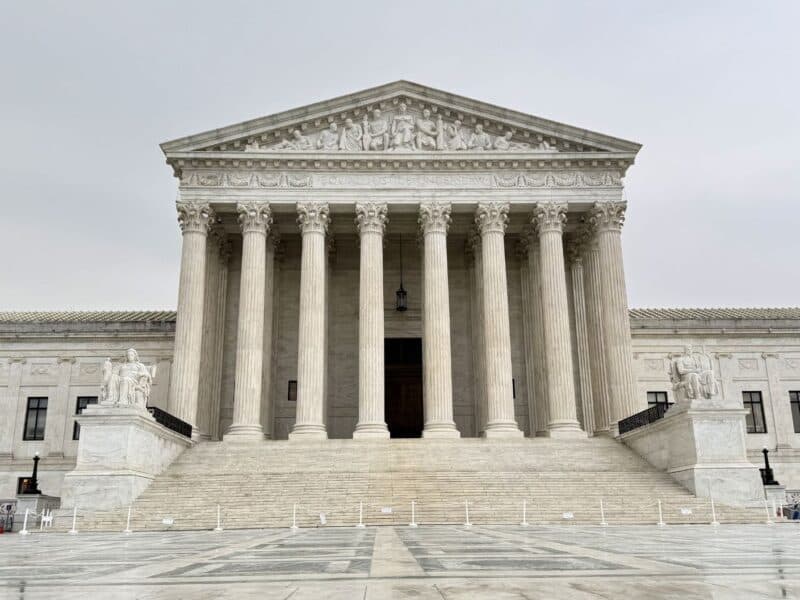
(CN) — The Supreme Court announced Monday it will take on a case that could significantly impact how federal sentencing guidelines are implemented.
Specifically, the high court will examine to what degree guideline commentary should be applied when sentencing criminal defendants — a question that has caused confusion among the circuit courts and led to unreasonable discrepancies in punishments.
The U.S. Sentencing Commission provides commentary to its guidelines, which advise judges on how to calculate an appropriate sentence based on the nature of the crime and the defendant's criminal history. The commentary serves to clarify the guidelines in the form of application notes, conclusions and background information.
In 1993, the Supreme Court held in Stinson v. United States that the commentary is binding and must be followed "unless it violates the Constitution or a federal statute, or is inconsistent with, or a plainly erroneous reading of, that guideline."
But as sought in the granted petition for review, the justices will reconsider whether this precedent still correctly states the rule for the deference that courts must give the commentary to the sentencing guidelines.
In his petition to the court, Kendrick Beaird claimed his sentencing was wrongly calculated to include an enhanced base offense level for unlawful firearm possession by counting a 17-round magazine attached to the firearm as a "large-capacity magazine."
Under the text of the sentencing guideline for the offense, an enhancement only applies to a "large-capacity magazine" but does not expressly define what that means.
However, the Sentencing Commission's official commentary defines the term to include a semiautomatic firearm that "had attached to it a magazine or similar device that could accept more than 15 rounds of ammunition."
Beaird objected to the enhanced range, arguing that the commentary defining "large-capacity magazine" to include any magazine that accepts more than 15 rounds of ammunition improperly expands the scope of the guideline.
In his view, the enhancement was intended to target weapons that are exceptionally dangerous and either inherently illegal, not industry-standard semiautomatic firearms.
He also noted a circuit split created by the justices' 2019 ruling in Kisor v. Wilkie, which cabined the level of deference courts afford to agency interpretations of their own regulations, including the federal sentencing commentary.
"When the courts' traditional tools of interpretation are exhausted, it becomes clear that a 'large-capacity magazine' refers to one that is larger than the industry standard," Beaird wrote in his petition for certiorari.
"A 15-round magazine (and a 17-round magazine, at issue here) is a perfectly ordinary sized magazine in the contemporary consumer market," he added.
Beaird argues the sentencing guideline manual is replete with commentary that interprets the guidelines in ways the reader would not predict from the text.
The Northern District Court of Texas overruled Beaird's objection, resulting in a sentence of 63 to 78 months' imprisonment.
In the government's perspective, the enhancement was justified. Beaird pleaded guilty to unlawfully possessing a firearm he had pointed at another person at an abandoned fast-food restaurant. At the time, he had four prior felony convictions: two for burglary of a habitation, one for possession of a prohibited item in a correctional facility and one for aggravated assault against a public servant.
Still, attorneys such as Cynthia Karnezis from the Georgetown University Law Center say the Stinson ruling has created inconsistent outcomes as many defendants have received severe penalties under the guidelines as a result of judicial deference to the commentary. Meanwhile, others have received the benefit of judges who, following the rule of lenity, find the commentary ambiguous or rule in their favor when they believe it disproportionately increases the defendants' sanctions.