Judges reject Alabama's redistricting plan as racially discriminatory
A federal three-judge panel prevented Alabama from using its 2023 congressional district map for this year's elections, ruling that the plan intentionally discriminated against Black voters in violation of the 14th Amendment.
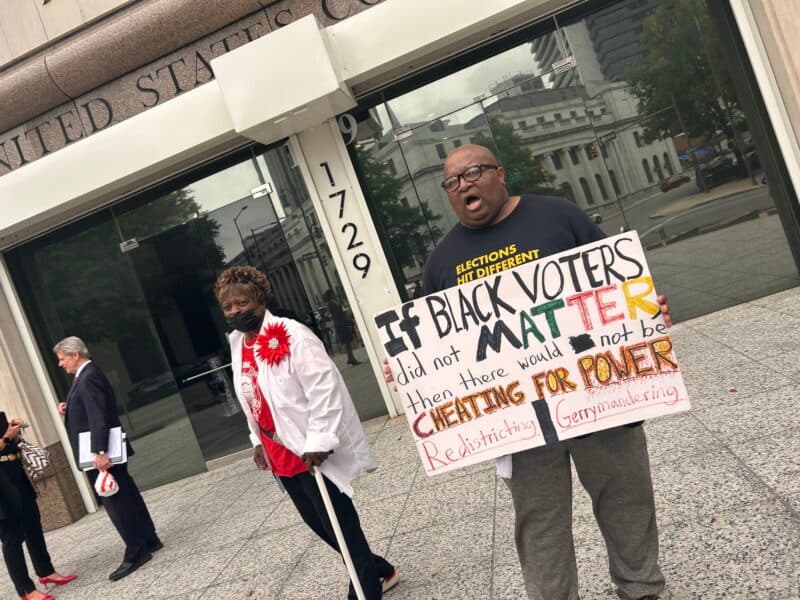
A federal three-judge panel prevented Alabama from using its 2023 congressional district map for this year's midterm elections, ruling Tuesday that the legislatively enacted plan intentionally discriminated against Black voters in violation of the 14th Amendment.
Following a lengthy hearing Friday, the panel ordered Secretary of State Wes Allen to administer all remaining 2026 election proceedings using a special master's race-blind remedial map that created a second Black-opportunity district. That map has already governed Alabama's 2024 elections and last week's primary for three of the state's seven congressional districts.
"We cannot see our way clear to requiring Alabamians to cast their votes in the 2026 elections under a districting plan tainted by intentional race-based discrimination," the judges wrote in a sweeping 102-page order. They emphasized that, despite the Supreme Court's recent decision in Louisiana v. Callais, the extensive record still compels the same result.
The ruling comes just one week after the May 19 primary and amid an extraordinarily compressed timeline. Governor Kay Ivey had called special primaries on Aug. 11 in four districts following the Supreme Court's May 11 vacatur of the panel's earlier permanent injunction. The court found that switching to the 2023 map now would create unnecessary chaos. The special master plan, one that is already loaded in county election systems, would minimize disruption.
State Elections Director Jeff Elrod testified Friday that implementing the 2023 map would require a frantic, manual reassignment of voters in multiple counties by June 2. The judges noted Elrod's own acknowledgment that sticking with the current map would be far simpler and reduce voter confusion.
Emphasizing the discriminatory intent of the Legislature's 2023 plan, the judges called it a "calculated, purposeful decision" to refuse the required remedy of a second Black-opportunity district. They highlighted the plan's cracking of majority-Black communities, unusual legislative findings and the absence of any credible partisan explanation.
"The purpose of the 2023 plan was to distribute Black voters across districts to dilute their votes, at least in part because they are Black," the order states.
The judges also concluded that plaintiffs are likely to prevail on their Section 2 Voting Rights Act claims even under the stricter Callais framework announced last month, which requires a strong inference of intentional discrimination and better disentanglement of race from politics.
The panel also set a schedule for further proceedings before the 2028 cycle. The state is expected to appeal swiftly to the Supreme Court.
Barry Moore, a Trump-endorsed Republican congressman running for reelection, posted that the ruling was "another activist court ruling rewriting Alabama's elections." He said the voters will ultimately "choose our representatives, not judicial activists."
Alabama Attorney General Steve Marshall vowed to appeal the ruling to the Supreme Court.
"I am disappointed, but not at all surprised, that the three-judge panel has again struck down Alabama's blandly unobjectionable congressional map that has been in place for decades," Marshall said. "Know this—in my mind, it is not a matter of whether we win this case, only when."
Marina Jenkins, executive director of the National Redistricting Foundation, issued a statement calling the ruling justice.
"The message from this panel is clear: Courts must fulfill their independent duty to protect voters' rights, not just rubber-stamp state officials' efforts to use the Supreme Court's Callais decision as an excuse to draw Black voters out of a say in our democracy," she wrote. "Politicians aiming to enact new gerrymanders in South Carolina, Georgia and elsewhere should take note."
The panel, convening in U.S. District Court for the Northern District of Alabama, included U.S. Circuit Judge Stanley Marcus — an appointee of Bill Clinton — along with U.S. District Judges Anna Manasco and Terry Moorer, both appointees of Donald Trump.