Judge declares mistrial for Palisades Fire arson suspect
Only two Los Angeles jurors believed former Uber driver Jonathan Rinderknecht was guilty of three arson-related charges, which could have landed him 45 years in prison.
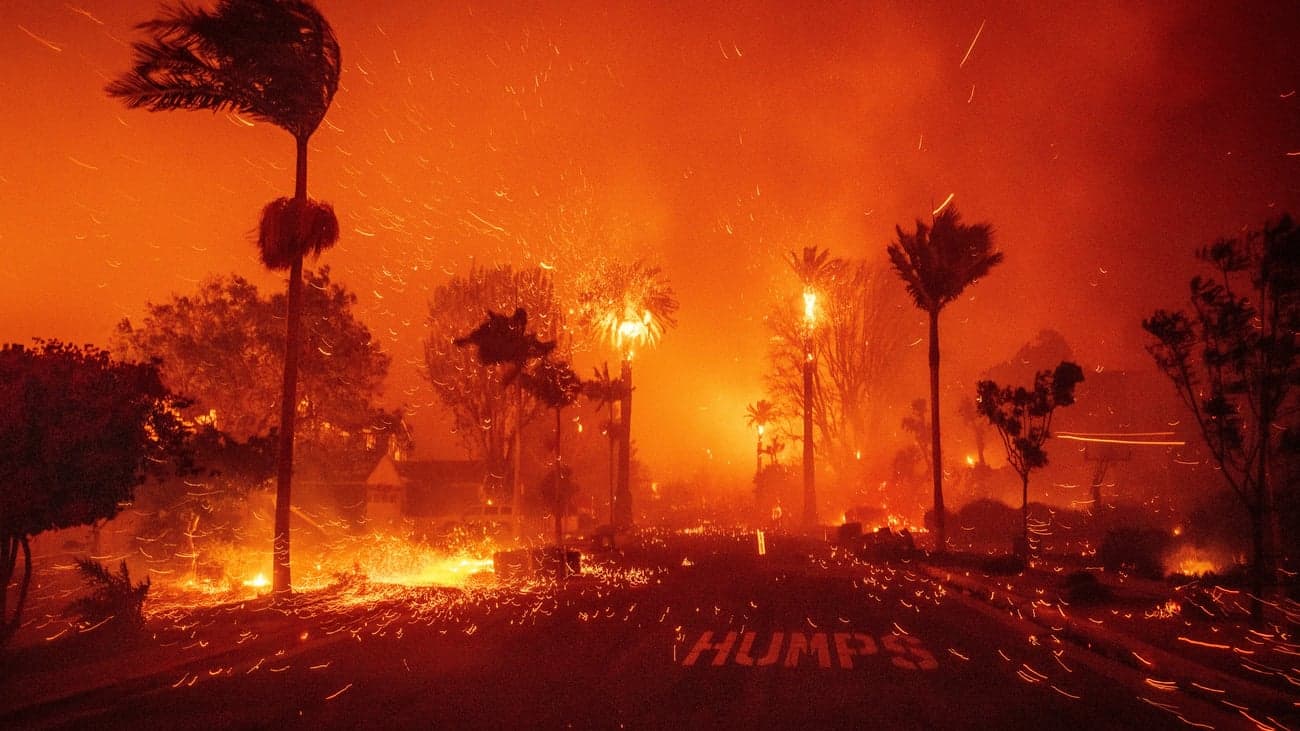
LOS ANGELES (CN) — A federal judge declared a mistrial Friday morning after a jury failed to reach a unanimous verdict on the charges against a former Uber driver accused of starting a brushfire in the early hours of Jan. 1, 2025, that days later morphed into the devastating Palisades Fire.
U.S. District Judge Anne Hwang excused the jurors after they revealed Thursday they were deadlocked on three arson-related charges against 30-year-old Jonathan Rinderknecht, who faced up to 45 years in prison if found guilty.
The jury foreperson told the judge that 10 of them believed Rinderknecht wasn't guilty, while two of them thought he was.
Assistant U.S. Attorney Bill Essayli vowed to retry the case before a new jury.
"The evidence is strong that Jonathan Rinderknecht is responsible for igniting the fire on Jan. 1, 2025, which eventually became the Palisades Fire," Essayli said in a post on X.
Prosecutors with the U.S. Attorney's Office in LA accused Jonathan Rinderknecht of lighting a fire in hills above the Pacific Palisades in the early hours of Jan. 1, 2025, because he felt ignored and rejected on New Year's Eve and sought to take revenge on the rich and powerful he blamed for his personal problems as well as societal wrongs in general.
Rinderknecht's defense attorney, Steven Haney, insisted the most likely cause of the fire was New Year's Eve fireworks and that the government's investigation into the origin of the Jan. 1 fire was fundamentally flawed because investigators didn't get to the scene of the fire until almost two weeks later — after hikers, the elements and the subsequent Palisades Fire had destroyed whatever evidence there might have been.
Investigators with the U.S. Bureau of Alcohol, Tobacco, Firearms and Explosives testified during the two-week trial that after he had dropped off a passenger around 11:30 p.m. on New Year's Eve in the affluent residential neighborhood — where he had lived himself a few years earlier — he drove up to a trailhead near his former home.
He then hiked up a trail to a spot known as the Hidden Buddha clearing, the prosecution said, where he used a Bic grill lighter to set fire to the dry vegetation in a gully.
Geolocation data from his cellphone showed that as the fire quickly spread, he remained in the clearing for a few minutes and then descended down the hillside back to where he parked his car.
Rinderknecht called 911 as many as 17 times — with most of the calls not going through because of the poor cell reception on the hillside — and used his phone to record himself making the emergency calls. He also asked ChatGPT if he could be held at fault for starting a fire with a cigarette.
A behavioral analyst testifying for the prosecution told the jury that the multiple 911 calls and the fact he was recording the calls showed Rinderknecht was "staging the scene" to divert suspicion away from him.
Rinderknecht initially drove away from the site where the fire was raging, but security cameras from houses in the area showed he turned around and raced after the fire engines that came from the opposite direction to fight the flames. He then stayed to watch and take videos of the fire, which ended up burning about 10 acres.
Although the LA firefighters were able to extinguish the so-called Lachman Fire overnight, smoldering embers remained underground among the roots of the shrubs on the steep hillside. When extreme Santa Ana winds struck Southern California six days later, those embers rekindled and started the Palisades Fire that destroyed most of the neighborhood and surrounding communities.
Hwang, a Joe Biden appointee, largely barred the defense from arguing that the Los Angeles Fire Department should bear responsibility for failing to fully extinguish the Lachman Fire.
A few weeks after the fire, investigators with the ATF and LA Police Department interviewed Rinderknecht because his cellphone data and security camera footage of nearby houses put him, and him alone, at the site where the Jan. 1 fire originated.
Rinderknecht told them he had been feeling "nostalgic" that evening because he hadn't been back to the neighborhood where he had enjoyed living a few years earlier and that he hiked up to the clearing to watch fireworks. But when he didn't see any fireworks, he said, he went back to his car and saw what he believed to be a fire as he was descending the trail.
Kevin Kelm, the government's behavioral analyst, told the jury that based on ChatGPT interactions and witness testimony, Rinderknecht couldn't cope with stressors in his life, such as financial and relationship problems. At the same time, he was fixated on political and social issues like wealth disparity that enraged him without being able to do anything about them.
"He tends to collect grievances," Kelm said. "It's always somebody else's fault."
The criminologist also noted the dystopian images Rinderknecht prompted ChatGPT to create in July 2024, with a wall separating the wealthy enjoying their lives from the rest of the people fleeing for their lives from burning forests. In particular, Kelm pointed out Rinderknecht's increasing frustration and anger in his prompts as the AI chatbot wasn't creating the exact images he had in mind.
"The people are running away from the fire," Rinderknecht argued with ChatGPT, according to prosecutors. "Where do you see people running away from the fire in this fucking picture? Goddamn, you're such a fucking idiot. On the far left, the forest is burning."