Inside King's College London's crackdown on pro-Palestine students
King's College London, which has ties to the defence industry, has disciplined at least 26 students in two years for pro-Palestine protest activity, the highest among most British universities.
Names marked with an asterisk* have been changed to protect identities
London, United Kingdom – Khadija* was just seven weeks into her degree when she received an early-morning phone call from her university, King's College London, that left her scared and confused.
The then-18-year-old was told she had made "inappropriate and offensive remarks" about one of her lecturers, who had served in the Israeli army. Over the next five months she would go through a disciplinary process that would see her banned from attending the lecturer's classes and ordered to write a 2,000-word "reflective" essay. She would also be considered for referral to the UK government's "counterterrorism" programme, Prevent, which rights groups have criticised for disproportionately targeting Muslims and lacking transparency.
This all took place last year after the teenager posted in a pro-Gaza student WhatsApp group, saying she had come across her lecturer's public LinkedIn profile and felt "sick" to discover they had spent four years in the Israeli army and had reposted and liked content defending Israel's treatment of the Palestinians.
At that time, Israel's genocidal war on Gaza had killed at least 67,194 people.
Other students responded with protest suggestions, such as attending their lectures wearing Palestinian scarves or carrying flags, questioning the academic "intellectually" about Gaza, and showing images of slaughtered infants on the projector, according to messages seen by Al Jazeera and Liberty Investigates.
Ten days later – without any of these protests transpiring – Khadija was banned from attending campus during the hours of her lecturer's classes after the messages were reported to the university.
"It felt like a humiliation ritual," said Khadija. "I didn't know many people, it was the start of the year … my peers would be like: 'Why didn't you come to class when you were literally on campus two hours ago?'"
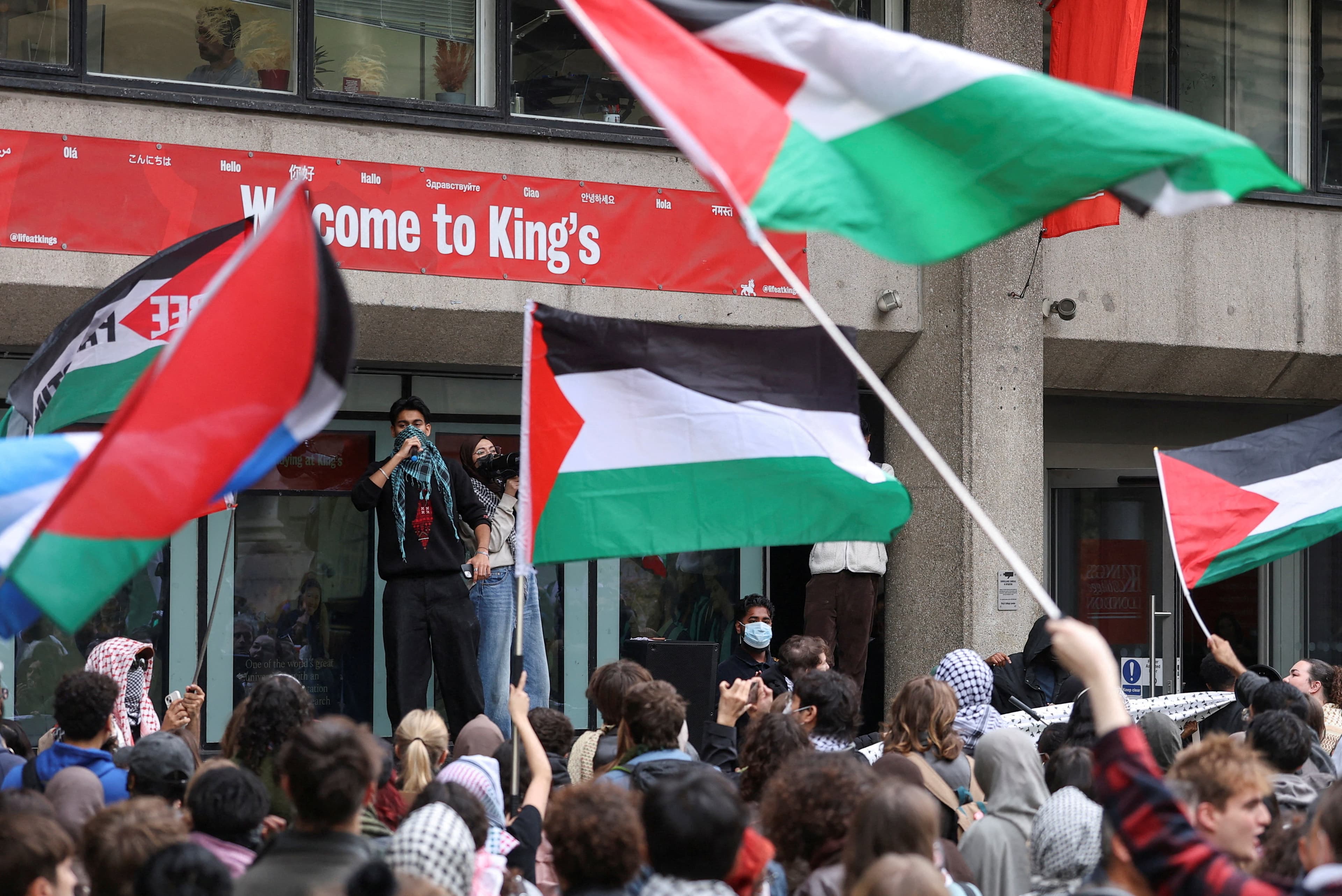
She is one of at least 26 students at the university who have faced disciplinary investigations after engaging in pro-Palestine protest activity between October 2023 and November 2025.
That is the highest of most British universities, this joint investigation by Al Jazeera and Liberty Investigates has found.
We submitted Freedom of Information (FOI) requests to 156 universities. A total of 42 have launched investigations into as many as 236 pro-Gaza students and staff, data obtained from FOI laws and documents shared by those affected show.
University College London opened at least 24 disciplinary cases, the second highest amount, the University of Oxford is third with 18 and Cardiff University has opened 12. As at King's, the true figure may be higher than officially disclosed via information requests.
King's is home to an active student protest movement, with demonstrations often erupting over the university's links to weapons companies. It also has a strong international contingent; seven of the students subject to investigations are on visas.
A King's spokesperson said the university "does not discipline students for lawful affiliations, including support for pro-Palestine views", nor for lawful protest, and that "any implication otherwise is simply untrue".
Disciplinary measures are taken after a complaint is made, and only in response to behaviour which threatens the safety or free expression of others, or which is racist or abusive, they added.
They said, "We are proud to welcome a diversity of political views, religious beliefs, and backgrounds, and have a long history of hosting lawful protests and vigils, and fundamentally reject any other characterisation."
But Luqmaan Waqar, president-elect of King's students' union, said that while certain cases required attention, such as those where staff and students felt unsafe and security were said to have been injured, the university's approach has been uneven.
In many instances the university appeared to "weaponise arbitrary investigations to dissuade participation in protest," he added.
The UN special rapporteur for freedom of peaceful assembly and association, Gina Romero, told us, "The weaponisation of university disciplinary frameworks at institutions like King's … is utterly disturbing". King's has become "a flashpoint" in the wider trend of universities repressing student activism, she added.
Thirteen of the 26 students were investigated for their involvement in an encampment protest at the university which began in May 2025, documents show. Nine of these received formal warnings for setting up tents on campus in breach of a health and safety policy introduced after a previous encampment in the summer of 2024. Two received formal warnings for lending their keycards to access campus buildings to non-students and two for filming security and asking them questions in a manner they reported to be intimidating.
Among those sanctioned for setting up tents was Hamza*, a 21-year-old of Lebanese heritage, who said the group decided to act after negotiations with university leadership about divesting from companies said to be complicit in Israel's military action in Gaza hit a brick wall.
Unlike with the first encampment, the university's crackdown on the second was swift, he claimed. Security staff, previously friendly, now refused students entry to university buildings to use toilets, locking doors shut with bike chains, he said. Within a day, students had reportedly been served an eviction notice. In less than three weeks, they ended the encampment.
Three months later, Hamza received a letter saying he was under investigation. Eventually, he was issued a formal warning. He appealed, asking the university to reflect on whether it was "sacrificing its principles of free speech, student democracy, and tolerance in exchange for higher returns on investment".
But after the university took over five months to arrange a hearing, he gave up and accepted the formal warning.
"For a long time, I couldn't go back into the [campus]. It just made me very upset," he said.
Another student protester, who was issued a warning for setting up a tent, fears the episode could potentially impact his desired career. The experience has put him off participating in student activism.
The 24-year-old said, "I feel as if I've been silenced. Their intention was to put fear into me, and it worked."
Of the remaining students, six were sanctioned over their involvement in protests aiming to disrupt three separate events: a June 2024 Alumni dinner; a talk by a pro-Israel Iranian speaker in February 2025 and the May 2025 London Defence Conference hosted by the university. Documents show that at one of these events, two security guards were injured unintentionally as a result of pushing and shoving.
Usama Ghanem, an Egyptian student, was among those disciplined. He was indefinitely suspended for his involvement in all three incidents, leading to his visa being revoked and leaving him at risk of being deported to his home country, where he says he has been tortured.
Two more cases were for social media posts, two others for unspecified "offensive and abusive behaviour". There were two for "holding inappropriate banners" and one for refusing to show ID when asked.
At the heart of this flashpoint appears to lie a tension between the values of the institution and some of its students and staff.
In April, Al Jazeera and Liberty Investigates revealed that King's was one of a dozen UK universities to have paid a private intelligence firm to monitor the social media of student protesters, including those who expressed solidarity with Palestine.
Last year, the King's branch of the University and College Union (UCU), which represents staff, became the first in the country to pursue a strike ballot over the institution's refusal to divest from companies said to be complicit in Israel's genocide of Palestinians. While many voted for strike action, the turnout was not high enough to carry out the protest.
Senior staff members and a King's branch UCU representative claimed university leadership has stalled on negotiations because it sees the institution's long-term future in defence industry funding. This logic may have fuelled the clampdown, they said.
Mayssoun Sukarieh, an academic at King's who helped produce a report on the university's "connections" to the Israeli ministry, various defence companies and pro-Israel funders, said, "If you depend on [their] money, then there will be influence."
The report, published by King's Boycott, Divestment, and Sanctions (BDS) Forum in November 2024, found that the university had invested 20 million pounds ($27m) of its endowment in companies "complicit in genocide, apartheid, illegal occupation, and ecocide," such as the tech company Palantir. The report was dedicated to two King's alumni killed by Israel, the Palestinian surgeon Adnan Al Bursh and Maisara Alrayyes, a Chevening scholar who completed a Master's in Women and Children's Health.
By December 2025, the university's investment in Palantir, a company which has a partnership with the Israeli Ministry of Defence, had reportedly risen to 159,596 pounds ($213,204), according to an investigation by the student newspaper Roar.
In May, King's announced plans to merge with Cranfield University – an engineering-focused university that also has strong ties to weapons companies.
Since 2020, King's has received at least 3.3 million pounds ($4.4m) from research partnerships with weapons companies BAE Systems, Thales and Rolls Royce, according to an FOI response. These all produce components for F-35 jets used to bomb Gaza, according to the Campaign Against the Arms Trade.
Sukarieh said past supporters of the annual London Defence Conference have included the Pinsker Centre, a think tank founded in 2016 as a centre for "Zionist education," in response to what its leaders described as the "annual hysteria of Israeli Apartheid Week".
King's also collaborates with the Royal College of Defence Studies, whose leadership reportedly discussed distancing themselves from the UK government's September 2025 decision to ban Israelis from attending.
Another source of concern for pro-Palestinian students has been the presence of former Israeli army soldiers among the university's teaching staff. At least three members of faculty have previously served, including Khadija's lecturer.
Days after being banned from classes, Khadija was called into a meeting for staff to consider referring her to Prevent. In the end, no referral was made.
At a disciplinary hearing, Khadija expressed regret for her WhatsApp posts and told university officials she did not intend to intimidate or harass her lecturer and intended only to wear a keffiyeh to the class, which she believed fell within her right to free speech.
But the university concluded that Khadija "created the conditions in which the lecturer became a target" by initiating the WhatsApp discussion, according to a disciplinary outcome letter.
Her plan to wear a keffiyeh to class "was intended to contribute to an intimidating environment", officials wrote.
The lecturer told the university they "felt personally targeted in a way they had never experienced before" and were "worried about the possibility of physical violence", the letter added.
She was ordered to write the essay, which she ultimately did, or face being prevented from graduating. A formal warning is recorded on her student file.
"It really messed me up," Khadija, who is due to begin her second year, said of the five-month-long disciplinary process.
Aaron Walawalkar is an investigative journalist at Liberty Investigates and a 2026 Bertha Challenge Fellow. He produced this work as part of the Bertha Challenge Fellowship.