In France, Lawfare Is Used to Silence Pro-Palestine Lawmaker
France's political elites have made vague criticisms of Benjamin Netanyahu but refused to denounce the genocide in Gaza. Now left-wing lawmaker Rima Hassan has been dragged to trial because she defends Palestinians' right to resist occupation.
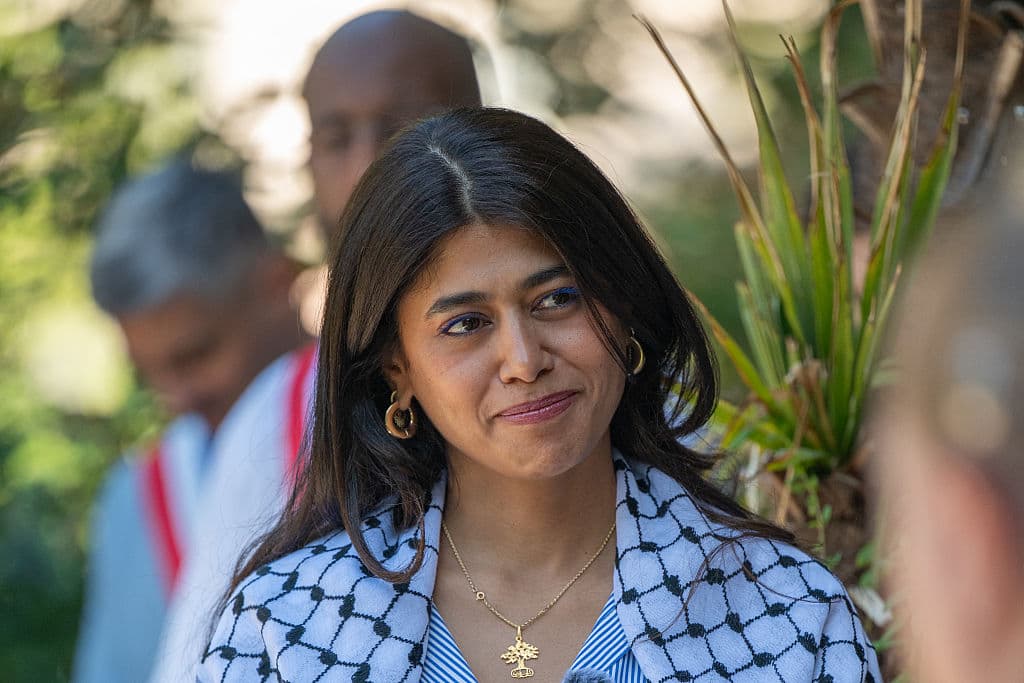
On July 7, France Insoumise Member of the European Parliament Rima Hassan will appear in court for the first time, after two years of judicial harassment from French pro-Israel organizations, Emmanuel Macron's government, and the far right.
The case against Hassan is based on so-called "apologia for terrorism" laws, after Hassan posted a tweet affirming the Palestinian right to self-defense. It's a controversial position in mainstream French political culture, which still doesn't recognize Israel's genocide against Palestine or France's own obligations under international law to prevent it.
"I gave my youth to the Palestinian cause. As long as there is oppression, resistance is not only a right, it is a duty," Hassan tweeted. The quote came from Kōzō Okamoto, a member of the Japanese Red Army who made this comment while on trial for a terrorist attack that killed twenty-six people at an airport near Tel Aviv in 1972.
For Hassan, posting the quote was an expression of the idea — clearly supported by international law — that people have a right to resist a foreign army occupying or colonizing their territory and didn't endorse Okamoto's own actions. Hassan soon deleted the tweet to avoid confusion.
But before she deleted it, Matthias Renault — a politician for Marine Le Pen's Rassemblement National — had jumped into action, on March 27 referring the tweet for prosecution to a Paris court. He was joined in the referral by the minister of the interior and two powerful French pro-Israel lobbies: the European Jewish Organization (OJE) and the International League Against Racism and Antisemitism (LICRA). Both organizations have pushed lawfare against supporters of Palestine in France, mendaciously casting expressions of anti-Zionism and even criticism of Israel as examples of anti-Jewish racism. The OJE's president, Muriel Ouaknine-Melki, despite previously enjoying good relations with Macron, denounced him last year for his fig-leaf decision to recognize the state of Palestine. OJE was also a civil party in a 2023 complaint against Jean-Paul Delescaut, a trade unionist in northern France who was convicted on apologia-for-terrorism charges. One resulting penalty was a €5,000 fine Delescaut was sentenced to pay to OJE before the conviction was overturned on appeal in March.
"Whether it's a politician, or an activist, or a comedian, or a journalist, if you say something they don't like about Israel, they'll file a complaint," Hassan told me.
Since Hassan's election two years ago, she has been targeted by a range of pro-Israel groups who have launched legal proceedings against her. Hassan has been faced with a total of sixteen such complaints so far, though thirteen of them have already been dismissed. Eight of the sixteen were initiated by pro-Israel groups, including B'nai B'rith, the Jewish Observatory of France (OJF), and the National Bureau for Vigilance Against Antisemitism.
"What I've learned from this is how to better map the actors . . . in the judicialization of the debate in France," Hassan said.
This transformation of political debates into drawn-out legal conflicts escalated ahead of Hassan's detention at the beginning of April.
After the charges were referred, Hassan was put under heavy and unusual surveillance — as if the court expected her to dodge the charges. Given her behavior in all the other legal proceedings against her, where she turned herself in voluntarily for questioning even when she had no obligation to do so, there was no honest reason to believe she would abscond. Still, according to a report by Mediapart, Hassan's travel records were pulled from Air France, the national rail operator Société nationale des chemins de fer français (SNCF), and Eurostar operator Thalys. Her phone was also put under active geolocation tracking. Hassan and her team first realized this when she turned herself in voluntarily to the police and they asked her where her phone was. They said they knew that she had it on her just minutes before. Hassan has two phones — a work one and one for personal and political messages. She left the personal phone with a parliamentary assistant out of worries that it could be searched and the contents leaked to the press.
Such concerns were well-founded. Not long after her detention, journalists who work closely with the French police and courts posted leaked information on social media claiming that an illegal synthetic drug called 3-MMC had been found in Hassan's purse alongside legal CBD. The story made an immediate splash in French media despite the fact that it was completely unverified. Over five hundred press articles were published linking her detention to the idea that drugs had been found in her purse, Hassan's press assistant Fiona Vanston told Jacobin.
Almost no outlets, Vanston said, reached out to ask for Hassan's side of the story or to find out whether she disputed the allegation. Most press inquiries, Vanston said, were about where Hassan was being held: an attempt to get photos when she was released.
The court's own tests quickly disproved the presence of the illegal drug — it had the results by April 4. But it didn't make the results of the test public until April 9. Possible drug charges were quietly dropped because they weren't based on anything.
Le Canard enchaîné reported that the leaks came from Justice Ministry spokesman Sacha Straub-Kahn. He denied those allegations on his official Justice Ministry X account and announced that he would be suing the newspaper for defamation, as well as launching a second lawsuit targeting antisemitic insults against him after the article was published.
Meanwhile, Hassan was detained for thirteen hours before being released. The detention of Hassan, whose parliamentary role in theory grants her immunity from these types of speech prosecutions, was an escalation in the judicial campaign against her. Hassan has never used this expectation of immunity as a defense — a political statement in support of other citizens who don't enjoy similar protection.
The court circumvented this expectation of immunity by leaking the false story and justifying her detention under the idea that she was being detained in the act of committing a crime. It was the first time a member of the European Parliament (MEP) has ever been held for a tweet based on the idea that she was being caught in the act of committing a crime.
Hassan's detention alternated between repeated sessions of questioning that went on for as long as an hour and a half and being locked in a small cell.
She told Jacobin that among questions about her background, she was also interrogated about her relationship with Islam, including whether she was a practicing Muslim. "It was as if they wanted to link me to radical Islamism," Hassan said.
Hassan, who never publicly discusses whether she is religious, told Jacobin that these sorts of questions were clearly racist. Hassan was born in Syria to a family of refugees who fled the Nakba. She moved to France when she was ten and got French nationality at age eighteen.
I mentioned the France Insoumise MP Thomas Portes, whom French pro-Israel politicians have also targeted with sinister accusations of links to terrorism after meetings with representatives of the Popular Front for the Liberation of Palestine as well as an NGO that France has since accused of financing Hamas. Portes has not been charged with any crimes but was fingered in a parliamentary report last year for his connections. I asked Hassan if she thought the type of surveillance against her was an attempt to build a similar case.
Hassan said she thinks it's unlikely: nothing was found, except for the normal movements of an MEP, as well as some personal trips.
And unlike Portes, who was born French, Hassan has also come under a sustained media and political campaign calling for her to be stripped of French nationality. For Hassan, it's just as much because she's a left-wing politician who supports Palestine as it is stone-cold racism.
Last July, Marion Maréchal, the racist politician and Marine Le Pen's niece, said that she considered Hassan to be "French on paper." It's a hardly subtle allusion to 1930s-style antisemitism that described Jews and other minorities as only formally compatriots, by dint of some document — casting them as outsiders poisoning French political life by bringing in foreign, subversive ideas.
Hassan has also come under attack from the former Interior Minister Bruno Retailleau, who is now leader and presidential candidate of the once mighty conservative outfit Les Républicains. Retailleau, formerly France's top law-enforcement chief, publicly supported stripping Hassan of her nationality over her politics. He later walked it back, though not because he had changed his mind but because doing so would leave her stateless, which would make it illegal under international law.
"I'm considered suspicious because of my background. It's this rhetoric of the internal enemy, in a climate of growing Islamophobia in Europe," Hassan tells me.
The government is, however, selective in its support of international law. Hassan told Jacobin that the government isn't only flouting domestic norms by targeting her for political repression. It's also systematically flouting its obligations toward Israel and Palestine under international frameworks to which it's a party, Hassan says.
She says this isn't a question of the French government having sympathy for the Palestinian people or not. Rather, it has a legal obligation to sanction Israel for its human rights violations, to try to change its behavior through diplomatic pressure, and to enforce arrest warrants against its leaders currently wanted by the International Criminal Court. Instead, France's foreign minister has repeatedly signed waivers to allow Israeli Premier Benjamin Netanyahu to fly across French airspace, despite the government's obligation to arrest him.
Hassan says that despite all this she still believes in the rule of law. She is a member of the European Parliament, not a revolutionary. This makes the repressive tactics of the government to muzzle her particularly egregious. The goal, she says, is to demonstrate that there's a cost to speaking out to try to change the consensus on the genocide in Palestine in France.
In France, a neoconservative, "war on terror" atmosphere reigns. It took over a year for the non–France Insoumise left to even clearly describe Israel's actions as genocide. Mendacious allegations against the party's leader and 2027 presidential candidate, Jean-Luc Mélenchon, still crop up endlessly. A recent program attacking him on public radio station France Culture falsely interpolated clips as part of an argument that Mélenchon was a "new" Jean-Marie Le Pen, who infamously dismissed the gas chambers of Auschwitz as a "detail of history." A professional organization for journalists at the station quickly condemned the program.
One of the endless polemics against Hassan involved her sharing accounts of the Israeli army training dogs to rape Palestinian prisoners. She was immediately accused of participating in a blood libel and roundly condemned by the French political-media class; this year, reporting by Nicolas Kristof at the New York Times confirmed the tactic was used. A particularly repugnant pseudo-left journalist at Libération frequently mocks Hassan as "Lady Gaza."
Anasse Kazib, presidential candidate for the Trotskyist party Révolution Permanente, went to trial last week on similar charges for tweets after October 7, 2023, condemning Israeli colonialism and supporting the Palestinian right to resistance. Mélenchon appeared at a rally in front of the courthouse, and Hassan has frequently called for the charges to be dropped.
Hassan says a commitment to the Palestinian right to resistance, as well as a dedication to expanding the limits of acceptable discourse on issues like a one-state solution, are among the real reasons she's been targeted. Hassan has also shifted the consensus within France Insoumise from its historic stand for a "two-state solution" toward an openness to look at a binational state in Palestine. This, she says, threatens Israeli interests in France to limit the acceptable range of opinion.
I asked Hassan if, beyond the constant reputational attacks and lawfare against her, she ever fears for her physical safety.
"No," she replied:
Fear isn't in my frame of reference. I know perfectly well what the Palestinian cause demands. It demands sacrifice. You can't get involved with Palestine if you have fear. For me, the Palestinian cause . . . requires investment, a dimension of sacrifice.
Because of this, Hassan said, it's not worth second-guessing how she speaks about Palestine. Despite over forty-five hours of police questioning, she says there's really no way to know in advance what language to avoid.
"I've received complaints for the type of things that nobody would ever be able to anticipate, [like] for using the word 'uprising.' How can you know when you make a tweet or a statement that you can't use the word uprising because on the other side they're going to say that you mean 'intifada'?" Hassan asked.
"I've also received complaints for quoting Franz Fanon. I have his books in my house — they're sold in bookstores in France. You can't tell yourself you have to anticipate not using words from him because you'll risk a complaint. You can see clearly the abusive character of these complaints."
But it's worth it, she says, because of the demands of the Palestinian cause. Pretty speeches about the need for "peace" or gestures like Socialist-run Paris city hall's recent "honorary citizenship" for Palestinians don't do much.
"For me, it's a fundamental political question to understand that being in opposition, we have to accept that we will have to make sacrifices for the Palestinian cause, that we will be in the spotlight, that we will be taken to court, that we'll be smeared in the press," Hassan said. "But the people in power have responsibilities and obligations to meet."