In Albania, a protest movement faces a defiant prime minister
It started as protests against a luxury resort backed by Jared Kushner and Ivanka Trump. Now, Albania is consumed by angry protests that threaten to topple the government.
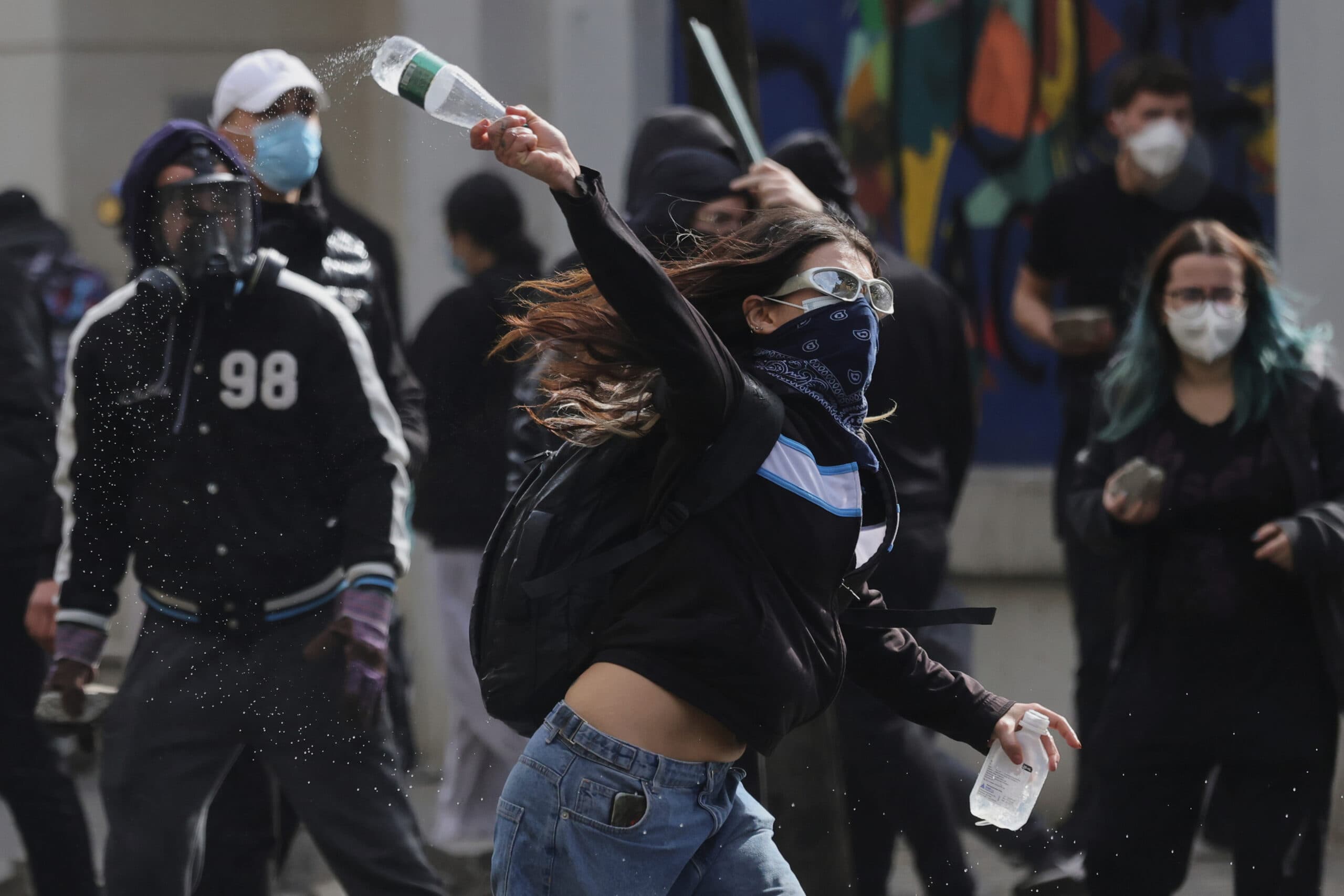
Defiant and glowering in a video released Friday, Albanian Prime Minister Edi Rama dismissed the crowds gathering outside his offices every day as anything but peaceful protests led by students.
His message was clear: For him, the rage burning in the streets of Tirana, the Albanian capital, isn't an expression of public anger against corruption in his government but the work of criminals, communists, political opponents — and stoked by enemies in Serbia, Greece, Russia, Iran.
"These are not students," he said. "I said it from the beginning. These are not students."
For the next seven minutes in the video, Rama read off the supposed rap sheets of men, most of them over the age of 30, arrested during the past 10 days of protests that saw government buildings set on fire and police use tear gas, water cannons and rubber bullets against angry crowds.
Mug shots of the men with their eyes blacked out popped up as Rama read.
This piece of crude political theater reflected the explosive mood in Europe where political leaders in France, Italy, Belgium, Serbia and elsewhere are facing a wave of anger over a range of issues: rising costs, a lack of opportunity, inequality, corruption, failed politics.
In Albania, protests have wreaked havoc in central Tirana with demonstrators repeatedly clashing with police as they demand Rama's resignation. Looting and police brutality have been reported too. More than 500 people have been detained and about 190 police officers injured in the skirmishes.
"It's like there are some no-go zones," said Mirela Bogdani, a politics professor at New York University of Tirana, speaking by telephone from Tirana.
People are afraid to leave their homes in the evenings because of the violence, she said. Scores of businesses, including banks, have closed.
Rama, the 62-year-old leader of the center-left Socialist Party, is the focus of the outrage.
After 13 years in power, the mood turned against Rama when the so-called "flamingo revolution" broke out in late May over his endorsement of a Jared Kushner and Ivanka Trump luxury resort project on a pristine part of Albania's coast known for its flamingos and beautiful beaches. The deal included allowing Sazan Island, a state-owned island in the Adriatic Sea, to be turned into an exclusive resort.
"Many Albanians feel profoundly betrayed," said Fatos Tarifa, a political social scientist at New York University of Tirana, in an email.
He said the resort project was seen as "exposing a pattern of secretive dealings conducted without public scrutiny" in Albania. Details of the deal, which includes Qatari investors, have been kept secret.
Many Albanians condemn Rama for undermining national interests in pursuit of his personal benefit and "securing the goodwill and political support of the Trump family," Tarifa said.
Rama, a painter and artist by passion, came to power in 2013 after serving as a modernizing mayor of Tirana. He won an unprecedented fourth term as prime minister by winning reelection in May 2025.
During his tenure, the European Union and United States saw him as a reliable NATO partner and pro-European politician who'd made getting Albania into the EU a core goal.
The international media praised him as an eccentric sneaker-clad artist-politician transforming a former communist dictatorship into a modern European state.
And Albania has become a prime tourism destination with Tirana undergoing a transformation as luxury high-rise buildings sprouted up.
However, even before the protests, his government was dogged by corruption scandals and links to organized crime. Critics warned the construction boom was fueled by money laundering.
On Saturday, Tirana is set to become the stage for another mass protest outside the prime minister's building.
But judging by Rama's defiant video, he's not about to make concessions.
"Edi Rama will resist resignation to the bitter end," Tarifa said.
Rama, he said, has become so arrogant in his exercise of power that he equates "his own political survival with the interests of the country, as though Albania could have no future without him."
"The danger is that, by clinging to power at almost any cost, he may deepen the political crisis, further polarize Albanian society, and tear apart an already fragile social fabric," Tarifa said.
Albanian society was deeply divided by the protests, but he said a "substantial part of the population" wants Rama to resign.
"Rama should have resigned months ago — not because his resignation would magically solve Albania's many problems, but because his continued insistence on remaining in office has itself become, in my judgment, a major obstacle to addressing them," Tarifa said.
Bogdani agreed that pressure was building on Rama to do something to resolve the crisis.
"If he lets this go unresolved, that would be much worse because it's like a snowball effect," she said.
She worried Albania's recent gains are at risk.
"Albania and Tirana have finally become safe," she said. "Tirana has become a safe city with a good standard of living with lots of tourists coming, enjoying holidays in Albania."
She recalled visiting a beach in southern Albania recently with a friend and being surrounded by tourists.
"I told her that it seemed like we were the only Albanians there," she said. "Everybody was a foreigner. It was full of tourists. Everybody was happy. And I said: 'Wow. Finally, Albania has been put on the world's tourist map. People like to come and to visit.'"
Both experts said the protests had drawn in unruly and suspicious individuals with unclear motives who appeared to be behind the most violent acts.
"Their actions should not be confused with the legitimate grievances of the broader protest movement," Tarifa said.
Tarifa criticized Rama for his "confrontational posture" and failure to listen to legitimate concerns.
"He bears the primary political responsibility for the escalation of the crisis," he said. "What began as a crisis of public trust risks becoming a broader crisis of political legitimacy."
Already, Rama and his Socialist Party have "effectively lost their political and moral legitimacy," Tarifa said.
"Sooner rather than later, the government will have to resign and Parliament will have to be dissolved," he said, "paving the way for early elections and, hopefully, a return to political normalcy."
Courthouse News reporter Cain Burdeau is based in the European Union.