Ibrahim Traoré Would Like to Be Thomas Sankara's Heir
Burkina Faso's military leader, Ibrahim Traoré, has styled himself as the political heir of Thomas Sankara. However, the substance of Traoré's record since taking power in 2022 is much less ambitious than Sankara's agenda as president in the 1980s.
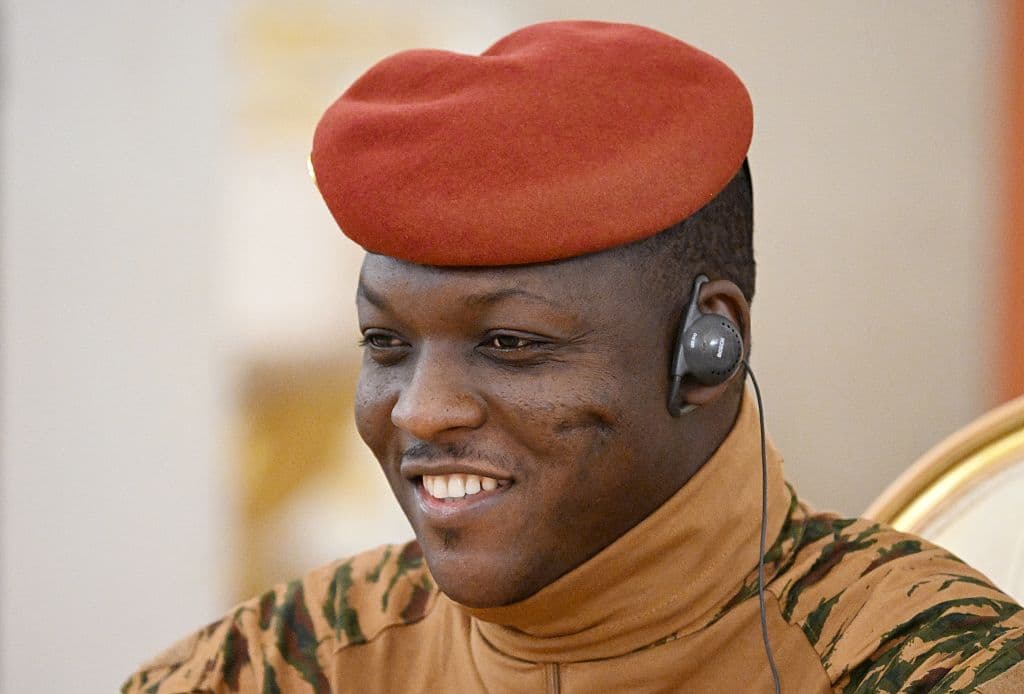
Ibrahim Traoré, president of Burkina Faso since October 2022, polarizes opinion, not only in Burkina Faso itself but also on the Pan-African and internationalist left. Some cheer for him as the hope for a new Pan-Africanism, the long overdue end of French imperialism in West Africa, and (resource) sovereignty. Others point to the authoritarian traits of the regime and to the repression against trade unionists, civil society activists, and journalists.
The scope of Traoré's political projects and the pace at which they are being implemented are significant. This is generating enthusiasm, particularly among the young generation, who vehemently reject French neocolonial dominance and are highly frustrated by a gerontocratic political system that is unable or willing to deliver reform. However, the question remains whether a military government can be the alternative, and whether the ends justify the means.
Coups to Fight Terrorism
Ibrahim Traoré and his "Patriotic Movement for Safeguard and Restoration" (MPSR 2) seized power through a coup d'état on September 30, 2022. Traoré overthrew the previous military government of Lieutenant Colonel Paul-Henri Sandaogo Damiba, which had itself only come to power in January 2022 through a coup. Damiba's junta called itself MPSR.
Neither Damiba nor Traoré came to power with a worked-out political-ideological agenda. They both justified their coups by pointing to the previous government's failure to cope with the security crisis. Attacks by jihadist groups had increased massively since the late 2010s, resulting in several thousand deaths annually, closures of schools and medical facilities, and the internal displacement of over two million people.
Given that his main and only agenda was the "fight against terror," at the end of 2022, no one would have predicted that Traoré would implement political reforms, some of which were far-reaching, in the space of just three years. Already in January 2023, he called on France to withdraw its remaining troops, consisting of four hundred special forces soldiers who were supposed to fight the jihadist groups.
The withdrawal of French troops was popular with many people in the region, and in Burkina Faso in particular. Radical social movement organizations have been mobilizing against French neocolonial dominance for many years. At the end of the 2010s, however, such mobilization spread widely beyond the circles of radical activists.
This broadening was related to the rapidly deteriorating security situation and the perception that the highly equipped French special forces were clearly unable — or unwilling — to push back the jihadist groups. "It's not for our beautiful eyes that France is here," one activist remarked in December 2020. Traoré has taken up the anti-French sentiment, which had increased since 2019, and used it to generate support for his government.
A New Geopolitical Bloc
Along with the rapid change in relations with France since 2022, there has also been a shift when it comes to neighboring Benin and Côte d'Ivoire as well as the Economic Community of West African States (ECOWAS). ECOWAS suspended Mali, Burkina Faso, and Niger as members after the respective military coups in those countries.
After the coup in Niger in July 2023, ECOWAS and France put pressure on the junta in Niger to reinstate the previous president, Mohamed Bazoum. Benin, Côte d'Ivoire, and Senegal signaled their willingness to send troops to Niger. It was obvious for the military governments in Mali and Burkina Faso that they should fear a similar intervention.
They declared their solidarity with Niger and their intention to support it militarily, if that proved necessary. In a move that was hardly surprising, Burkina Faso, Mali, and Niger announced their withdrawal from ECOWAS in January 2024. The end of their status as members was formally confirmed one year later.
The adoption of the Liptako-Gourma Charter by the three countries in September 2023 laid the foundations for the establishment of the Confederation of Sahel States (AES) in July 2024. It was primarily a response to external pressure, created as a mutual defence pact following the crisis of July–August 2023, although it has continued to develop beyond that point of origin. A joint TV channel (AES TV) and an investment and development bank were established in 2025.
Defense and security policy still remain at the center of the alliance. In December 2025, the five-thousand-strong AES Unified Force was launched. The AES does not represent a new Pan-African movement so much as a new geopolitical bloc that reflects the recent regional and global geopolitical shifts. "Like a marriage of reason," as AES TV's director, Salif Sanogo, put it.
More Economic Sovereignty, Fewer Civil Liberties?
The Traoré government has also implemented a number of reforms in domestic and economic policy. A new mining law was adopted in July 2024 that promotes local processing of minerals and formalization of artisanal mining and grants the state the right to purchase shares of mining projects. The mandatory state share in a mine increased from 10 to 15 percent.
In August 2024, the government acquired two gold mines (out of twelve in the country, all operated by multinational mining companies) for US$90 million. It transferred them to the state-owned Société de Participation Minière du Burkina (SOPAMIB).
Prominent projects aimed at boosting the local economy include two tomato processing plants, which were largely financed by the state and inaugurated by Traoré in September and December 2024. Strengthening value creation in the country and increasing state participation in the mining sector have long been demands of social movements and radical civil society groups. Ironically, those demands are now being addressed by a government that has also proven to be repressive toward such movements and activists.
In fact, the military government has been able to implement its projects in part because there is effectively no institutional room for opposition and the scope for criticism by the media, social movements, and organized civil society is significantly limited. The civilian government under Roch Marc Christian Kaboré, who was ousted by Damiba's coup in January 2020, had already restricted freedoms of assembly, expression, and the press, citing the terrorist threat, during Kaboré's first term of as president (2015–19).
The activities of political parties have been suspended since October 2022. In February 2026, political parties and groups were formally dissolved. The Burkinabé Journalists' Association was also dissolved in March 2025, and its president and vice president, as well as a number of other journalists, were forcibly detained. Some of the detained journalists later appeared in a video wearing military uniforms, having been conscripted to fight terrorism.
Control over the media is strong. The country's most important independent radio station, Radio Oméga, was suspended in August–September 2023 when it broadcast an interview with a representative of a civil society organization on the coup in Niger. It was suspended again for three months in August 2025 after referring to the government as a "junta" — a term that the authorities deemed "inappropriate" as well as "prejudicial and offensive."
Social media in particular plays a key — and problematic — role. While the possibilities for media coverage are limited, social media is heavily used to generate support for Traoré and his government. Traoré has become a star in this field within a very short time.
A significant part of the images and videos circulating on social media are AI-generated: praise for Traoré from Beyoncé, Justin Bieber, and Rihanna, for example, or a message from the pope. It is virtually impossible to trace how these videos came to be made.
The hype on social media has combined with a lack of alternative information and the strong desire, especially among the younger generation, for substantial change in political and economic structures, namely an end to neocolonial and imperialist exploitation and domination. This has led to Ibrahim Traoré being stylized as a Pan-Africanist revolutionary.
Sankara and Traoré
References to Thomas Sankara, with whom Traoré has been compared frequently, form part of this image. Sankara, who served as president from 1983 to 1987, was also an ambitious young military officer who came to power through a coup. He is an icon of Pan-Africanism, referred to as "Africa's Ché."
In terms of political-ideological content, the comparison between the two men is only valid to a limited extent. But it has a real impact on public discourse, and Traoré himself knows how to use allusions to Sankara as a way to gain legitimacy.
His government declared the anniversary of Sankara's assassination, October 15, to be a national holiday for the first time in 2023. It honored Sankara with the title "hero of the nation" and renamed one of the central roads in Ouagadougou, Boulevard Charles de Gaulle, as Boulevard Thomas Sankara.
In fact, Sankara had already been rehabilitated and designated a national hero in 2000 under the rule of Blaise Compaoré, the man who overthrew him. Traoré opened the Thomas Sankara Memorial in Ouagadougou in 2025, although the planning for the memorial and the commission granted to the Burkinabe-German star architect Francis Kéré date back to 2017, during the first term of Roch's government.
Polarization
The conditions for movements and activists have changed significantly in recent years. Human rights organizations, youth groups, and labor unions that had been active in the country for decades had already been struggling with the security crisis since the late 2010s. This made large-scale activities across the country difficult.
Restrictions on civil rights under the state of emergency further limited their scope for action. Under the 2023 policy of "general mobilization," the transitional government empowered itself to requisition people and goods for the "fight against terror." It has applied the decree to conscript journalists and representatives of civil society organizations and trade unions to participate in counterterrorism operations across the country.
While the organizations that mobilized the popular insurrection of 2014 have been pushed into the background, a number of new groups and social media activists have emerged in recent years. They are less concerned with their own political and ideological agendas than with supporting the current government.
The most visible are the "Wayiyan," groups of mostly young men in cities who gather at roundabouts and other central locations to observe the "smooth running of the transition." According to Rahmane Idrissa, to ensure that the transition can "run smoothly," they threatened to attack anyone who organized a ceremony to mark the 2014 insurrection's anniversary. It is difficult to understand why a progressive popular revolution, as the Burkinabe president proclaimed it to be on April 2, 2025, would need to restrict the action of movements and media that have long been campaigning for policies such as resource sovereignty.
Traoré cultivates his image as a revolutionary, as Sankara once did, and the association with Sankara plays an important role in this image. Those who discuss the politics of Sankara often refer to his philosophy as a form of pragmatic socialism. Traoré's outlook is rather more pragmatic than socialist.
This approach may be strategically astute, as it appeals not only to the younger generation but also to powerful religious and traditional elites. Sankara's experience showed how difficult it is to overcome those elites. He tried anyway.
It is important to note that the conditions under which Traoré and Sankara operated are quite different. In particular, Sankara did not face the threat from terrorist groups that currently dominates the situation in Burkina Faso. However, the main problem with the comparison of the two men is that the link to Sankara is used as a source of legitimacy for Traoré, giving rise to a personality cult that hinders rather than promotes critical debate on political strategies and visions.