How to Democratize the United States
Donald Trump's authoritarianism has been enabled by long-standing antidemocratic features of the US state — the same features that have time and again blocked pro-worker policies. The Left needs a serious program aimed at democratizing our political system.
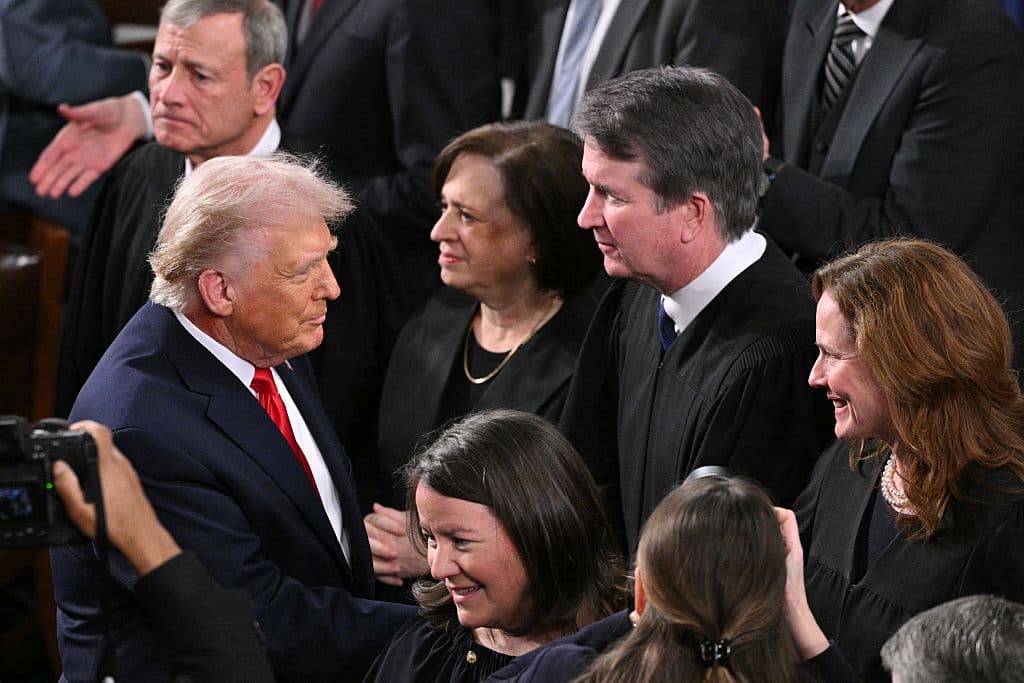
Donald Trump launched his latest war with Iran from Air Force One in the middle of ongoing nuclear negotiations. He did so without any widespread public appetite for war and without congressional authorization.
It was the latest and most extreme act of unilateral executive action by the Trump administration, but it sits within a broader pattern. In the months prior, Trump unilaterally abducted a foreign head of state; attacked numerous vessels in the Caribbean; threatened the sovereignty of Canada, Greenland, and Panama; gutted congressionally created federal agencies; and implemented a brutal immigration crackdown. Each of these actions was taken without legislative approval, and each therefore constituted an exercise of unilateral executive authority. These aggressive actions were widely unpopular and have generated a nascent anti-authoritarian movement, reflected in the Minneapolis mass protests and No Kings marches.
As others have observed, the growing reliance on unilateral executive authority has been a bipartisan trend over the past several decades. Barack Obama used executive authority to implement immigration reform through Deferred Action for Childhood Arrivals (DACA) but also to sharply increase deportations and to conduct a bombing campaign in Libya. Joe Biden likewise attempted to use executive authority to implement stricter emissions standards and to forgive student loan debt, though he came up against judicial resistance in both attempts. Trump's use of executive power must be situated within this broader trend.
Underlying the recent growth of executive power is the undemocratic nature of America's political institutions as well as the limited power of organized social forces outside the state to constrain or compel state actors. These two conditions have produced a Congress largely incapable of legislating, a judiciary free to reshape the law in the interests of capital, and a presidency that faces few meaningful checks on its exercise of power.
These conditions also inform what strategy the Left should adopt in combating rising authoritarianism. In addition to crucial electoral organizing and the labor organizing that the Left is doing to build power outside the state, we also need to develop a democratization program to change the terrain of political struggle within the state.
The antidemocratic nature of the US government has three main sources: the unrepresentativeness of Congress, the skewed power of the presidency, and the conservative bias of the federal judiciary.
Elections to the House of Representatives use single-member districts, producing an outcome where the winner of a plurality of votes in a district is its sole representative in Congress — a "winner-take-all" system. This results in the infamous spoiler effect, where voters are incentivized to choose the least-bad candidate that they think could feasibly win the election (typically a Democrat or Republican) rather than the one they would most prefer, in order to ensure that their vote counts.
The Senate suffers from the same problem, compounded by the fact that senators are not apportioned by population, giving disproportionate weight to voters in rural, Republican states. In addition, the Senate traditionally imposes the filibuster on itself via procedural rules, requiring a supermajority of votes to pass bills outside of budget reconciliation. In recent decades, this has meant increased congressional gridlock, as a weak labor movement and business disorganization have led to fierce inter- and intraparty conflict. These problems are amplified by court-shaped campaign finance laws that allow unlimited spending on politics by corporations and individuals through super PACs.
Congressional gridlock has in recent decades led both parties to rely more and more on the presidency to enact their partisan agendas. Presidents — who are increasingly the leaders of their parties — seek to deliver for their supporters, and given the difficulty of passing legislation, they have been turning to executive action to do so.
Yet the power of the presidency better suits the Right than the Left. The constitutional framework of the United States leaves considerable room for the expansion of executive power, given the relatively underdefined role of the executive branch. The modern state bureaucracy — the many departments and agencies that now constitute the executive branch — came into being long after the country's founding. This gives the judiciary substantial power to "interpret" the Constitution's bare-bones sketch of the executive in relation to the modern state apparatus.
Unsurprisingly, the modern Supreme Court has interpreted executive power in a way that almost explicitly limits its threat to business interests while allowing for its growth in other domains. The clearest example is the recently coined "Major Questions Doctrine," a judicially created rule holding that Congress must give clear authorization for executive agency action with major economic or societal impact. This vague requirement has been used almost exclusively to strike down Biden-era initiatives that threatened business interests, like environmental regulation and student debt forgiveness. By contrast, Trump's campaign of mass deportations, agency gutting, and launching of foreign wars has been allowed to proceed unimpeded by the courts. In this way, the Supreme Court has prevented executive power from threatening business, while giving presidents wide leeway to enact repressive and deregulatory measures.
While executive power in the 1930s was used by Franklin Delano Roosevelt to carry out a progressive New Deal agenda, this was in conjunction with legislation enacted by Congress, and even then it was attacked by the courts. In fact, Roosevelt had to face down the courts in order to bring about major aspects of the New Deal. Some Democratic presidents still attempt mildly progressive uses of executive power, as Biden did with his Federal Trade Commission and National Labor Relations Board appointments and his regulatory agenda. But lacking mass movements for change and stronger legislation coming from Congress, these efforts hardly moved the needle on reining in corporate power or boosting union density.
By contrast, the coercive apparatus of the state — immigration enforcement, the military, surveillance — has been built out with bipartisan support over recent decades. The result is not that executive power has totally abandoned progressive ends but that its progressive uses are more limited than its coercive ones.
The Supreme Court stands as another immensely undemocratic American institution, in which a supermajority of unelected conservative justices now determine the constitutionality of legislation and the legality of executive action. The conservatism of the Supreme Court, and of the federal judiciary as a whole, is not the exception but the rule in American history.
Comparative research has shown this is due to the institutional features of federal courts — namely their greater power to halt rather than bolster legislation, and the appointment of federal judges by the president with consent of the unrepresentative Senate, biasing selection toward more moderate and conservative judges. While some liberals hope the court will prove a bulwark of democracy, the reality is the court has historically proven more a protector of elites than of democracy, including rulings giving corporations the "right" to spend as much on politics as they want; consistently undermining labor rights; and miring the regulatory power of the state in bureaucracy, by, for example, requiring agencies to explain any proposed regulation in granular detail and respond to every significant comment that interested parties (usually corporations) make about it. The few times the court has initiated progressive reform, as in its rulings ending segregation in the 1950s and '60s, it was largely just solving problems the court itself had previously created — as with its infamous rulings in the 1880s striking down a congressionally approved anti-segregation bill and gutting the Fourteenth Amendment's power to fight racial discrimination.
Executive power is skewed toward the deregulatory and repressive projects of the Right, and the judiciary plays a structurally conservative role. So, if the Left wants to use state power for progressive ends, it will largely have to do so through Congress. Yet Congress remains shackled by the undemocratic constraints described above.
The Left, then, needs a democratization program to transform our political system. We think such a democratization program should have three goals: 1) an electoral system that democratically represents the political will of the people, 2) the empowerment of the legislature over the judiciary to make the law, and 3) making federal government administration more democratic by curtailing presidential power. Such reforms are likely necessary conditions for a socialist transformation of society.
Any program to make our government more democratic needs to address how we elect representatives in the first place. Election procedures in America for both the presidency and Congress are far less democratic than those in most countries around the world and hamper the Left's ability to build political power.
On the congressional level, our single-member, winner-take-all elections mean that many voters' political preferences go unrepresented and a two-party system predominates, severely constraining the political options on the table. Multimember districts with ranked-choice voting, as proposed in the Fair Representation Act, would ensure that congressional representation is proportional to the support for candidates among voters, end the antidemocratic gerrymandering arms race, and reduce the barriers to third-party candidacies by ending the spoiler effect.
For example, under our current winner-take-all system, if 45 percent of a congressional district voted for a Republican, 25 percent for an independent, and 30 percent for a Democrat, one Republican would be elected. Under a proportional representation system, this election would result in multiple representatives elected from the district from each party, in proportion to the votes each party won.
For the presidency and Senate, ranked-choice voting would allow third-party candidacies to avoid the spoiler effect, which, combined with proportional representation in House elections, would facilitate the development of a genuine multiparty system.
The domination of electoral campaign funding by the rich in this country is also heavily antidemocratic, with three hundred billionaire families making 19 percent of all reported federal contributions in 2024 and corporations making billions in contributions every election cycle to political causes. Unlimited corporate spending on politics infamously won the Supreme Court's blessing in Citizens United as "free speech," ignoring the fact that this makes political propaganda "free" only for those who can afford to fund it.
In the short term, campaign finance could be democratized by increasing matching funds programs on local, state, and federal levels, similar to the approach in New York City that helped Zohran Mamdani remain competitive. To halt the unequal flow of money into politics, however, Congress will eventually have to reclaim its power to make the law from the judiciary and reverse Citizens United and other past court decisions like Buckley v. Valeo that have enshrined legal protections for unlimited campaign expenditures.
The judiciary has long been a force for reaction in the United States and was designed by the Framers as an elitist check on the democratic will of the people. Since Marbury v. Madison, the Supreme Court has claimed the power for itself to "say what the law is" and overturn laws passed by Congress that it finds unconstitutional, a power called judicial review.
While judicial supremacy in interpreting the law is the status quo in the United States, socialists and dissident legal scholars have long maintained it is not required by the Constitution. As Samuel Moyn and Ryan Doerfler have recently argued, there is fundamental ambiguity in the Constitution regarding the scope of the judiciary's power and a strong case for Congress to democratically reduce it, such as by setting supermajority vote rules on certain subjects, establishing a legislative second-vote override of judicial decisions, or stripping federal courts of jurisdiction to review certain issues entirely. Reforms like these would begin to shift lawmaking power from the courts to the legislature, as steps toward potentially ending judicial review altogether. Socialists should once again demand that Congress reclaim the power to make the law from the judiciary by ending judicial review of at least some congressionally enacted legislation and put the judiciary in its place of adjudicating specific cases and controversies. In other words, the Left should argue for a shift from undemocratic judicial supremacy toward what Beau Baumann has called legislative supremacy.
But the public is likely to be indifferent to abstract debates about judicial decisions if there are no concrete struggles at stake. For this reason, a democratization strategy should focus on defending widely popular substantive policies that the judiciary is likely to try to nullify through its review power. Perhaps congressionally stripping the judiciary of the right to review campaign finance laws would be a good place to start, so as to reverse antidemocratic and unpopular decisions like Citizens United. Until such a conflict over judicial review arises, the Left should publicly defend its belief in legislative supremacy and warn the public that winning transformative legislation like a jobs guarantee or Medicare for All will likely require a showdown with the Supreme Court over who gets to say what the law is — and that our elected representatives should have that power, not nine unelected judges with lifetime appointments.
While the courts are unlikely to stop the rise of executive branch authoritarianism, Congress does not need to be so complacent. The president's power as actually specified by the Constitution is in fact rather minimal. The president is supposed to execute the laws Congress passes, appoint some federal officers, make treaties, and serve as commander-in-chief of the military. Congress has delegated much more power to the president through laws it has passed, so it could bring much of this power back under its purview if it wanted to. For instance, the US Constitution grants Congress the exclusive authority to impose tariffs under Article I, Section 8. However, over the last century, Congress increasingly delegated this power to the president through statute, ultimately granting the president substantial discretion to impose tariffs under a variety of circumstances — a power it could withdraw, if it wanted to.
Congress should also make the regulatory apparatus of the state more accountable to the people by cutting the procedural red tape corporations use to capture regulatory bodies. For instance, industry heavily influences environmental regulations through its frequent lobbying of the Environmental Protection Agency (EPA): scholars found that during the rulemaking process for air toxic emissions standards, industry submitted 81 percent of all comments, as compared to 4 percent from public interest groups, and dominated the pre- and post-rulemaking landscape. The EPA, like all other agencies, is mandated by law to take into account each significant comment when it sets new standards — a procedural burden that could be reduced by Congress.
Congress could also streamline some administrative state functions while shifting power to the working class by delegating some state functions to working-class organizations, such as by empowering unions and workers to help enforce worker and consumer protection laws.
These transformations assume a less gridlocked Congress that is more responsive to the people — which is why reforms to the regulatory state and presidential power will likely not happen without reforms to our electoral system, and why we need a multipronged democratization program to transform the US state.
If some of this democratization program is achieved, it also may become more politically feasible to deepen the democratic transformation of our political system through constitutional amendments that chip away at the elite-biased nature of this country's founding document. Such amendments might include abolishing the Senate, reducing the barriers to the nationalization of private property, and making it easier to amend the Constitution itself.
While these revisions of the Constitution will likely be necessary at some point, however, we cannot sit on our hands until these changes are feasible. There's much we can do in the meantime to democratize our political system and achieve what Bernie Sanders called a "political revolution." As a first step, socialist politicians and their progressive allies could adopt a democratization program like the one outlined above — and begin explaining the need for democratic reforms when their political agendas are blocked by the undemocratic features of the American state.