How Revolutionary, Really, Was Christianity?
Amid renewed interest in the religion across the political spectrum, the historian of antiquity Tim Whitmarsh argues in his new book, Rome's Age of Revolution, that Christianity's success relied on the physical and cultural infrastructure of empire.
In the Acts of the Apostles, the followers of Jesus Christ are repeatedly described as belonging to "the Way." In the modern Christian lexicon, this phrase is often understood as a spiritual path rather than a physical one. One travels the Way from a life without Christ to one with him. Returning to the original ancient Greek texts, the classicist Tim Whitmarsh points out that the word that underpins the idea of the Way, hodos, can mean a spiritual path, but it can also, and more often, means a physical road — or a journey along one.
Paul and other early Christian missionaries were on a spiritual journey, but they were also on what Whitmarsh calls a literal road trip, traveling across modern-day Turkey, Syria, Greece, and elsewhere to convert anyone who would listen. They made these journeys through a Roman world whose network of roads had been dramatically reorganized and extended under Augustus, facilitating movement across the empire. Whitmarsh's new book, Rome's Age of Revolution: Augustus, Empire and the Making of Christianity, asks how revolutionary the religion really was, and does so by situating its original texts in the context from which they emerged and which aided their success: the Roman Empire, and the myriad cultures that it encompassed.
The question of Christianity's influence is usually fought out at the extremes. On one side are the New Atheists of the 2000s, among them the late Christopher Hitchens (God Is Not Great) and Richard Dawkins (The God Delusion), who saw religion as a poison to be reasoned out of existence. On the other are the likes of Tom Holland, whose Dominion argues that Christianity broke with the ancient world and shaped the West's ideas of morality, compassion and human dignity — arguments he has carried to a vast audience through The Rest Is History podcast.
Whitmarsh does something neither camp can. He does not argue against Christian belief; he argues against Christian uniqueness, and his tool is philology rather than polemic. Reading the texts in their original languages, he shows that much of what seems distinctive about the Christian narrative stems from cultural tropes already circulating in the Roman Empire and that it spread along the infrastructure the empire provided. Because he finds the revolution in Rome rather than in the church, he comes close to dismantling Holland's thesis that Christianity was revolutionary, without having to debunk the faith: if roads, languages and the constant movement of people made Christianity possible, then it was the empire, not the new religion, that remade the world. He is not anti-Christian so much as anti-exceptionalist.
He develops this through two concepts. The first is what he calls "swirl," the unprecedented movement of people, goods, and ideas across the empire, which allowed a religion drawing on Jewish, Greek, and Roman culture to flourish. "Paradox" is the idea that the Roman order, stretched across such vast territories, tended to provoke its opposite, as it did in the birth of Christianity. Swirl is where Whitmarsh is at his best, his grip on ancient languages taking him back to original sources.
Roughly two thousand years ago, a biographer told of a boy whose birth was preceded by a portent announcing that nature was pregnant with a king, after which the city's leaders, fearful of losing power, ordered that all new male offspring be killed. You'd be forgiven for thinking this is the story of the birth of Jesus, so close to the slaughter of the innocents ordered by Herod. In fact, this account comes not from the Gospels but from Suetonius — and the boy in question was Augustus.
We find similar accounts in the poetry of the time. Virgil's Fourth Eclogue, composed around 40 BCE, prophesies a golden age ushered in by the birth of a boy, arriving when virgo (the "virgin," evoking Astraea, goddess of justice) returns. Whitmarsh doesn't propose a direct line from Virgil to the Gospels; rather, he suggests the poem may be one strand in a wider swirl of savior-birth imagery circulating in the Roman world — imagery that Christian writers would later draw on independently. More speculatively, he traces the poem's own birth narrative back further still to the birth stories of Alexander the Great and to Jewish scripture.
In Jewish scripture, Isaiah predicts that a time of prospering will be preempted by a sign, when a woman will conceive and bear a son named Emmanuel (7:14). Returning to the original Hebrew, Whitmarsh points out that the word used to describe the woman is almah, which generally means a young woman of childbearing age rather than specifically a virgin. In the Greek Old Testament, this was translated as parthenos, a word whose range of meanings includes "virgin" — and which Matthew later uses when quoting Isaiah in his account of Jesus's birth. Whitmarsh takes this a step further, asking whether Virgil (who could read Greek) may have encountered versions of this Jewish tradition as well as narratives of Alexander the Great's birth.
Drawing these threads together, Whitmarsh suggests that the Christian story of the virgin birth emerged partly through this movement between languages: Jewish scripture translated into Greek, reinterpreted by Christian writers, and read against the same swirling Greek-speaking culture that Virgil himself inhabited. On this reading, Virgil and Matthew are less cause and effect than two writers independently reaching into the same pool of Greek-Jewish material — Virgil's virgo, already carrying the multiple meanings of Astraea and justice, potentially absorbing yet another resonance in the process. It is an arresting example of his swirl in action.
Whitmarsh is on firm ground when dealing with language and translations, but his arguments feel somewhat shakier when he turns to larger hypotheses. He proposes that Augustan dominance of both the physical and political spheres provoked a counterreaction in the form of a seeking out of alternative imaginative spaces. Noting the tendency of Greek literature of the second century to look up or down to venture into new spaces — whether in the form of narratives concerned with deep-sea diving or trips to the moon — Whitmarsh argues that this fascination with finding new spaces beyond governmental control extended to the first Christians too.
Early Christian literature conveys a powerful sense of space and travel — whether Paul's journeying in Acts or the Gospels' descriptions of distant and unfamiliar places. In time, it would be the desert that would dominate the setting of the Christian imagination in the Life of Anthony. It is here, though, that Whitmarsh's textual precision gives way to something looser. For instance, the claim that a whole imaginative geography, from lunar voyages to the desert fathers, can be read as a counterreaction to Augustan order is suggested rather than demonstrated; Rome's Age of Revolution asks the reader to accept a fair amount of inference, in a book otherwise so careful to show its working. Paradox, unlike swirl, is a harder idea to ground in the sources.
In the final sections of the book, Whitmarsh moves away from a focus on Augustus and his revolutions and toward a dissection of the Greek-speaking culture of the eastern empire and its role as an incubator of early Christianity. It is here that he lands his biggest argumentative punches, showing both swirl and paradox at work. He takes aim at the "Hollywood image" of persistent, structural opposition between Christians and Romans. Executions and persecution certainly happened, he explains, but martyrdom stories exaggerated and dramatized them, and they did so using narrative forms borrowed from the newly emerging genre of the Greek novel.
Take the martyrdom tale The Passion of Perpetua and Felicity, which tells of the arrest and public killing of the young noblewoman Perpetua, still nursing her infant, and her fellow Christian Felicity, who gave birth shortly before their execution, in 203 CE. Crucially, the text was produced in a world in which Christianity was not subject to a straightforward empire-wide ban. A stable Roman order, paradoxically, gave Christians the space to write up stories of persecution and for these tales to flourish.
Whitmarsh argues, against those who read the story as eyewitness testimony, that it relies on strategies borrowed from the Greek novel: pity, tension, and, most of all, eroticism. In the arena, he notes, the women are stripped and put in nets, and the crowd recoils at the sight of Perpetua's lactating breasts. They are then thrown to a "ferocious cow," an animal chosen, the text tells us, to match their sex. Perpetua is tossed by the cow, and she is forced to rearrange her clothing to cover her thighs. Later the crowd demands that the martyrs be brought into the center of the arena, so that "they might join their eyes with the sword that penetrated their bodies." The text is laced with innuendo and sexual imagery, drawing the reader in and allowing them to enjoy it under the alibi of a dedication to Christian martyrdom.
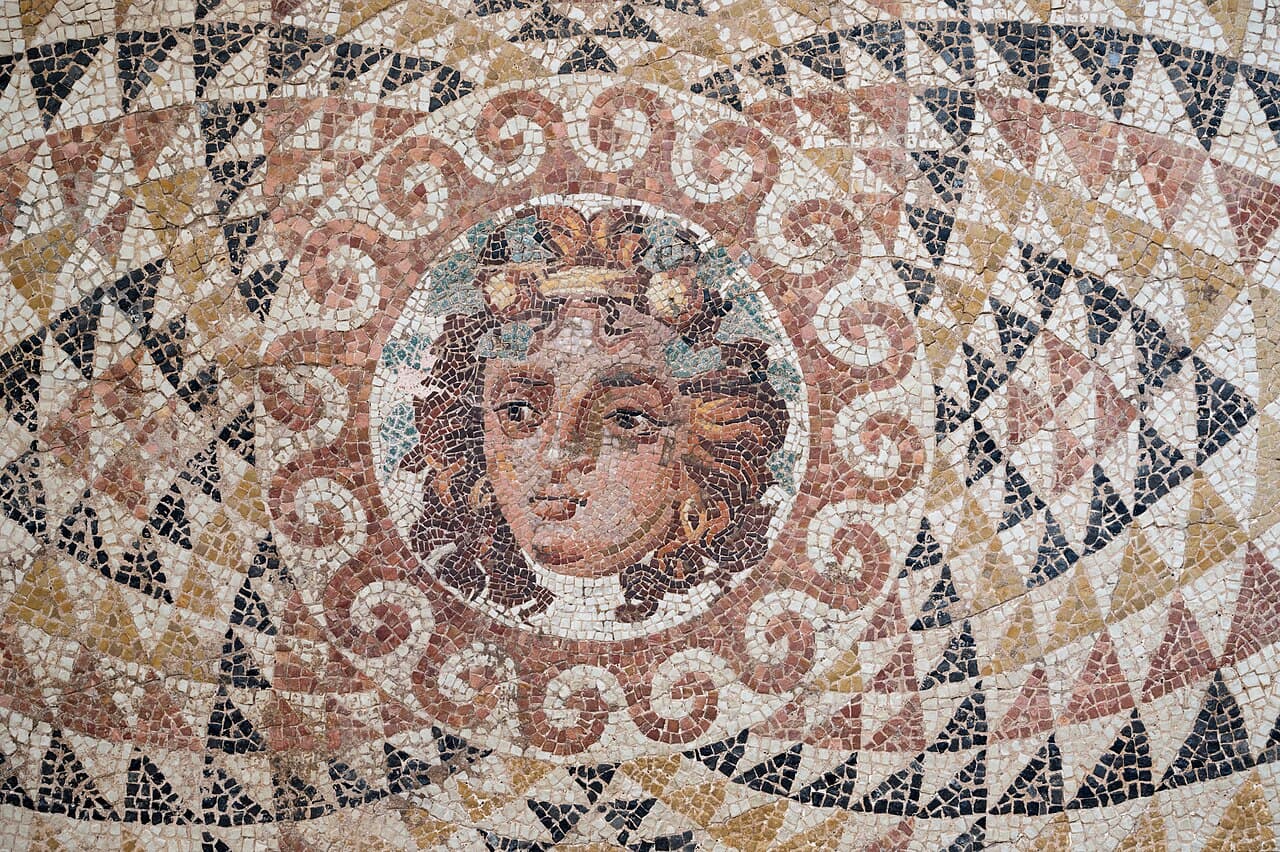
The Greek novel is Whitmarsh's final argumentative device, and though successful, as an art historian I am left wondering if he has neglected the visual culture in which early Christianity was operating. Rome's Age of Revolution is primarily concerned with textual analysis, though if it does have a visual signature, it's the cover: a detail from a Roman mosaic of Dionysus, found in a Roman villa excavated at Corinth. It's a striking choice — the kaleidoscopic mosaic tiles presenting a literal manifestation of the swirl of which Whitmarsh writes. The content of the mosaic speaks directly to Whitmarsh's argument: Corinth was a Greek city remade under the Roman Empire, and Dionysus was a Greek god displayed here within a Roman urban setting. Whitmarsh shows (without referencing the cover) that several pagan texts, even those written as late as the second century CE, align Dionysus with Jesus: he had a divine father and mortal mother, could turn water into wine, performed supernatural wonders, and died before coming back to life. But beyond the cover and a few brief mentions of material culture in the book, Whitmarsh excludes this visual line of enquiry. This is understandable, given he is not an art historian, but there are many times when a brief interlude may have added to his argument.
On a recent trip to Rome, a label in the Vatican Museums taught me that the Good Shepherd motif so central to early Christian iconography was modeled on the kriophoros, or ram-bearer, a figure already centuries old in Greek art and closely associated with the god Hermes. The label went further, suggesting Christians adopted this borrowed imagery partly because its familiarity let them worship somewhat covertly under Roman eyes — the same shepherd could read as Hermes to a suspicious neighbor and as Christ to a fellow believer.
It's a tidy story but I found myself doubting it, and Whitmarsh's dismantling of the Hollywood image of relentless persecution gave me reason to look deeper. Many scholars of early Christian art are now cautious about treating such imagery primarily as a form of disguise: Christians may instead have been adapting a visual language their neighbors already knew how to read, recasting an image associated with care and safe passage within a new theology, rather than smuggling one past the authorities. If that's right, the Good Shepherd isn't evidence of a persecuted religion in hiding — it's another instance of exactly the kind of confident, opportunistic repurposing that Whitmarsh traces through Christian texts.
Whitmarsh gives us a masterclass in tracing swirl through language, translation, and narrative and a more tentative case for paradox. But the book's real achievement is to ask how revolutionary Christianity was without taking either of the usual sides. Christianity, he shows, can be taken seriously as a historical force without being treated as an exception to history. The mosaic on the cover makes the point better than any argument: like the empire itself, it is assembled from borrowed pieces and is no less striking for it. It repays close looking, and so does this book.