Gaza Was the Last Nail in the Coffin of Liberal Atlanticism
Since the end of the Cold War, European and US liberals have claimed to defend a "rules-based international order." Often a fiction, even the pretense has now vanished under the rubble of Gaza.
Trümmer auf Trümmer is a German-language collection gathering critical perspectives on so-called Staatsräson, which has served to justify the German state's continued support for Israel as well as its repression of the pro-Palestinian movement.
Among other topics, it deals with the racist weaponization of Holocaust memory, the history of German-Israeli relations, and the role played by the German left in this context. In this interview with the book's editors, international relations scholar Gilbert Achcar explains why Israel's genocide in Gaza represents a historical watershed, killing off illusions in liberal Atlanticism.
In Israel and most Western countries, Palestinians and critics of Israeli policy are frequently subjected to Nazi comparisons. Since October 2023, these comparisons have increasingly been used to justify Israel's genocidal actions, for example by Benjamin Netanyahu, when he described Hamas as "the new Nazis" at a press conference with former German Chancellor Olaf Scholz. Already in 2019, the German Bundestag employed this rhetorical maneuver in an anti–Boycott, Divestment, and Sanctions (BDS) resolution, proclaiming the boycott of Israeli products reminiscent "of the darkest phase of German history." What is the historical lineage of this narrative? To what extent is it the result of what you call the "Arab-Israeli war of narratives"?
The Nazification of Palestinian Arab and Muslim rejection of the Zionist settler movement and the Israeli state that it founded is a very old propaganda device. It was facilitated historically by the nefarious role of Haj Amin al-Husseini. He was grand mufti of Palestine and was appointed to this position by a very pro-Zionist British high commissioner. The fact that he ended up in 1941 traveling between Berlin and Rome and working with the Nazis and the Italian Fascists made him a very appropriate figure for that propaganda and helped it a lot.
Since its inception, the Zionist movement has consistently sought to portray Arabs not merely as adversaries but as ideological affiliates — or even allies — of Nazism. Within this narrative framework, the 1948 Arab-Israeli War, which followed the proclamation of the State of Israel, is often abstracted from the concurrent reality of the Nakba: the large-scale displacement and ethnic cleansing of the Palestinian population — an act that meets the criteria of a major war crime and a crime against humanity under international law. The fact that it was ethnic cleansing is hardly disputable: even someone like well-known historian Benny Morris, who has turned from post-Zionist back into rabid Zionist, acknowledged that what happened was ethnic cleansing. He justifies it in some way but doesn't shy away from recognizing the fact. Thus, the 1948 war could be presented in some way as the last battle of World War II, the last battle against Nazism or its allies.
Here we can see where the justification of ethnic cleansing of the Palestinians lies: it's "either we did that to them, or they would have continued the Holocaust on us." That's the logic, and you can see how this logic follows a direct thread to October 7, 2023, which was immediately framed as "the worst murder of Jews since the Holocaust." This way of framing it was extremely widespread. From Israel to every kind of Western government we heard the same: this was the worst massacre of Jews since the Holocaust. What does it mean? It means putting what happened on October 7 in a continuity with the Holocaust. That is the very same logic of Nazification that has been running since the 1940s.
Locating October 7 — regardless of what atrocities were committed on that day — in a continuum that goes back to the Holocaust is a very distorted view of history. For the Palestinians and most people in the Global South, the continuum is a long tradition of anti-colonial struggles. Anti-colonial struggles are not immune to atrocities. There had been several such events in history, in Angola, in Algeria, and in other countries, where ugly massacres were committed at some point by the locals against the white settlers. There is no justification for massacres of civilians, but we understand how it can be a reaction to accumulated colonial oppression, usurpation of land, and racism.
Depending on which historical sequence you locate October 7 within, you will get two very different outcomes. On the one hand, the Nazification of Hamas, and beyond Hamas the Gazans, if not all Palestinians, because many of Israel's zealous supporters hardly make any distinction between the people of Gaza, the Palestinians in general, and Hamas. The other historical sequence allows you to supersede this kind of "absolute evil" perspective and understand — without justifying — how people who have been so much oppressed, who have been living for so many years in an open-air prison, suffering all kind of sadistic practices imposed on them concerning their living, including periodical bombing, let alone the fact that the majority of the Gazans are 1948 refugees and therefore direct victims of ethnic cleansing, how people like that resort to such actions, even if — again — you don't need to condone what they did.
In my view, October 7 was a huge miscalculation, which actually did much more harm to the Palestinians than any good. It did much more harm to the Palestinians than to the Israelis, as it was used by the Israeli far right coalition to launch a genocidal war with a view to completing the ethnic cleansing of Palestine in Gaza, and at the same time, as we can see, also moving in the same direction in the West Bank, where settler and military violence against the population has increased tremendously and is still increasing since October 2023. All this is part of the war of narratives that has always been a crucial part of this national, ethnic, and colonial conflict.
There is nothing new in this regard, except that October 7 made it more acute than before. Hamas's violent strategy is ill-adapted and inappropriate for the struggle of the Palestinians. The 1988 Intifada was a nonviolent mass uprising, just throwing stones at the occupying army. Significantly, women could take part in those demonstrations, which Zionist propaganda could not Nazify. It could not say of nonviolent civilians demonstrating against an occupation army that they are similar to the Nazis; that would have been completely absurd. This shows you the kind of struggle appropriate for people facing an enemy much stronger militarily than they are.
It is much more efficient to resort to nonviolent struggle and use your moral superiority against the oppressor's physical superiority. The amount of violence that has been applied to the Palestinians since the turn of the century, since the collapse of the Oslo Accords, has been such that attempts at reviving a nonviolent mass struggle were always and easily nipped in the bud by the likes of Hamas. Hamas played, in that sense, a very negative role for the Palestinian struggle in my view. I can understand where Hamas comes from as a reaction against a very long oppression. But that does not make it any better. It is not what the Palestinians truly need.
Going back to "Nazification," this is part of a broader buildup, rooted in using Nazism as the epitome of absolute evil. We know how extensively this has been deployed across various contexts. Even within Israel, political factions have compared one another to Adolf Hitler, as a rhetorical weapon. In Middle East politics, Israel and its Western allies have repeatedly labeled as "Nazis," or Nazi sympathizers, those who opposed Western domination: one figure after another has been subjected to this delegitimizing stratagem. Gamal Abdel Nasser, the Egyptian anti-colonial, anti-imperialist leader, was compared to Hitler. Yasser Arafat was compared to Hitler. Saddam Hussein — an awful dictator in his own right — was also compared to Hitler to justify the 2003 US-led invasion and occupation of Iraq. Slobodan Milošević in Europe was compared to Hitler. Every time Western powers are attacking someone, Nazification immediately comes up. This propaganda device builds upon a very Eurocentric perspective, in the sense that European powers are always projecting their own history on the rest of the world. In fact, most of the world does not revolve around the history of Europe. The colonial trauma, which is one of the historical conditions of Nazism and of the Holocaust if we follow Hannah Arendt in her analysis of totalitarianism, is for most humanity much more impactful than Nazism.
For this ideological framework, in which, as you say, Nazism serves as absolute evil, any criticism of Israel amounts to a relativization of the Holocaust. Consequently, attempts have been made to criminalize terms like "genocide" and "apartheid."
Nazism was an absolute evil in the sense that the Nazis' systematic, industrialized extermination of a whole population is more perverse than any other genocide we know of that preceded or came after. Other twentieth-century genocides were perpetrated with much less sophisticated means of destruction — the Armenian genocide, the Rwandan genocide, Darfur, and so on. In that sense, I wouldn't hesitate to say that the worst genocide since the Nazi genocide of the Jews is what we have been witnessing in Gaza since October 2023. Because, as I describe it in my new book, The Gaza Catastrophe: The Genocide in World-Historical Perspective, it is the first genocide perpetrated by an industrial, highly militarized state, backed by the West, since 1945.
We can see how Israel is very systematically applying sophisticated means of destruction against a small population, in full knowledge that they are killing far more civilians than Hamas members, far more noncombatants, including a majority of women and children. They know what they are doing, and they continue doing it with a level of protracted sadism that we haven't seen since 1945. The whole West called what happened in Bosnia, in Srebrenica, a genocide. Yet it refuses to acknowledge the genocidal character of what is going on in Gaza, although it is quite a lot more obvious. Even worse, as you mentioned, it tries to criminalize the very fact of calling what is happening in Gaza a genocide. If you call it a genocide you are labeled "antisemitic" and in some way it means you are weaved into the Nazification narrative, since it immediately brings back to memory the worst iteration of antisemitism in history.
Since October 7, the German state has been pursuing an unprecedented campaign of repression against Palestinians and their allies, in the name of combating what is called "Israel-related antisemitism" and "imported antisemitism." The idea of a specifically Arab antisemitism is neither new nor exclusively German — why did it emerge and in what context?
The concept of the "new antisemitism" was first coined by Bernard Lewis, a scholar of Islamic and Middle Eastern studies who is also known for denying the Armenian genocide. Edward Said famously described Lewis as a quintessential Orientalist. In the 1980s, Lewis argued that European antisemitism was vanishing and only residual, while a new antisemitism was surging — one that he claimed was rooted not in Christian or racial prejudice but in political opposition to Israel. This new antisemitism, according to Lewis, was closely tied to what he called the "Israel-Palestine conflict" and was increasingly expressed in critiques of Zionism and Israeli policy, particularly in the Arab and Muslim world.
Now, this is as perverse as the Nazification device in the sense that "new antisemitism" establishes a continuity with old antisemitism and therefore puts political opposition to Israel in continuity with European history, whereas it is actually quite disconnected from it. Even Bernard Lewis himself recognized that, whereas antisemitism was the cause of what happened in Europe, in the Middle East it is the result of the "Israel-Palestine conflict." He admitted that what he called "new antisemitism" was a reaction to the establishment of the State of Israel. And that makes a huge difference, because a dominant majority targeting a minority for purely racist reasons, like you had in Germany under the Nazis, is radically different from an oppressed people reacting to their oppression by showing hatred of the oppressor.
This hatred of the oppressor can, in some instances, lead to an essentialization of the enemy — like not drawing a clear distinction between Zionist and Jew. But I should say that this distinction is actually well understood in the Arab region, and especially by the Palestinians, because there are so many Jews supportive of their cause. In the Palestine solidarity movement in the United States itself, many young American Jews are involved, and such facts facilitate the perception of the difference between Zionist and Jew. Not every Jew is Zionist, and not every Zionist is Jewish, because it is well-known that some of the most rabid Zionists and Israel supporters are Christians, the so-called Christian Zionists. They represent a key part of the base of the neofascist movement in the United States.
The idea of a "new antisemitism" became a mantra used by Western governments later on, especially after October 7. It is a convenient way to criminalize critiques of Israel, which is inscribed in the definition of antisemitism adopted by the International Holocaust Remembrance Association (IHRA). Even the author of that definition took his distance from it, recognizing that it was a weak, hasty draft. But it was nevertheless adopted by several governments with an attempt to force it onto academic institutions and the public in general. This was an attempt to stifle discussion, to prevent academic freedom, freedom of speech and freedom to criticize the state of Israel, freedom to criticize one of the ugliest wars we have seen in decades.
It is even more perverse in the sense that the Western governments using this kind of trope — and the German government is obviously one of the most prominent — are applying it to people who are contesting a far-right government that has much more in common with Nazism than any Palestinian entity. The Israeli government includes the whole spectrum of far-right forces: it is openly racist, openly annexationist, openly expansionist — more so than any previous Israeli government. These forces have much more in common with the Nazis than Hamas, because of their structural position as invaders, occupiers, and perpetrators. They are perpetrating a genocide. And when governments such as the German government condone the genocide and condemn those who criticize it, it is really sickening. It is morally disgusting and shows you how much indeed the so-called philosemitism can actually consist in inverted antisemitism: people who have a guilt complex and try to hide their latent antisemitism by adopting a philosemitic attitude. You don't need to be Sigmund Freud to understand this mechanism, and it is, indeed, quite perverse.
It also means that Germany, which boasts of having done radical work of memory to extirpate its Nazi past, actually drew the wrong lessons, because the right lessons of the Nazi catastrophe are precisely what so many of those who fought Nazism, including key Jewish thinkers, have put forward, countering the ethnic, racist, genocidal legacy of the Nazis with universal humanism. The right lesson to be drawn from the Nazi genocide is not Nie Wieder (never again) harm to the Jews alone, but Nie Wieder occupation, oppression, genocide to any people.
The Holocaust bears universal lessons. If you narrow its historical significance down to a matter concerning the Jews alone, you belittle its historical importance and draw the wrong lessons. Germany is, after the United States, the second-greatest purveyor of weapons to the Israeli state, so it is directly involved in the ongoing genocidal war. If the only lesson that the German rulers can draw from the Nazi past leads them to take part in a new genocide because it is perpetrated by a state that claims to be Jewish, that's absolutely tragic. This miserable failure is a consequence of the ideological buildup of a state that has been under right-wing rule in the context of the Cold War, with a lot of former Nazis within its institutions after 1945. Such folks are not of the kind who can draw universal lessons of a progressive character. They are reactionary, and the only kind of lessons they could draw from the Nazi past are the wrong lessons, confined to the same ethnocentric, limited perspective, leading therefore to a shift from antisemitism to philosemitism with all the ambiguity of this so-called philosemitism. It gets even more outrageous when the current German state attacks German Jews for their critique of Israel. They have no shame.
In concert with the popularization of the concept of a new antisemitism, the 2000s also saw the emergence of the idea that Israel's safety is Germany's reason of state – its so-called Staatsräson, which since then has increasingly been enforced through authoritarian measures. Could you speak about its origin and on German-Israeli relations? What role did Israel play for postwar West Germany?
This goes back to the very conservative government of West Germany after 1945. Konrad Adenauer had a few very ambiguous statements about the Jews. Since we know that there were plenty of former Nazis in the state institutions — Hannah Arendt in her Eichmann in Jerusalem evoked one famous case, but there were many — you can understand how these people's mentality functioned.
Let us not forget that in the eight years between 1933 and 1941 — the year when the Nazis started implementing the systematic extermination of the Jews, the so-called Final Solution — the Nazis were not perpetrating a genocide against German Jews. They were implementing ethnic cleansing, making Germany "judenrein" ("Jew-free") by expelling and deporting the German Jews, an issue upon which they found a common ground with the Zionist movement, keen on attracting Jews to Palestine. This convergence of interests translated into the famous 1933 Haavara Agreement between the Nazi authorities and the German Zionist movement to force German Jews to migrate to Palestine as the only destination where they were allowed to take with them some capital. After 1945, Germany no longer had any Jewish population because of deportation, first of all, followed by the genocide. So, a large proportion of German Jews ended up in Palestine because of the Haavara Agreement.
Thus, when the West German state started supporting the new Israeli state, it was in some way a resumption of the previous 1933–1941 collaboration, since Bonn reduced the Jewish victims of Nazism to the state created by the Zionist movement. It supported the Israeli state to the benefit of its own military industries. Instead of the reparations directly going to the victims, they went to the state that pretended to be representing them, even though Zionism was contested by many of the Jewish victims of Nazism, let alone the fact that the Zionist state itself was built on ethnic cleansing and occupation. By the same token, the West German government got its visa to the Western club in the Cold War. It saw in its support of the Zionist state a way to rehabilitate themselves from the opprobria of the Nazi genocide and getting a visa to Germany's joining NATO and being allowed to rearm. All that was linked. The first who studied that process thoroughly is an Israeli academic who later moved to Vienna, Frank Stern, and the most recent thorough study of the same is the book of my former PhD student Daniel Marwecki.
In one of your articles, you argue that Atlanticist ideology was able to present itself as a counterforce to both Soviet communism and fascism by identifying the former with totalitarianism and reducing the latter to Nazism. You further claim that the liberal mask of Atlanticism has slipped off in recent years. Where do you situate Atlanticism today, and what role does Gaza play in this context?
What I call liberal Atlanticism is a reference to the moment of the Atlantic Alliance during World War II — originally an anti-Nazi, anti-fascist alliance, which was also at the same time anti-totalitarian even though it allied with the Soviet Union until 1945. The key architect of this conception of a "liberal rules-based order," and the United Nations as an embodiment of it, was Franklin Delano Roosevelt, who was a true liberal, a progressive. But he died in 1945 and was succeeded by his vice president, Harry Truman, who represented the Democrats' right wing. Roosevelt had taken him on the ticket as vice president to cover the party's whole political spectrum. Truman was very much a Cold Warrior. He basically initiated the Cold War.
Therefore, from the start, the "rules-based liberal international order" was stillborn, vitiated by the Cold War. And the Cold War led the United States in particular, even though it had been the godfather of the United Nations, to behave like a rogue state in dealing with the UN. To the point that up to Ronald Reagan, the United States basically regarded the UN as the enemy after having used it for a while, when Western countries had a majority in the organization. Since the 1960s, when most of the Global South decolonized and the character of the majority in the UN General Assembly changed, the change of attitude of the United States was obvious. It got to regard the UN in an increasingly hostile manner. The United States has been a key violator of the rules of international law.
This Atlanticist liberal order was flawed, to be sure, but there was still some credibility adhering to the ideological pretense of "We are democrats, the beacon of freedom, against communist totalitarianism." That was despite the fact that NATO had among its members from the start a quasi-fascist dictatorship in Portugal. Then there was an attempt to revive Atlanticist liberalism at the end of the Cold War. With the end of the Soviet Union, we saw a surge of liberals calling for a new cosmopolitanism, with attempts at reviving some kind of global rules-based liberal order, which unraveled quite quickly. The occupation of Iraq in 2003 led by the Bush administration was a key moment in that regard. There is an obvious parallel in the way that US administration seized on 9/11 and the way the far-right government of Israel seized on October 7 in order to fulfill premeditated designs.
During the 1990s, the United States behaved in such a way that the world shifted quickly, in a matter of few years, from the Cold War to what I call the New Cold War. I published a book under this title, analyzing this tripolar New Cold War that started at the turn of the century, between the US-led Western bloc, Russia, and China. The post–Cold War attempt to revive the "international liberal order" failed in its turn, coming to an end with the Gaza war, which showed in the most blatant way the full hypocrisy and double standards of those who condemn in the most categorical terms the Russian invasion of Ukraine but at the same time defend the Israeli invasion of Gaza.
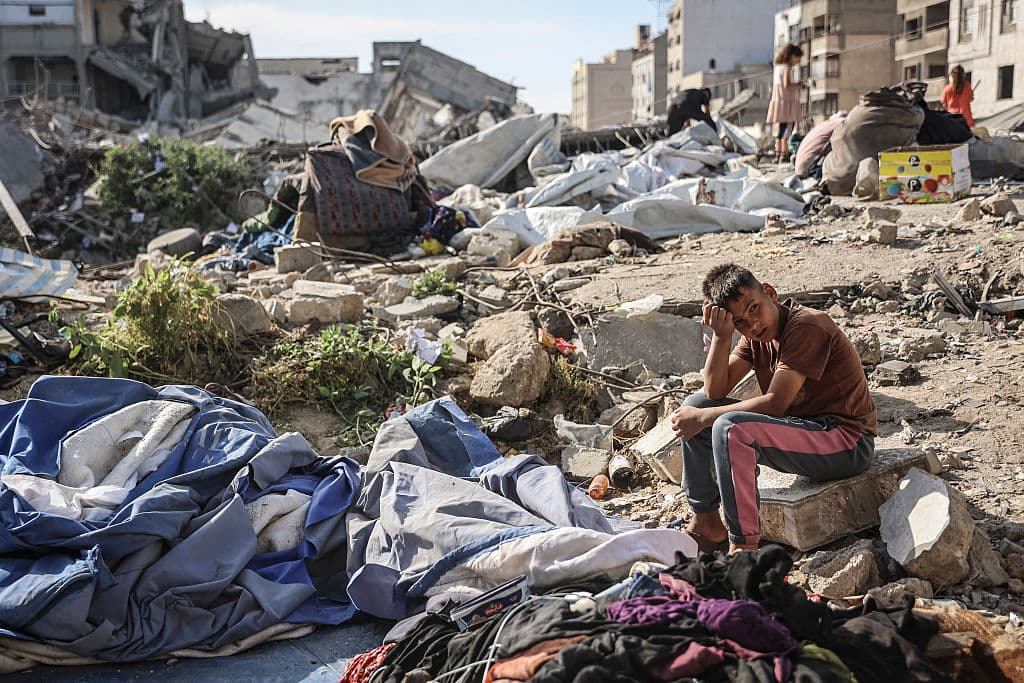
Israel's onslaught on Gaza was the first war in which the United States has been fully committed on the side of Israel. Of all Israel's wars, this is the first one that can be accurately described as a joint war with the United States, which provided, through air bridge and shipping most of the bombs used in the destruction of Gaza. This fact and the fact that Western governments supported this war to the point of even opposing a ceasefire for several months — Berlin, Paris, and London were against calling for a ceasefire in Gaza — show their blatant complicity in what was happening. That was the final nail in the coffin of liberal Atlanticism.
The second Trump administration is dismantling the Atlanticist bloc, and relations between Europe and the United States have degraded so much one can barely speak of unity. Simultaneously, all Western states are seeing the rise of the extreme right, which is largely supportive of Israel. How do you evaluate these developments in the West?
The final nail was not when Donald Trump went back to the White House on January 20, 2025. The liberal order was already dead under Joe Biden and his position on Gaza. This death opened the way to a global shift into the age of neofascism, a global surge of far-right forces.
The big difference with the past century fascistic surge is that the United States is no longer a bulwark against right-wing extremism, but it is, on the contrary, its epicenter. It is supportive of the Alternative für Deutschland in Germany, of Viktor Orbán's regime in Hungary, of every kind of far-right force in Europe and the world. The Western political momentum has shifted from liberalism to neofascism. The liberal governments in Western Europe are themselves shifting more and more to the right by adapting to the far-right discourse, and they are hence on the decline. We have entered a very dangerous historical era.
One theme that is common between these forces, in the United States and Western Europe at least, is Islamophobia. That's the real "new antisemitism," in the sense that Islamophobia is the main form of racism and xenophobia in today's Europe, playing a role similar to that of antisemitism in the late nineteenth century and the first half of the twentieth. Anyone who is really anti-racist, anti-fascist, and anti-Nazi should be able to grasp this obvious fact.