European Democracy Is Eroding
Watchdogs identified a deterioration of democratic space in Italy, Germany, and France last year. Using so-called emergency security measures, the EU's leading states are squashing the right to dissent.
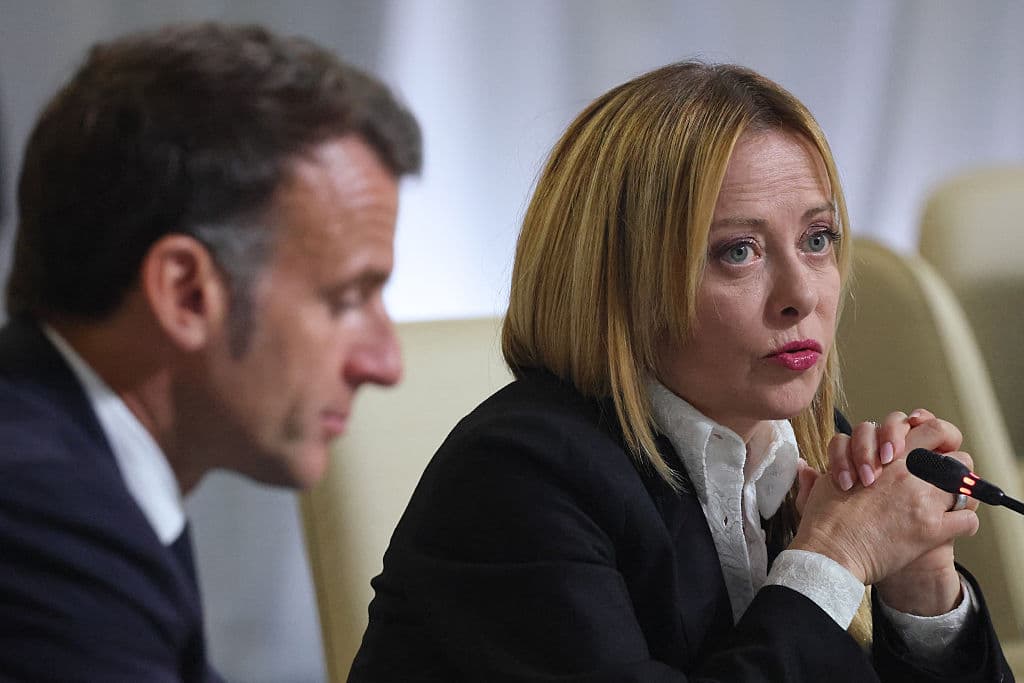
Last summer, Giorgia Meloni's Italian government approved a so-called "anti-Gandhi law," which criminalizes even nonviolent protests and passive resistance. The highly controversial "Security Decree" was recently followed by a further one, introducing measures such as preventive detention during public gatherings and signaling a shift toward police-state measures. Civil society organizations warn that these "security packages" constitute "one of the most serious attacks on the right to protest in recent republican history."
When Hungary was still governed by Viktor Orbán, it presented itself as a champion of illiberalism. Yet it was not an outlier. By the end of last year, it had been joined by Italy, Germany, and France in what watchdogs call a common deterioration of civic space. This trans-European trend coincides with efforts to prevent civil society organizations from participating actively in the EU's political life.
This downward spiral is bound up with a political turn. For this exclusion of civil society from decision-making processes goes hand in hand with pro-corporate politics at the expense of the vulnerable, while reducing once-inalienable rights to privileges that belong only to a few. My recent report "Shrinking Civic Space in the European Union" identifies key political tactics and narrative strategies that have been deployed to scale up attacks on civil society around the EU.
Growing support for the far right in the EU has bolstered the political actors who are driving this erosion of fundamental freedoms.
Indeed, many of the attacks on civil society were first systematically tested in states with autocratic tendencies and in areas where a tactical alignment between the EU center-right establishment and the far right was already explicit. This was especially true with regard to migration and environmental policy.
Yet such moves have increasingly been replicated all over the EU. Many examples can be seen even in France, which considers itself the home of human rights. For instance, the controversial "global security law," enacted in 2021, embodies a form of meta-repression of dissent, evident both in its content and in the repression of protests against the bill itself.
The downgrading of this space across the EU reflects a broader process in which restrictions on civil society organizations, limitations on protest and workers' rights, and mounting pressure on independent media, all feed into one another. From legal harassment and political pressure to more intrusive forms of surveillance, "there has been an increase in threats and intimidation against journalists," as the 2025 Media Pluralism Monitor states about Italy. Attacks on media freedom are no merely collateral phenomenon but a central mechanism in the restriction of civic space.
These developments signal a shift in how dissent, collective organization, and public scrutiny are treated by state authorities: not as essential components of democratic life but simply as risks to be neutralized. This includes three major trends across Europe: the growing use of "emergency" frameworks to restrict civic freedoms and collective action; sustained smear campaigns aimed at delegitimizing civil society; and forms of repression that undermine democratic participation.
Emergency frameworks have increasingly been used to bypass democratic safeguards, criminalize humanitarian aid, and, in some cases, restrict or effectively ban the work of NGOs and independent media. In Poland in 2021, for example, the declaration of a "state of emergency" at the border with Belarus, after reports of migrants being pushed across the border into the EU, created a legal and political blind spot. Journalists were barred from the area, while the work of lawyers, NGOs, and activists monitoring human rights violations was obstructed.
Even in the absence of a formally declared state of emergency, the pattern of exception increasingly shapes governance, enabling the de facto suspension of rights through securitization, criminalization, and the arbitrary enforcement of the law. This trend is accompanied by sustained campaigns of vilification and delegitimization, which prepare the ground for repression by portraying civil-society actors as dangerous or extremist.
All over Europe, a whole arsenal of restrictive instruments — security decrees, anti-terrorism and anti-extremism laws, anti-LGBTQ legislation, and "foreign agent" frameworks — has been deployed to this end, often combined with the use of surveillance technologies and violence to stifle dissent. Orbán's Hungary long represented the most advanced and systematic crystallization of these trends.
The contraction of civic space does not stop at civil-society organizations and social movements; it also extends into the workplace, where collective organization and the right to strike are a central form of democratic counterpower. The 2025 Global Rights Index, an annual study of violation of workers' rights, shows Europe recording its worst scores since the index's inception in 2014.
Attacks on the right to strike are a deliberate strategy to neutralize collective power at a moment of social conflict and must be understood as part of the wider erosion of civic space. When workers tried, in recent years, to mobilize against the rising cost of living and the inadequacy of their wages, European right-wing and far-right governments made a series of attempts to restrict the right to strike. In the UK, 2022 was a year of unprecedented strikes, followed by a Strike Act introduced by the Tory government obliging workers to provide minimum service levels (it was only repealed in December 2025).
In Orbán's Hungary, teachers had no option but civil disobedience to protest for the right to strike; the government dismissed some of them for "unlawfully refusing to work." In Italy, Meloni's government has also attacked the right to strike, both by attempting to limit its duration to a few hours and by delegitimizing trade union action, accusing unions of "calling strikes on Friday to get a long weekend."
The repressive push against strike action must also be seen alongside the exclusion of workers from the EU policy agenda, the marginalization of European trade unions in EU decision-making and the erosion of labor protections through deregulation. At the EU level, an informal alliance between the traditional conservative right and far-right parties normalized this latter's role in powerful positions and helped to marginalize progressive forces, workers' organizations, and civil society in general. Yet while they are excluded from EU decision-making processes, corporate actors gain ever-more influence.
My report — a joint publication by the European Network of Political Foundations (ENoP) and the Rosa-Luxemburg-Foundation's Brussels Office — also analyzes how illiberal narratives are lifted from the national to the EU level. It traces the convergence between far-right and conservative forces as well as the political tactics that help shift the power balance through which the shrinking of civic space in Europe is rendered legitimate and, ultimately, normalized.
This right-wing convergence at the EU level has not only reshaped political alliances. It has also helped mainstream narrative strategies that delegitimize dissent and representation, reframing critical voices as threats and paving the way for their exclusion. To understand how this demonization works, it is useful to revisit what has become known as the "Finkelstein formula," a strategy first tested in Europe by Orbán in the election campaign that returned him to power in 2010, before being widely replicated. The principle is simply to "project all kinds of evil onto your opponent" as a crucial instrument for both gaining power and retaining it.
Having proven effective under illiberal leadership, this formula has evolved into a transatlantic playbook not only to stigmatize dissent but also to prepare the ground for criminalization and repression. Its circulation between Europe and the United States amplifies its impact, boosting attacks on civic space on both sides of the Atlantic. Donald Trump's cuts to development assistance, demonization of civil society, and escalating rhetoric have also emboldened Europe's illiberal leaders. This has paved the way for increasingly aggressive repression of dissent, as attacks on NGOs show.
The deployment of the Finkelstein strategy can also be seen in the abuse of notions such as "extreme left" or simply "the Left," stretched to include a wide range of civil-society organizations, social movements, and critical actors, prefiguring their delegitimization or criminalization. See what happened at the European Parliament: the attack on NGOs by the European People's Party (the main center-right grouping) can be traced back as far as 2016. But more recently, teaming up with the far right, members of the European Parliament's Committee on Budgetary Control have argued that the EU should not provide funding to NGOs if they take action on EU policies or legislation.
While the alliance between conservative and far-right parties is scaling up at the EU level, the logic of the cordon sanitaire has actively been redirected against the Left — whether this means left-wing parties or civil society groups labeled as leftist in order to delegitimize them. These attempts at silencing also extend to social movements, climate activists, NGOs, trade unions, and, more generally, a civil society that challenges the emerging right-wing bloc and its corporate-first agenda.
Through this discursive reversal, the boundaries of legitimate political participation are narrowed and democratic representation itself is recast as a threat. Here, demonization functions as a critical enabling condition: it prepares the ground for exceptional measures, emergency governance, deregulation, and the exclusion of civil society from decision-making.
The normalization of alliances between the far right and centrist forces, together with the demonization of dissent, isn't just about discourse. It is connected to a practical agenda in which a corporate-first approach and the systemic use of emergency framing reinforce one another, narrowing opportunities for democratic oversight. This past November, the EU ombudsman confirmed these concerns, finding "maladministration" in how the European Commission prepared its deregulation packages. It framed them as "urgent legislative proposals" and managed the process without transparent and inclusive preparation, while also failing justify what was so "urgent."
Blatant attacks on civil society are integral to a political project that redefines whose interests count and how decisions are made at an EU level. The deregulation, pro-business agenda has brought conservatives into open convergence with far-right forces such as Meloni's post-fascist Fratelli d'Italia party. EU Parliament groups including the European People's Party, European Conservatives and Reformists, Patriots for Europe and Europe of Sovereign Nations increasingly unite around this agenda, as seen when the first "omnibus" package was passed by the parliament. Framed as a means of legislative "simplification," the omnibus package bundles together wide-ranging rollbacks of social, environmental, health, and equality protections.
European Commission President Ursula von der Leyen has explicitly adopted Italian premier Meloni's narrative that the state "should not bother those who have a business" — a refrain that has become emblematic of von der Leyen's current orientation. This logic is pushed to the extreme, with business allowed to "bother" the policy process through the open legitimization of powerful industrial lobbies as privileged interlocutors.
Deregulation packages are inspired by demands from BusinessEurope, the lobby group representing European companies; von der Leyen has even publicly claimed credit for incorporating industry proposals into EU legislation. The warm welcome given to corporate lobbyists is inversely proportional to the attention paid to those whose rights these deregulation packages undermine.
"There is a growing chill wind coming from America towards Europe, which is that solutions for working people are no longer guaranteed in laws," European Trade Union Confederation (ETUC) General Secretary Esther Lynch warned in mid-2025, complaining that the ETUC had not even been consulted on crucial policy dossiers that impact workers.
A new balance of power is reshaping the European Union's governance and, ultimately, its institutions. Civil society organizations, trade unions, and other public-interest actors are increasingly constrained, with their space for participation narrowed. At the same time, decision-making processes are becoming more arbitrary and less transparent, favoring the interests of large corporations at the expense of European citizens and workers' rights. As a result, a structural imbalance is quietly redefining how power is exercised in the EU.
The convergence between corporate-first agendas, militarized framing, and permanent emergency has begun to reshape the conditions under which political participation takes place. While this democratic participation is not formally abolished, it surely is hollowed out. In such a political environment, the space for deliberation and organized counterpower is structurally constrained. Yet while illiberal forces have a transnational playbook, it's far less clear that their opponents do too.