Democrats could flip this swing district in Nebraska, but at what cost?
Elevation of a prominent candidate to the 2nd District U.S. House seat could further diminish the Democratic minority in the Republican-dominated, but officially nonpartisan, Nebraska Legislature.
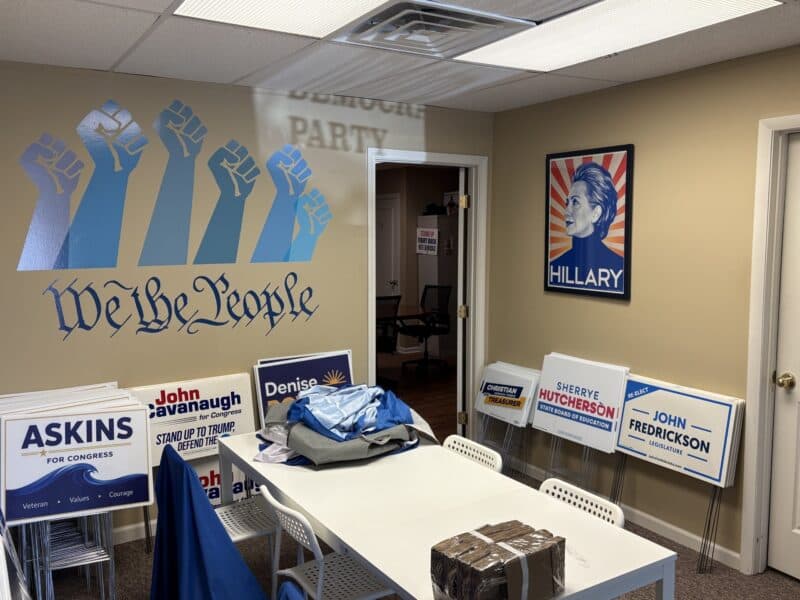
OMAHA, Neb. (CN) — The most talked about issue as the May 12 primary approaches in the 2nd Congressional District of Nebraska is this: What happens if one of the leading candidates actually wins?
It's an important question, with nothing less than control of the U.S. House and abortion access for Nebraskans at stake.
John Cavanaugh, a Democratic state senator, is considered by many to be the front-runner to win the primary. But if he were to win the general election against Republican Omaha City Councilman Brinker Harding, who is running unopposed, GOP Governor Jim Pillen would appoint his replacement. That replacement would no doubt be a Republican, thereby making the Democratic minority in the single-house Nebraska Legislature even smaller.
It's an issue some of Cavanaugh's opponents have been wielding. And the Democratic Party itself acknowledges that it is an issue, though it would rather focus on pocketbook issues, like the cost of food and fuel.
"We know the possibility of what can happen if that seat is lost," said Precious McKesson, executive director of the Nebraska Democratic Party. "It's going to be an issue. … We are not going to sugarcoat it."
But Cavanaugh has pushed back, and he and his supporters point out that this year is likely to be a good one for Democrats, even in Nebraska, with the party likely picking up seats in the officially nonpartisan unicameral Legislature.
Political science professor Richard Witmer of Creighton University pointed out that some third parties spending money on this issue are actually connected to the GOP, meaning Republicans consider him the most difficult opponent come fall. Witmer described the issue as a "red herring."
"I think the Republicans fear Cavanaugh in the general election more than the other candidates," he said. "The reason you do that is because he is the strongest candidate both in the primary and in the general election."
The other Democrats running include Douglas County District Court Clerk Crystal Rhoades, business owner Denise Powell and former deputy assistant secretary of the Department of Veterans Affairs Kishla Askins.
The district is one of three in the Cornhusker State and is an anomaly in not only the state but also the region as one of the few that has been represented by a Democrat in Congress during the last 10 years.
The district consists of Omaha and Douglas County, the most populous in Nebraska, and also part of suburban Sarpy County to the south and the entirety of more rural Saunders County to the east.
While its voters have mostly sent Republicans to Congress in recent decades, it is widely considered a swing district. Democrat Barack Obama won it in the 2008 presidential contest, as did Joe Biden in 2020 and Kamala Harris in 2024.
Since 2017, the seat has been occupied by Republican Don Bacon, a retired U.S. Air Force brigadier general. Bacon toppled single-term incumbent Democrat Brad Ashford in 2016. He is a moderate and has clashed with the Trump administration. He is not running for reelection, and Democrats see an opportunity for a pickup. The Cook Political Report rates the district a D+3.
Former representatives include Howard Buffett, who was Warren Buffett's father; Gilbert Hitchcock, founder of the Omaha World-Herald newspaper; and Roman Hruska, who would later, as a U.S. senator, famously defend a Supreme Court nominee by saying, "There are a lot of mediocre judges and people and lawyers. They are entitled to a little representation, aren't they?"
Another former representative is John Joseph Cavanaugh, a Democrat, who served from 1977 to 1981. Two of his children serve as Democrats in the Nebraska Legislature. One of those children is John Cavanaugh.
Party breakdown in the officially nonpartisan state Legislature isn't as straightforward as it is in other statehouses. But 16 of the 49 seats are generally considered to be Democratic or Democratic-aligned, and Republicans already hold a supermajority. Stopping the most controversial of legislation requires at least one Republican senator to cross over to the minority when both parties otherwise stick together. Democrats would prefer that number not go up to two.
Nebraska currently has a 12-week abortion ban. Pillen has said he supports a total ban. Also, many Republicans would like to end Nebraska's somewhat unique system of assigning three of its five electoral votes by congressional district. This method has meant that the Cornhusker State has provided a single electoral vote for the Democratic nominee in 2008, 2020 and 2024.
If there is no blue wave in the Nebraska unicameral and Cavanaugh goes to the U.S. House, those two issues will be more precarious in the eyes of the state's progressives.
Randall Adkins, a political science professor at the University of Nebraska at Omaha, said the issue of Cavanaugh's seat was important but not the only important thing that matters.
"If I was a concerned Democrat, it would be something I would pay attention to. It would not be the only thing I would pay attention to," he said.
The victor in the primary, no matter who it is, may have their work cut out for them.
"There probably are multiple candidates that can win, but it's not going to be easy because Brinker Harding is a good candidate, too," Adkins said. "So I still expect to see another close race in this district."
Adkins pointed to Harding's prior political experience, the former chief of staff to Omaha Mayor Hal Daub in the 1990s who has served on the Omaha City Council since 2017. Also, the field is cleared for him, so he doesn't have to spend his money yet.
"A lot of people in Omaha have voted for him before," Adkins said. "His name recognition is high."
Mary Jane Truemper, chairman of the Nebraska GOP, described Harding as a people person and a good listener who knows how to communicate with a wide variety of people.
"I know Brinker very well, and I know Brinker to be a solid person, a man of integrity, a solid thinker, a very reasoned person," she said. "I think he is going to be a great candidate of CD 2."
Witmer said that in most election cycles, Harding would be considered a good candidate. But the nationalization of the electorate means he and other Republicans will face headwinds this year.
"It was probably smart on the Republican side to only have one candidate in the primary so he can work to consolidate support," Witmer said. "We don't have to hear too much about whether he is with the president and the MAGA movement. … That's not part of the conversation right now."
Of all the candidates, Powell, co-founder of Women Who Run Nebraska, a political action committee, has consistently led in fundraising, having raised $1.6 million, according to the Federal Election Commission. She is followed by Harding at $1.2 million and Cavanaugh at $1.1 million.
Crystal Rhoades, a Democrat expected to be competitive, raised far less, with $172,000. But Adkins, who once taught her at the university, said she benefits from having previously won countywide. A voter who has once voted for a candidate will likely vote for him or her again, even for a different office, he said. Rhoades also aggressively campaigns door-to-door and has run political campaigns before.
"Out of the remaining candidates, the one that probably has the most name recognition and the greatest number of people who have voted for before is Crystal Rhoades," he said.
If there is one thing everyone agrees on is that the district's voters, like most everywhere, are mostly focused on what affects their daily lives, and their bank balances are the biggest factors in deciding how they cast their ballots.
"I think this is going to be a national election, so things like affordability, prices, inflation," Witmer said. "We're going to see a little bit on the remnants of the war in Iran. But I think there are going to be a lot of financial issues that are going to drive these decisions."
Tim Hagle, a political science professor at the University of Iowa, said purple districts like this are important in part because control of the House affects the agenda of President Donald Trump.
"Because the U.S. House and the U.S. Senate are so closely divided … even a couple of seats could make a difference," Hagle said. "If they have control of one of the chambers, it's going to stop any legislative enactments."