Democratic incumbent Carson and Trump-endorsed candidates win big in Indiana
Democrats in the U.S. House sailed to primary victories, while Republican contenders scored key upsets over incumbents who opposed the president's redistricting plan.
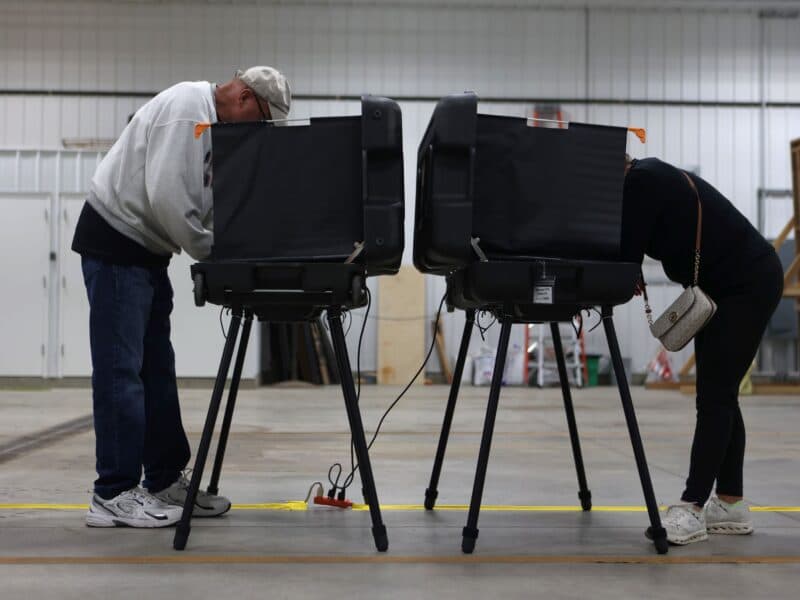
INDIANAPOLIS (CN) — Indiana's longest-serving U.S. Representative Democrat André Carson prevailed over a trio of candidates, while Trump's backing proved key for U.S. House incumbents and his hand-picked challengers in the state General Assembly.
Democratic turnout in Tuesday's primary election was up significantly in Indiana's deep blue 7th congressional district, while the president's endorsement paved the way for victory for Republican U.S. House incumbents.
But the biggest results were among normally hyperlocal down-ballot races: There was only one winner among seven GOP state senators who defied President Donald Trump's call to redraw Indiana's congressional map, with another race too close to call. Five challengers backed by Trump grabbed their party's nomination.
Laura Merrifield Wilson, a political science professor at the University of Indianapolis, thinks Tuesday's results show a growing backlash to the current state of affairs.
"My biggest takeaway from the evening is that incumbents are very vulnerable. This cycle for Indiana's congressional races, incumbents survived, but many of the Trump-backed challengers in the state Senate races beat out their incumbent foes," said Wilson. "It feels that many voters are dissatisfied with the status quo, and people are very engaged."
Carson, 51, has represented the 7th District since 2008, after winning a special election following the death of his grandmother, U.S. Representative Julia Carson.
Defeating a diverse trio of challengers, Carson won 62.4% of the vote over Democrats George Hornedo, Destiny Scott Wells and Denise Paul Hatch, with 95% of the votes counted.
Since Indiana started using its current electoral maps in 2021, Carson has received over 90% of the vote in each of his other primaries; in this year's race, he drew challengers with a variety of backgrounds.
Wells is a lieutenant colonel in the United States Army Reserve and an attorney with name recognition, having unsuccessfully run for state attorney general and secretary of state.
Wells took 23.5% of the vote but failed to find a statewide home for her political ambitions.
Hornedo, who ran an aggressive campaign against Carson, took 10.5% of the vote. He served in the Department of Justice under Obama.
Hatch was Marion County township constable before being removed from office for felony official misconduct. She received 3.7% of the vote.
"Carson received 60% against a diverse array of opponents, including a female veteran who should have very good name ID within the party," said Chad Kinsella, a political science professor at Ball State University. "He did well and was, overall, able to handily beat a significant challenge."
Shortly, after the race was called, Carson released a statement thanking the voters and taking aim at the rising cost of living.
"The race has never been about me. It's always been about we. Marion County voters turned out because we believe in a future where no one struggles to buy groceries or pay their bills." Carson said.
Turn out the Marion County voters did, with over 71,600 Democrats voting in the 7th District, eclipsing the 2022 primary vote total of 38,598.
"Democratic voters in Indiana are definitely engaged," said Wilson. "We saw more candidates running for our state legislative races for the Democratic Party ticket, and we saw great voter turnout, both in early voting and Election Day."
The only other Democratic Congressman from Indiana, Frank J. Mvran, also sailed to victory in his primary in the 1st District, getting 80.2% of the vote, with 95% of the votes counted. Challenger LaVetta Sparks-Wade received 19.8%.
All seven incumbent Republican U.S. House members won their respective primaries on Tuesday, but at least five Trump-endorsed challengers upset incumbents in state Senate races.
"Last night was a referendum on President Trump and Republican primary voters clearly resounded their approval with the president," said Wilson.
Last year, at the president's behest, the Indiana State House took up plans to redistrict and redraw the state's nine congressional districts, creating a map that would have favored Republicans across the board. Currently Republicans hold seven of the nine seats.
The proposal passed the state House of Representatives but hit a huge snag in the Republican-dominated state Senate, whichhandily rejected the redistricting proposal.
Trump took aim at seven Republican state senators who voted against his plan and backed challengers.
Five of the seven Trump-endorsed state senate candidates beat anti-redistricting incumbents, with one race still too close to call and another going in favor of Terre Haute incumbent Greg Goode.
Republican Governor Mike Braun, who also pushed for redistricting, championed the challengers in a social media post release after the races were called.
"Historic night for Indiana as Republicans stood with me and President Trump to nominate some great America First conservatives. I look forward to winning big in November and serving Hoosiers with this team in the statehouse!" Braun wrote.
The winning challengers were Trevor De Vries, Brian Schmutzler, Blake Fiechter, Tracey Powell and Michelle Davis.
Incumbent Spencer Deery leads by just three votes over Trump-endorsed Paula Copenhaver in a race that has yet to be called with 99% of votes counted.
"For President Trump, this was about the redistricting fight and the fact that they did not follow what was, in his estimation, best for him and the party," said Kinsella.
Trump's endorsement also shone in Indiana's 4th Congressional District, where Republican Jim Baird claimed victory over state Representative Craig Haggard and Republican John Piper.
The 80-year-old Baird is seeking his fifth term in the red 4th district and received 60.5% of the vote, while Haggard got 30.5% and Piper 8.9%, with 95% of the votes tallied.
Haggard ran a grassroots-style campaign, racking up many local endorsements and a key endorsement from Indiana Attorney General Todd Rokita, but Baird, like many of the down-ballot state Republicans, had Trump's endorsement.
Though recent polls show his approval rating declining nationally, Trump's influence over the Republican Party, even at the state election level, still seems robust.
"The modern president has vast control over their party. President Trump proved tonight that his power in the Republican Party is unparalleled," Kinsella said. "He was able to endorse and support primary challengers to otherwise backwater, largely uninteresting state Senate seats in Indiana, and get his way."