Debanking, an Authoritarian Threat to the Left
Rote Hilfe is a German solidarity organization that aids people hit by state repression, such as anti-fascists. Recent moves to close its bank accounts are aimed at wrecking its activity, even though it hasn't broken the law.
The twenty-first century brought the utopian promise of an ever more interconnected world. Champions of globalization aspired to ever more international connectivity, meant to discourage powerful actors from creating divisions that might threaten the well-being or existence of others. It was rarely mentioned, however, that global interconnectedness could also allow individual actors in key positions of power to influence decisions across the entire network.
Nowhere is this danger more evident than in the now-globalized banking sector. The serious consequences of interconnected global banking and finance have recently threatened the left-wing German solidarity organization Rote Hilfe (Red Aid). Citing the Trump administration's declaration of an enigmatic German antifa group as a "terrorist" organization, a Göttingen-based bank attempted to shut down Rote Hilfe's accounts. Similar cases have threatened other left-wing and anti-fascist groups in Germany and across the world. It lays bare the threat that "debanking" — the shutting down of accounts or refusal of services on political grounds — poses to the Left.
Rote Hilfe is a German solidarity organization that provides material and political support for individuals and groups on the Left affected by state repression. It is part of a tradition of self-help within the European labor movement dating back more than a hundred years. After multiple worker uprisings during the early years of the Weimar Republic, the state's repressive measures intensified enormously. The bourgeois-democratic state directed its ire primarily against the far left: the communist wing of the labor movement.
In response, following the example of the International Red Aid founded in 1922 in the Soviet Union, spontaneous "red committees" popping up across Germany developed into a stable, active membership organization in 1924: the Rote Hilfe Deutschlands (Red Aid of Germany).
At its peak, it boasted around one million members, and during the 1920s ran internationally recognized campaigns, provided immense financial and legal support, and was a significant factor in Weimar-era German domestic politics. After the Nazis came to power, it continued to operate underground, up till the late 1930s. It was not reestablished until the 1970s, when repression against West Germany's student movement made the renewed need for such an organization apparent.
Today's Rote Hilfe was originally founded by the now-defunct KPD/ML (Communist Party of Germany/Marxists–Leninists). It considers itself nonsectarian and focuses primarily on forging links with social movements and grassroots left-wing campaigns. It has around 20,000 members and enjoys strong links across a relatively wide spectrum of the German left, from its more traditional base of supporters from Germany's far-left political parties to young activists in radical climate movements like Ende Gelände.
Unlike Germany's numerous amorphous groups from the autonomous tradition, however, Rote Hilfe operates as a legal organization in compliance with federal law. It is registered as an association, has an official HQ, and maintains an elected federal executive committee as well as local chapters and activities in the public sphere. Although it is regularly attacked by Germany's ruling Christian Democratic Union (CDU) and features prominently in reports by the Federal Office for the Protection of the Constitution, it is not a banned organization. This makes the repression it is currently facing all the more astonishing.
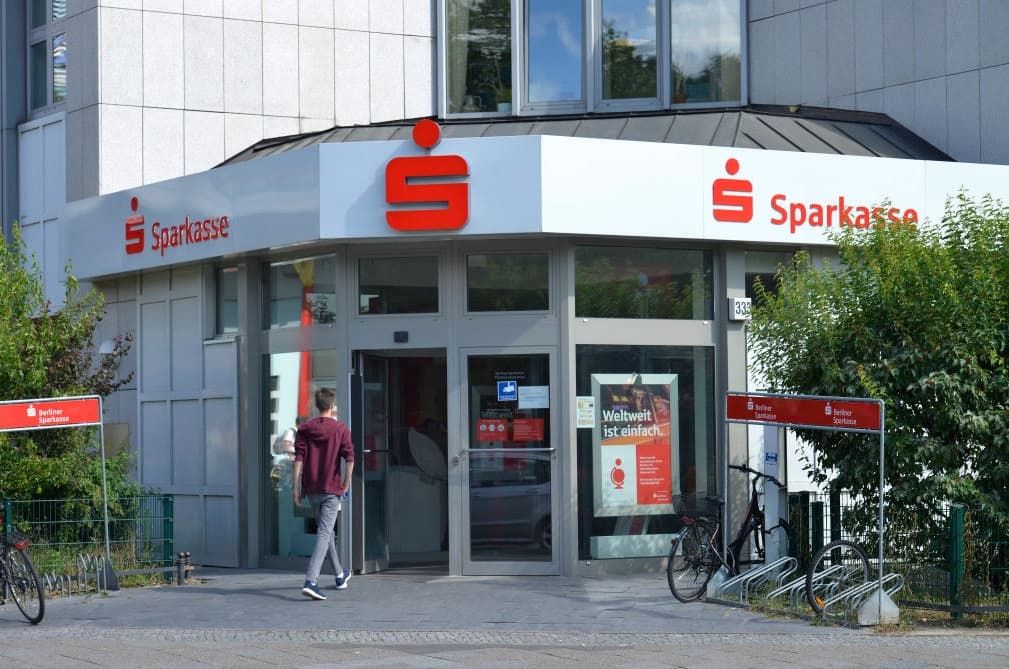
Until recently, Rote Hilfe held bank accounts with Sparkasse Göttinger and the cooperative bank GLS. They used them to collect membership fees and to help provide political and material support to people hit by political repression. But in December 2025, within the span of a few days, the two banks sent notifications of the imminent termination of Rote Hilfe's accounts — without providing any further explanation.
The accounts were to be shut down by the end of the year. Without access to organizational bank accounts, Rote Hilfe would suddenly find itself completely unable to collect dues or distribute funds to activists and organizations in need. Since the organization supports activists financially, through paying fines and funding ongoing legal help, the consequences could have been disastrous.
This practice is known as "debanking": a form of repression aimed at excluding certain organizations and activities from sociopolitical life without needing to resort to an outright ban. Debanking exploits civil law — the right of banks to refuse services to clients — to limit political activity. Without a bank account, an organization's potential actions are severely restricted and even simple transactions become nearly impossible. The phasing out of cash payments only makes this threat graver.
One of the most insidious aspects of debanking is that the victims have almost no ability to formally protest the action. Maintaining an account is a private legal transaction between a customer and bank, to which there is no entitlement under civil law. In other words, you usually cannot bring a lawsuit against a bank for dropping you as a customer. Banks can open and close accounts as they please. Nor do they have to give any reason for closing an account. Debanking is in effect like a ban with no recourse to the rule of law or even right to demand an appeal to the decision.
Rote Hilfe was just one of a growing number of organizations facing repression through debanking in Germany and across the world. Only a few months before, GLS announced the termination of the accounts of the German Communist Party (DKP) and the Anarchist Black Cross (ABC) in Dresden, also effective for the end of 2025. Berlin's Postbank terminated several accounts held by the VVN-BdA (Association of Persecutees of Nazi Persecution – Federation of Anti-Fascists) taking effect on March 31, 2026. These actions against the VVN by Postbank, now owned by Deutsche Bank, are particularly heinous in light of the latter's actions during the Nazi era, when it was deeply implicated in fascist state terror.
Rote Hilfe was caught completely off-guard by the banks' decision. According to Hartmut Brückner, a long-standing activist and member of its federal executive committee, the group never expected this kind of repressive action. Rote Hilfe has been a client of both banks for many years, and there have been no irregularities in their business dealings. There was no change in the organizations' accounts with the banks, apart from the amount of money, which had increased due to a growth in membership. So, when the cancellations reached the group's leadership, it had no contingency plan.
There was general agreement among the Rote Hilfe leadership that being cut off from banking services should be understood as a form of political repression and a threat to the foundations of its work, and must be met with political resistance. Initially the priority was to remain calm, check the facts, and keep operations running. Rote Hilfe considered its beneficiaries as its first priority: the activists and organizations who it helps should still get the support they need. Rote Hilfe's first move was to reach out to supportive journalists who would publish the first articles in German newspapers.
Rote Hilfe made a conscious decision to focus on engagement with the left-liberal public sphere, beyond the ranks of its more radical supporters. "We call on the progressive forces in this country to stand by our side so that we can continue to fight for a better society, free from US interference and against the global far right," Brückner urged in a press statement written on behalf of the federal executive committee.
Articles first appeared in Germany's stalwart left-wing papers Junge Welt and Neues Deutschland, but these were soon followed by detailed pieces in the left-liberal Taz and Süddeutsche Zeitung, as well as several regional public broadcasters. The case caused a major media stir and led to Rote Hilfe gaining over a thousand new members.
This got the public's attention — but then what? It wasn't clear to Rote Hilfe members why they were being targeted and why these account closures are happening now. They could rule out some of the most obvious explanations. The account closure notification came without specified reasons, but they knew there had been no ostensible breaches in the management of the accounts. Initial suspicion pointed to an indirect source: the organization's support for defendants in recent ongoing high-profile criminal trials.
A few weeks earlier, the Trump administration placed the so-called "Antifa-Ost," along with Italian and Greek groups, on the SDGT (Specially Designated Global Terrorist Organization) list. Financial transactions with these groups are prohibited for US citizens and subject to criminal prosecution. At the same time, the US Treasury Department's OFAC (Office of Foreign Assets Control) list was updated, prohibiting US companies from conducting business with these groups and requiring that their assets be frozen whenever possible.
But what does this American decision have to do with German banks and Rote Hilfe? The problem starts with the fact that no organization by the name of "Antifa-Ost" exists. It is a media construct. It is just a name used to lump together various regional anti-fascist groups and individuals in order to subject them to legal prosecution. Rote Hilfe offers legal assistance to activists accused of membership in this organization, through its "We Are All Antifa" campaign, which was launched in response to the proceedings against antifa activists accused of attacking neo-Nazis in Budapest in 2023 and other recent actions within Germany.
Since Rote Hilfe provides political and financial support in pending legal proceedings, it can be considered associated with "Antifa-Ost." Shortly before the termination of its accounts, the federal executive committee of Rote Hilfe was questioned by Sparkasse regarding its role in fundraising activities relating to these proceedings.
Suspicion that the threatened debanking of Rote Hilfe was linked to these proceedings was confirmed over the course of the subsequent court case launched by Rote Hilfe to appeal their account closures. In its written statements, Sparkasse cited Rote Hilfe's involvement in the "Antifa-Ost" trials. It argued that the classification of "Antifa-Ost" as a foreign terrorist organization had created a new legal situation, which posed new due-diligence obligations and negatively impacted its risk assessment.
It also claimed that this would lead to reputational damage. In the end, Rote Hilfe obtained a temporary order for the restoration of its Sparkasse account from the Göttingen Regional Court, citing its status as a noncommercial bank with a "public service" mandate. A similar argument seemed unlikely for its accounts with GLS, which is a purely private bank.
Sparkasse's legal representatives argued that the alleged connection between "Antifa-Ost" and Rote Hilfe was revealed to them via an inquiry from the Federal Financial Supervisory Authority — a regulator able to pressure banks by threatening fines. This time, because Rote Hilfe could bring its grievance to court and raise public awareness, judges ruled in its favor. But the role of the German state through the courts and the Supervisory Authority must not be underestimated. The case is now before the higher court. Meanwhile, an out-of-court settlement was reached with GLS: following public pressure resulting from an open letter, the ten accounts held by the federal executive committee will remain open, while around fifty accounts previously held by local Rote Hilfe groups remain closed.
There is no doubt that the debanking of left-wing organizations in Germany is currently on the rise. Yet this kind of bureaucratically aided repression is nothing new. It's just that we on the Left have largely dodged it in recent years. Meanwhile, it has been used by the Left against the Right: one of the favored tools of the "Grandmothers Against the Right" group is to publicize regional savings-bank branches where local Alternative für Deutschland (AfD) associations hold accounts, hoping to get them shut down. This aim was achieved in several cities, such as Berlin and Düsseldorf. Similarly, during the coronavirus pandemic, the accounts of several prominent activists from the anti-vaccine-mandate "Querdenker" movement were shut down.
At the time, these actions were still generally viewed positively, or with amusement, on the political left. But no one is laughing now. Brückner comments: "Once our opponents have this in their arsenal, sooner or later it will be used against us too." A similar pattern is also repeating itself with the resurgence of political firings and professional bans.
While in recent decades it was primarily directed against far-right individuals (most notably the removal of AfD judge Jens Maier and the refusal of a legal traineeship for membership of the neo-Nazi group "Der Dritte Weg"), more cases are now piling up on the Left.
Take the highly publicized case of Lisa Poettinger, a climate activist who was refused the ability to work as a public school teacher due to anti-capitalist political beliefs deemed "extremist" by the Bavarian state, among others from Munich to Bremen. These aren't isolated cases. Just last year, the state of Rhineland-Palatinate formally tightened recruitment criteria for the civil service. What these developments also have in common is that they operate without the proceedings necessary to formally ban an organization, and can and do affect legal organizations. This severely restricts their scope of action.
This threat is real and growing. The increased awareness and protests against debanking must not be confined to the left-wing fringe. These cases are about basic political freedoms and concern the entire public. Above all, it is crucial to forge links with trade unions, the center left, and liberal journalists in building public pressure. As political and social conflicts over the distribution of wealth intensify in the coming years, repression will continue to increase.
This makes it all the more important for the divided and fragmented German left to support a long-standing, established institution like Rote Hilfe, committed to supporting left-wing activism — from climate strikes to demonstrations in support of Palestine. Rote Hilfe has set its sights on reaching 25,000 members. But, as the name of its newest campaign, "One Million Against Repression," suggests, protecting civil liberties requires the support of the whole society: not thousands, but millions.