Bulgaria's political instability ends, but with a pro-Russian twist
Last week, Brussels was relieved by the defeat of Viktor Orbán, a Kremlin ally. But Brussels was put back on guard this week after voters elected a pro-Russia party in Bulgaria.
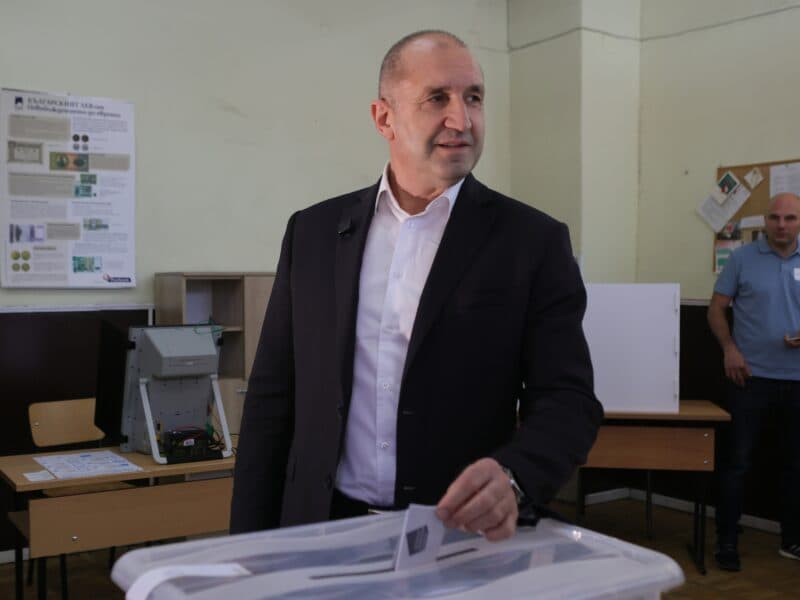
(CN) — After eight parliamentary elections since 2021, Bulgaria on Monday was set to finally get a stable government. But the winner of Sunday's ballot, former Bulgarian President Rumen Radev, posed a fresh headache for the European Union due to his pro-Russia stance and dislike of some key EU policies.
Radev's anti-corruption message about taking on oligarchic structures struck a chord with voters and his newly founded center-left Progressive Bulgaria party picked up 44.5% of the vote.
Turnout was just under 50%, a good level for a country known for voter apathy and fatigue after so many elections.
Radev will command about 130 seats, an outright majority in the 240-seat National Assembly, the country's parliament in Sofia, the capital. This is the first time since 1997 for a single party to hold a majority.
"He will govern alone, and from the perspective of parliamentary support, he will not have trouble staying in office," said Maria Spirova, an expert on Eastern European politics at Leiden University, in an email.
Bulgaria, the EU's poorest country in terms of gross domestic product, has long struggled with wide-scale corruption and its economy has been hammered by recent high inflation.
Adding to anxiety, Bulgaria dropped its lev currency and adopted the euro on New Year's Day, a shift opposed by many Bulgarians, particularly older ones uncomfortable by the loss of the national currency.
Adopting the euro can slightly raise costs, for instance by businesses rounding up prices. Bulgaria saw a surge in home sales last year as buyers panicked, thinking the euro would jack up house prices.
Radev, a former air force commander, is a popular and trusted figure in Bulgaria who served as president between 2017 until this January when he resigned from the mostly ceremonial position and set his sights on becoming prime minister.
Bulgarians threw their support behind Radev in the hope he would go after corruption and oligarchic systems linked to his political rivals, strengthen judicial independence and usher in political stability.
On Sunday, as he cast his vote, Radev promised to deliver on voters' expectations.
"For me, the most important goal is to form a regular and stable government capable of solving people's problems," he said, as reported by Bulgarian media.
Further instability, he said, would be a "disaster for Bulgaria" because that would mean "going from crisis to crisis when what we have to do is work very hard to emerge from these crises."
But his approach to Russia and Ukraine may cause friction with Brussels. He has called for "pragmatism" in dealing with Russia and he's balked at sending weapons to Ukraine. Also, he's urged Europe to restore energy flows from Russia to bolster its struggling industries.
In 2018 and 2019, Radev, then serving as president, met with Russian President Vladimir Putin and called for "restoration of political dialogue at the highest level" after years of interruption.
"He is openly pro-Russian, and has acted on it before," Spirova said. "There will be a foreign turn to Russia."
On Sunday, Radev repeated his call for "more dialogue" with Russia, noting that other European leaders, including French President Emmanuel Macron and German Chancellor Friedrich Merz, have expressed a willingness to open talks with the Kremlin.
"A strong Bulgaria in a strong Europe needs critical thinking and more pragmatism," he said. "Europe fell victim to its own ambition to be a moral leader in a world without rules."
He added Europe "must restore its competitiveness and stop the process of de-industrialization" by obtaining cheaper energy, a clear reference to restoring energy flows from Russia.
Still, many experts do not expect him to become a major troublemaker in Brussels and replace outgoing far-right Hungarian Prime Minister Viktor Orbán, who repeatedly used his veto powers to block Ukraine aid.
Radev was expected to mostly toe the line coming from Brussels because Bulgaria, with its 6 million people, is small and dependent on EU funds. To deal with Orbán, Brussels withheld billions of euros in EU funds from Hungary, a deeply damaging move that contributed to Orbán's election loss last Sunday.
"I hope Brussels is strong at twisting arms," Spirova said.
Despite his wish for political stability, Radev also faced potential splits inside his brand-new party, which sucked in support from across the political spectrum.
Spirova said rifts might crop up as the government gets down to work "given Bulgaria's history of party factionalism."
For now, though, Bulgaria's five-year period of mind-boggling political fragmentation appears to be over.
The election was a big defeat for long-time Prime Minister Boyko Borissov, the head of the conservative Citizens for European Development of Bulgaria, or GERB. It was their worst showing ever after it got 13.4% of the vote. Their seats will drop from 66 to 39.
On the campaign, Radev attacked Borissov for ruling over an oligarchic system.
A pro-EU and pro-Ukraine party, Continue the Change–Democratic Bulgaria, came in third with 12.6% of the vote. It is led by former Finance Minister and Harvard graduate Asen Vasilev.
Remaining parliamentary seats went to two smaller factions.
The Movement for Rights and Freedoms — a party led by oligarch Delyan Peevski that represents Bulgaria's ethnic minorities, particularly Turks — got about 7% of the vote and the far-right Revival 4.2%.
Both of these smaller parties suffered a big drop in support. Revival, an ultra-nationalist and pro-Russia party, took a drubbing with its vote total dropping by nearly 9% and its seats in parliament shrinking from 33 to 13.
Meanwhile, the once-powerful Bulgarian Socialist Party failed for the first time to snatch enough votes to enter parliament. A party must obtain at least 4% of the vote to get seats.
Courthouse News reporter Cain Burdeau is based in the European Union.