Abortion pill fight brings volatility of post-Roe world back to SCOTUS
Doctors, drugmakers, policy experts and advocates flooded the Supreme Court's emergency docket with warnings of imminent danger that could come from the latest fight over abortion care before the justices.
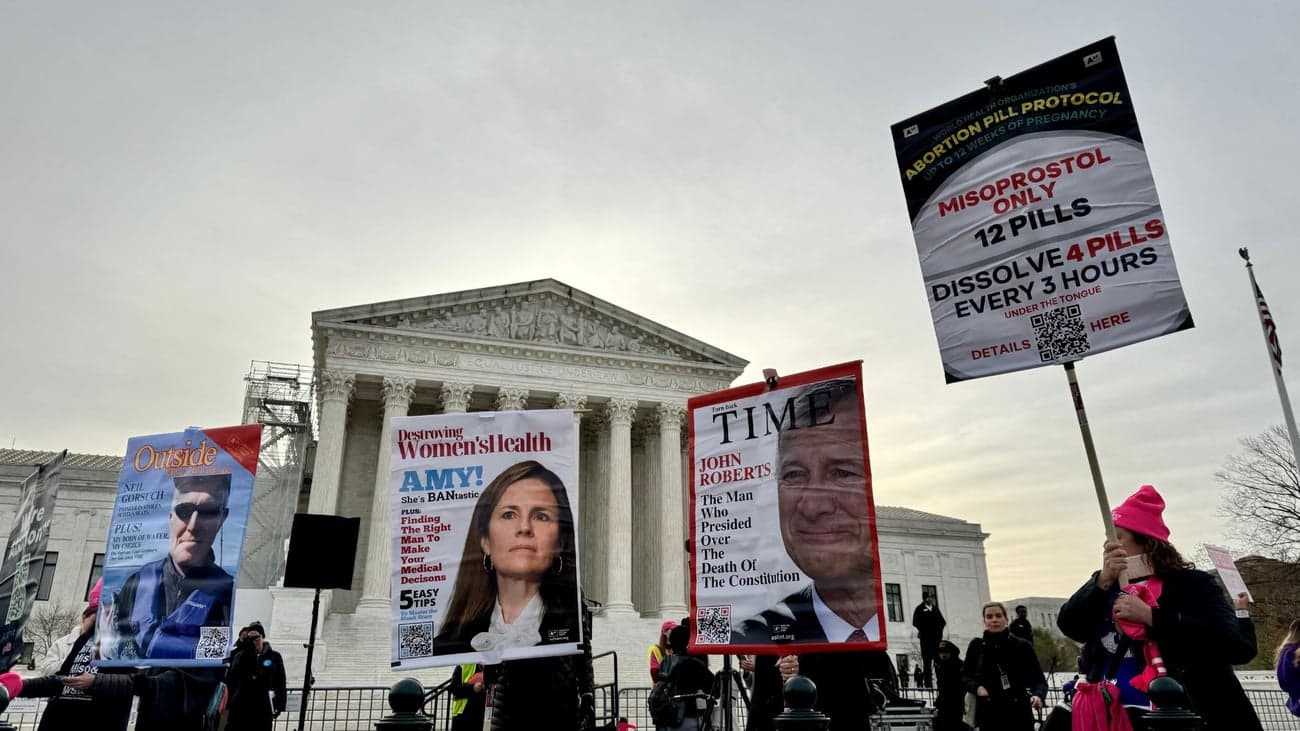
WASHINGTON (CN) — Louisiana asked the Supreme Court for help enforcing its near-total abortion ban on Thursday, forcing the justices to confront how a state's policy preferences in the post-Roe world could imperil healthcare nationwide.
Over a dozen states imposed strict prohibitions on abortion care after Dobbs v. Jackson Women's Health Organization, the landmark 2022 high court decision that overturned Roe v. Wade. One such state, Louisiana, wants to reinstate in-person prescription and dispensing requirements on the abortion pill mifepristone to crack down on loopholes around bans on the procedure.
But to do so, an appeals court added new limits on mifepristone's use nationwide, cutting off telemedicine and mail access to the pill. If upheld by the Supreme Court, the ruling would restrict abortion care even in states where it is legal as the U.S. faces a national shortage of women's reproductive specialists and rising rates of maternal mortality.
"Restricting access to mifepristone puts everyone's health at risk, because if courts limit access to mifepristone as they did this past weekend, they open a Pandora's box," said Jen Castle, a nurse practitioner and national director of abortion service delivery at Planned Parenthood. "Putting at risk the thousands of FDA-approved medications that millions of people rely on and rolling back access to mifepristone could be devastating for reproductive healthcare across the country."
Medication abortion accounts for over 60% of abortions in the U.S. each year. A quarter of all abortions nationwide are provided via telehealth, which saw a two-fold increase after Roe v. Wade was overturned.
Mifepristone was approved over two decades ago for its use in ending early-stage pregnancies. Taken together with misoprostol — an ulcer medication — the regime can be used up to 10 weeks' gestation. The pill's safety record rivals drugs like penicillin and Viagra; it is also 14 times safer than childbirth.
The pill's in-person dispensing requirement was first suspended due to the Covid-19 pandemic. After additional reviews, the Food and Drug Administration modified mifepristone's safety warnings in January 2023 to permit pharmacies to dispense the drug by mail going forward.
Despite assertions from medical organizations and the drugmakers, Louisiana argues the FDA's decision was based on inadequate or flawed data, claiming the 2023 regulations violate the Administrative Procedure Act.
The state claimed that out-of-state prescribers are causing around 1,000 illegal abortions in Louisiana each month, claiming that investigatory and Medicaid costs from emergency room visits justified its lawsuit.
"In a world with the in-person dispensing requirement, Louisiana would be fully capable of enforcing its abortion laws — for any mine-run prescriber would be physically present in Louisiana and thus subject to apprehension within Louisiana's borders," the state wrote. "But that is not the world today."
In emergency applications before the Supreme Court, Danco Laboratories and GenBioPro, which make abortion pills, say both arguments were based on attenuated downstream harms, too disconnected from the FDA's 2023 regulations. And they admonished the Fifth Circuit for issuing relief sweeping far past Louisiana's borders.
In 2023, the justices issued an emergency ruling barring a lower court from removing the popular drug from shelves nationwide. The following year, they unanimously rejected a challenge from conservative doctors seeking to add new limits on mifepristone.
Louisiana's case closely mirrors the doctors' challenge, which was dismissed based on lack of standing. The drugmakers urge the justices to follow a similar pattern here.
American College of Obstetricians & Gynecologists and reproductive health advocates said restricting access to mifepristone would exacerbate existing inequalities in maternal health for patients of color, low income, with disabilities or who live in rural areas.
As abortion was legalized in the years leading up to Roe, maternal mortality among people of color was redacted by 30 to 40%. Researchers said they are already seeing that pattern reversing since Dobbs.
In Texas alone, researchers found a 6 to 13% increase in infant mortality. Across the 13 states with abortion bans, they found an estimated 478 additional infant deaths above what would have been expected.
"These are not abstract projections," a group of 163 reproductive health, rights and justice organizations told the court. "They are documented consequences of restricting access to care."
Providers said telehealth gives patients who would typically struggle to get care an essential resource. Helen Weems, a family nurse practitioner in Montana, said although abortion care is protected by her state's constitution, that doesn't mean it's accessible for all residents.
"Being able to mail abortion pills has revolutionized abortion access in Montana and throughout the country," Weems said. "If a woman is living, say, in Glendive, and she needs an in-office procedural abortion, she would need to drive seven hours and over 400 miles to a clinic in Helena. With telehealth abortion, we can mail abortion pills directly to her home."
Congressional lawmakers presented competing assessments of Dobb's promise to "return the issue of abortion to the people's elected representatives." Republicans say the FDA's expansion of telehealth and mail access to abortion pills sought to contravene state bans on the procedure.
Conservative lawmakers also argued that the decision violated an 150-year-old morality law barring the mailing of contraceptives and abortion related materials. Federal officials have largely refused to enforce the Comstock Act of 1873 for a better part of a century, but Republicans say the FDA's actions nonetheless violated it.
"Unelected, unaccountable bureaucrats in Biden's FDA therefore overrode the will of the American people as expressed through their elected representatives in Congress and in state legislatures and subverted Congress's critical public policy interests in upholding patient welfare," Republican lawmakers wrote.
Democrats countered that the FDA first suspended in-person requirements for mifepristone in 2020 — two years before the Supreme Court ruled in Dobbs — undercutting claims that the agency acted in response to abortion bans. They argued that Louisiana's position would undercut the will of the American people in states with abortion access.
"This court should not permit Louisiana to weaponize its policy disagreements with sister states to force FDA to violate its statutory obligation not to unduly burden patient access to medication nationwide," Democratic lawmakers wrote.
Pharmaceutical researchers and manufacturers warned against allowing states to dictate federal drug regulations. They argued the appeals court's ruling introduced a profoundly destabilizing force into the nation's drug regulatory regime.
"The court should not permit a collateral attack by unregulated parties seeking to skip FDA engagement to supplant the judgment of the agency with their own — whether an initial approval or a later modification grounded in new evidence," industry experts wrote. "That regime would not only distort the administrative process Congress carefully designed but also undermine the reliance interests that make biomedical innovation possible."
Justice Samuel Alito, a George W. Bush appointee, paused the Fifth Circuit's ruling until Monday evening.